
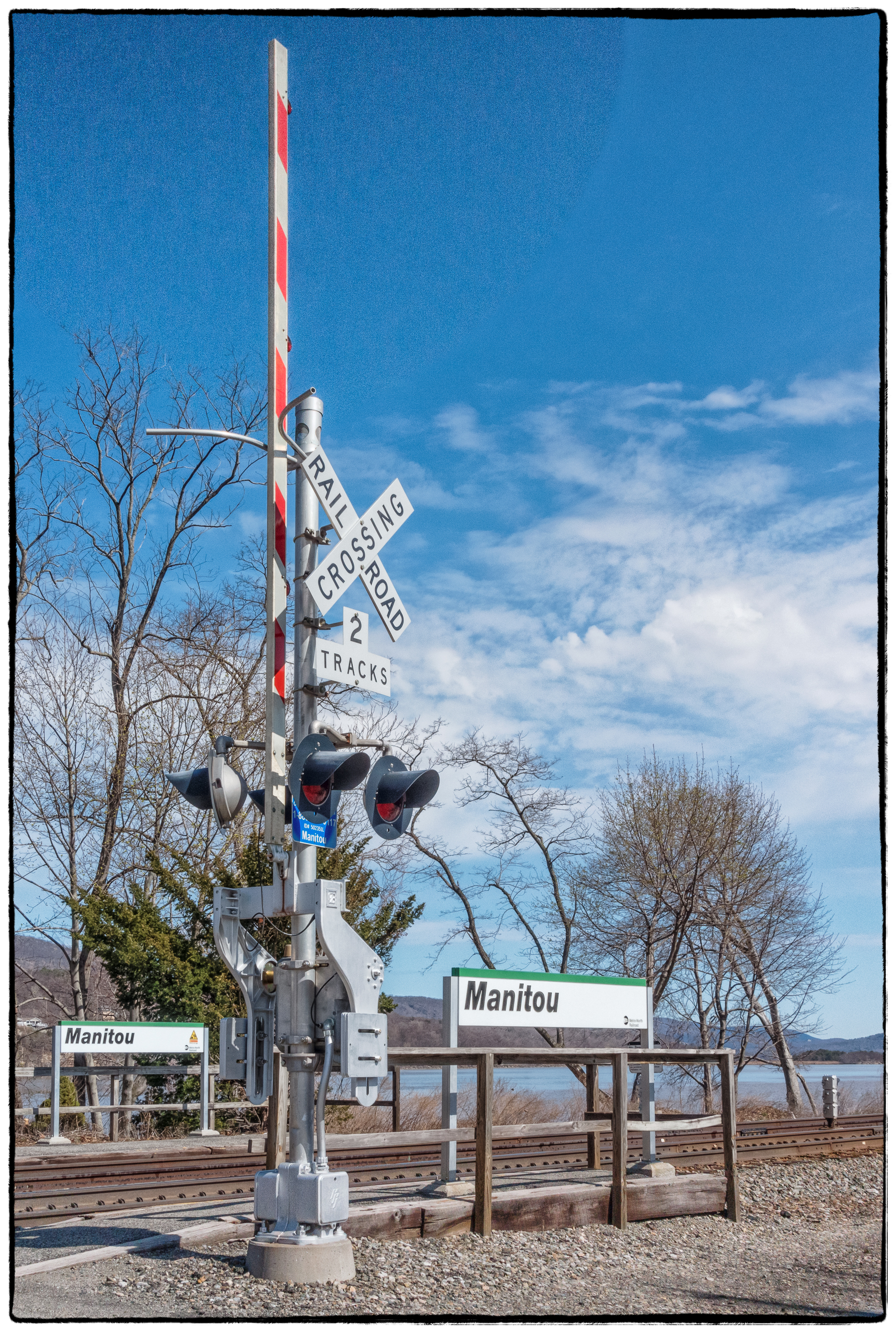
Mystery Point – Manitou Station

If you follow Mystery Point Road past the ruin mentioned in the previous post you come to Manitou Station.

This has to be the smallest station I’ve ever come across. According to my very approximate measurements the platforms are about 23 feet long.

My first thought was “What famous/powerful person lives here who has enough clout to have a station to himself?” But apparently I thought wrong.

According to Wikipedia:

Manitou /mænɪtoʊ/ is a limited service Metro-North Railroad station. The station is open part-time, serving one peak hour (weekday) train in each direction, and six weekend trains each direction. It serves the residents of that hamlet in the southwestern corner of Philipstown, New York in Putnam County, New York, via the Hudson Line. It is 46 miles (74 km) from Grand Central Terminal and travel time to Grand Central is approximately one hour, 16 minutes.

Manitou is one of three stations – along with Breakneck Ridge on the Hudson Line and Appalachian Trail on the Harlem Line – that receives limited passenger service. Like these stations, it serves mainly hikers visiting nearby state parks in the Hudson Highlands. There is no elevated platform or facilities at the station, one of two on the line adjacent to a grade crossing, are limited to a small shelter with the current schedule posted inside. The station predates the merger of New York Central and Pennsylvania Railroads.

Happy Traum at the Tompkins Corners Cultural Center

I’d never heard of Happy Traum, but the events at the Tompkins Corners Cultural Center (TCCC) (see also: Tompkins Corners Cultural Center; Latino music festival at Tompkins Corners Cultural Center; David Amram Quintet at Tompkins Corners Cultural Center) are usually worth going do so when my wife mentioned that this was taking place we decided to go. She also alerted our friends George and Gloria, which turned out to be a wise move as George has a particular connection with Happy Traum and had not known that the concert was taking place.

George is a real folk afficiando (he’s particularly fond of Bob Dylan) and has, as far as I can tell, a virtually encyclopedic knowledge of folk, blues and possibly other musical genres. Mr. Traum plays a particularly important role in George’s life as the featured performer in the first folk concert he attended.

So George was excited to go to the concert and told us that he would pick us up at 7:00pm for the 7:30 start. They arrived early and we chatted for a bit while my wife finished getting ready. Consequently, when we left I forgot to take a camera so we only had access to our iphones. My old iphone 5s didn’t do a great job in the gloom of the former church. My wife’s iphone 6 did better, but not as well as I could have done with one of my other cameras. Still it’s better than having no record at all.

I very much enjoyed the concert. The first part was Mr. Traum playing the guitar and singing. This was followed by a short intermission and then an entertaining audio-visual presentation by Mr. Traum on the Folk Music Revival of the 1950s and 1960s of which he was very much a part. I was surprised to learn that Mr. Traum, as a member of the New World Singers, was involved in the first recordings of Blowin’ in the Wind, and Don’t Think Twice It’s Alright. Bob Dylan also performed in the band, but because he was under contract to another label could not use his real name. So he appeared on these recordings as Blind Boy Grunt. John Cohen (see John Cohen at L. Parker Stephenson Photographs in New York), also an important figure in the Folk Music Revival was also at the concert (he lives close by and has been heavily involved in the creation and ongoing work of the TCCC). He introduced Mr. Traum and added the occasional insight during the presentation.

Here Mr. Traum sings a song involving ‘robber baron’ Jay Gould, whose mausoleum (see: Woodlawn Cemetery – Dr. Dunlop, his parrot and magic boots) we had recently bumped into in Woodlawn Cemetery in the Bronx and whose house (see: House of Dark Shadows) we had often visited in Tarrytown, NY.

Phoenix arising from the ashes

In a post in December, 2015 I mentioned a fire in the pavilion in our local park (see: Fire In Law Park, Briarcliff Manor).

I was walking in the park the other day and the pavilion is now almost back. They’ve almost finished the roof. This is quite an achievement as they had to remove almost everything (except for the chimney) down to the base of the upper level (i.e. up to the top of the seven stone buttresses seen in the picture). They’re also building a covered walkway from the pavilion to the nearby library.

Apparently they are ahead of schedule because of the relatively mild Winter. Well done Town of Briarcliff Manor!

At the Shakespeare

I went into New York City about a week ago to have lunch with old friend/colleague, Tom. We went to the Shakespeare pub on 39th Street between Park and Madison. I find it a very pleasant, cosy place for a chat, an English meal (I had a chicken pie and chips), and a few beers.

One inevitable result of the “few beers” was few few trips to the men’s room. While there I noticed this pull to flush the toilet. It interested me because 1) We had one just like in the house where I grew up and I hadn’t seem one for a while; 2) I liked the red wall with the lettering; 3) I liked the strong shadows.

However, I didn’t want give the impression that a toilet pull is the only thing of interest in the Shakespeare so I took the wider picture below to give a better sense of the place.

Thousand lotus terrace

I recently visited the Chuang Yen monastery again.

As I was leaving I noticed an area that I had not so far visited. It’s called the Thousand Lotus Memorial Terrace and the Chuang Yen website describes it as follows:

The Thousand Lotus Memorial Terrace is a service Chuang Yen Monastery provides.

Twice a year, in the spring and autumn, there are ceremonies during which the ashes of the deceased are placed in the Thousand Lotus Memorial Terraces. In Mahayana Buddhism, being grateful to all sentient beings is strongly emphasized, especially to our parents. According to one of the Mahayana Sutras, we should be grateful to our parents, and also to sentient beings, the king or minister of the Triple Gems. They are our providers who also protect and guide us in every aspect of life. These memorial terraces, therefore, enable us to express our love for and gratitude to our parents, and to teach or show our next generation how to be grateful to their elders.

There are two Thousand-Lotus Memorial Terraces situated on the northwestern slope of Chuang Yen Monastery. They face southeast and are built with granite. The half circle design and the statue of Amitabha Buddha which overlooks the terrace and symbolizes the Western Paradise in Pure Land Buddhism.

I didn’t have a wide enough lens with me to capture the terraces in their entirety so I focused on the detail above. As a result of this I didn’t even notice the Buddha statue mentioned above. I’ll have to go back and have a look. Until I can get a few more pictures you can find some here.