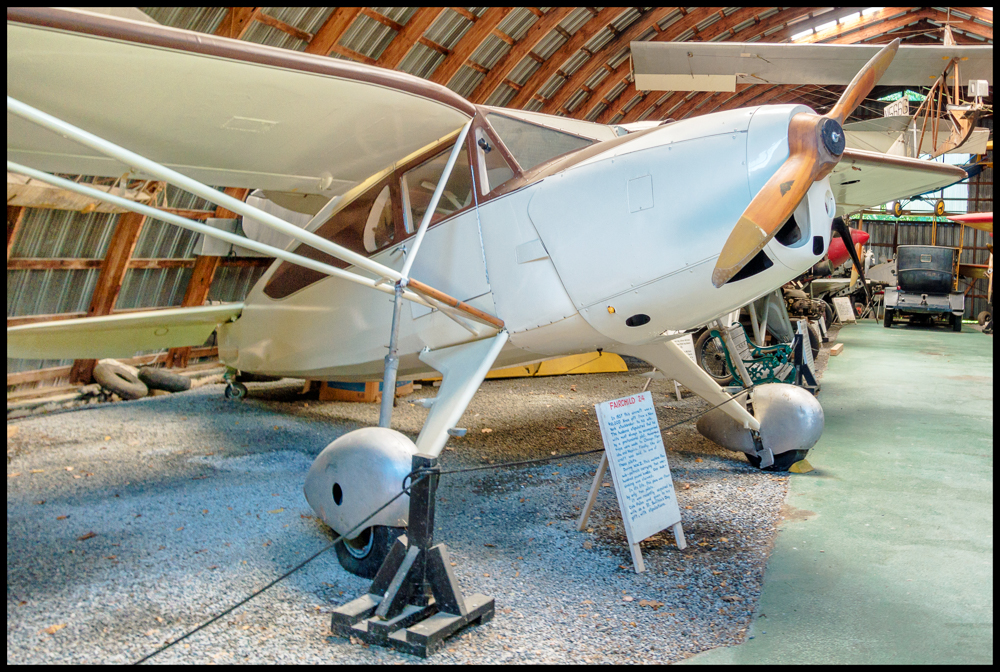
According to The Museum of Flight:
The Fairchild F-24 is a truly classic aircraft in its field. Built in the 1930s and 1940s as an economical and easy-to-fly touring aircraft, the F-24 became the plane of choice for many Hollywood stars including Robert Taylor, Tyrone Power, Mary Pickford, and Jimmy Stewart. When the U.S. entered World War II, Fairchild’s production line was diverted to the military and the F-24 became the Army UC-61 Forwarder light utility transport and Royal Air Force’s “Argus.” Civilian versions of the planes were also pressed into service. After the war, the manufacturing rights were sold to Temco, which built 280 additional F-24s to bring the total number to about 1,800 planes.
Long-nosed “Rs” and Stubby “Ws”
Fairchild F-24s were produced with two different types of engines which give each a distinctive appearance. Some, including the Museum’s example, have Warner “Super Scarab” radial engines. These planes, called F-24Ws, have stubby noses housing the round engine with pistons oriented around a central crankshaft. The others, called F-24Rs, have Ranger in-line engines. These engines have their pistons in a line front-to-back and allowed a more streamlined look to the long-nosed F-24R versions.
The Museum’s F-24 was built in Hagerstown, Maryland in early 1941 and purchased by famous ventriloquist Edgar Bergan. Bergan sold the plane to the president of a Spokane radio station and it was acquired for Army use in 1943. After the war, it flew with many private owners until it was purchased and restored by Ragnar Pettersson in 1981. Pettersson donated the F-24 to the Museum in 1985
Taken with a Sony RX-100 M3.
.