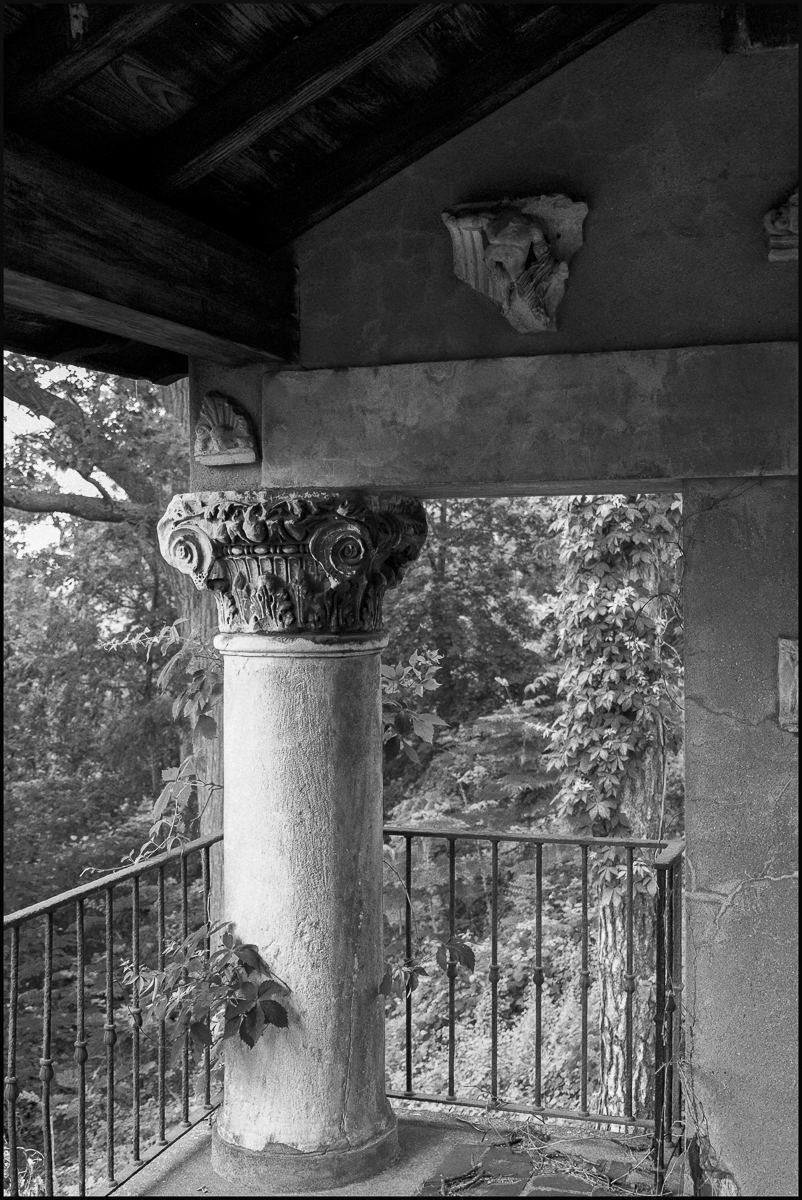
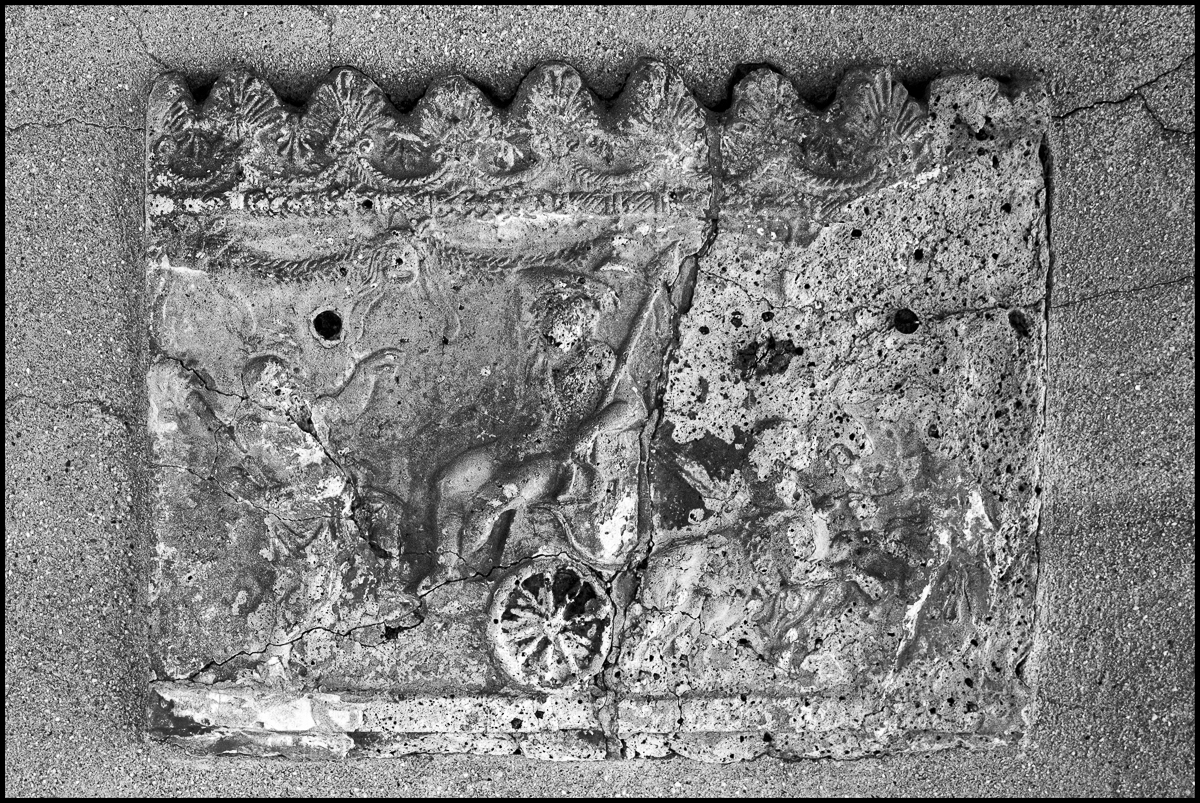
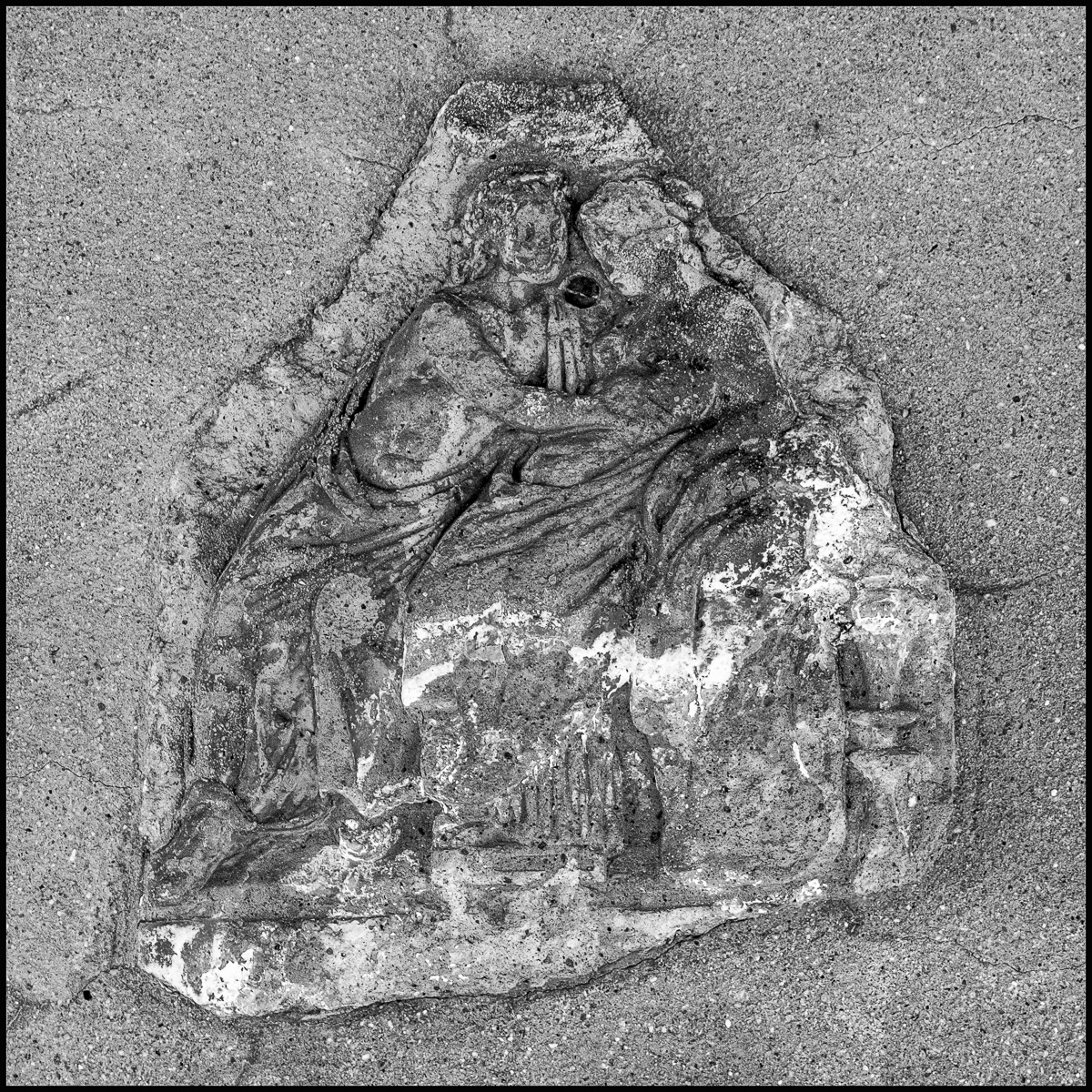
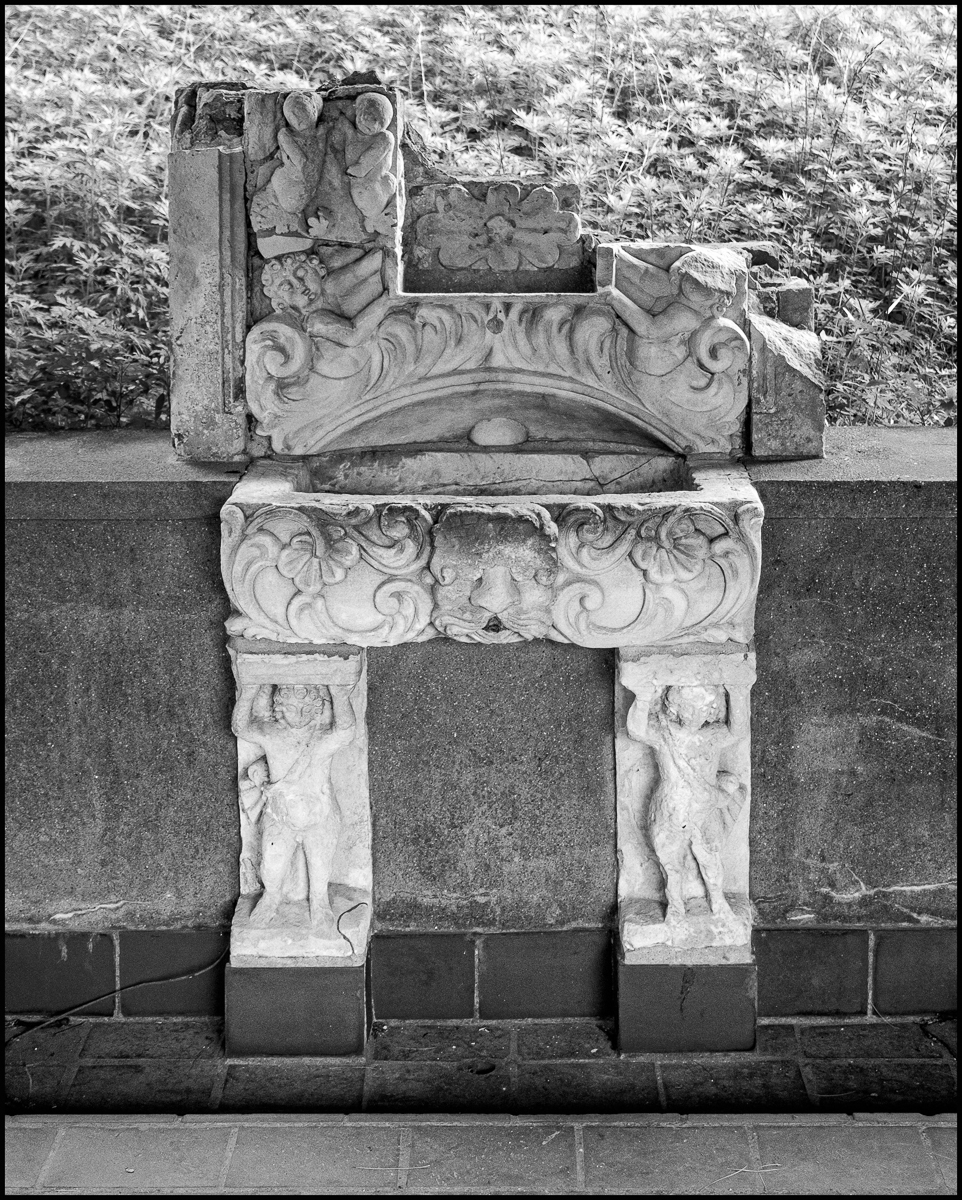
A Walk along the Old Croton Aqueduct – Untermyer Gardens, A lion and a unicorn

I’ve been to Untermyer a couple of times before, once in 2012 (See: Untermyr Park, Yonkers, NY) and again in 2016 (See the series of posts starting with: Untermyr Gardens Revisited – Overview). The restoration work has made great progress. When I first went quite a lot of structures were virtual ruins, now they’ve mostly been partially or fully restored. Great Work.

For years I’ve been trying to find these two statues. The first time I went I couldn’t find them because I didn’t really know where they were (they’re right at the lowest part of the property where it meets the Old Croton Aqueduct trail). Once I discovered that they were next to the trail I figured I would find them if I walked South on the trail from Tarrytown. Unfortunately my legs gave up before I got to them. I’m glad that I was finally able to get there.

Also in the picture are the deliberately only partially restored Gate House on the left and the overlook from The Vista on the right.

An information board nearby reads:

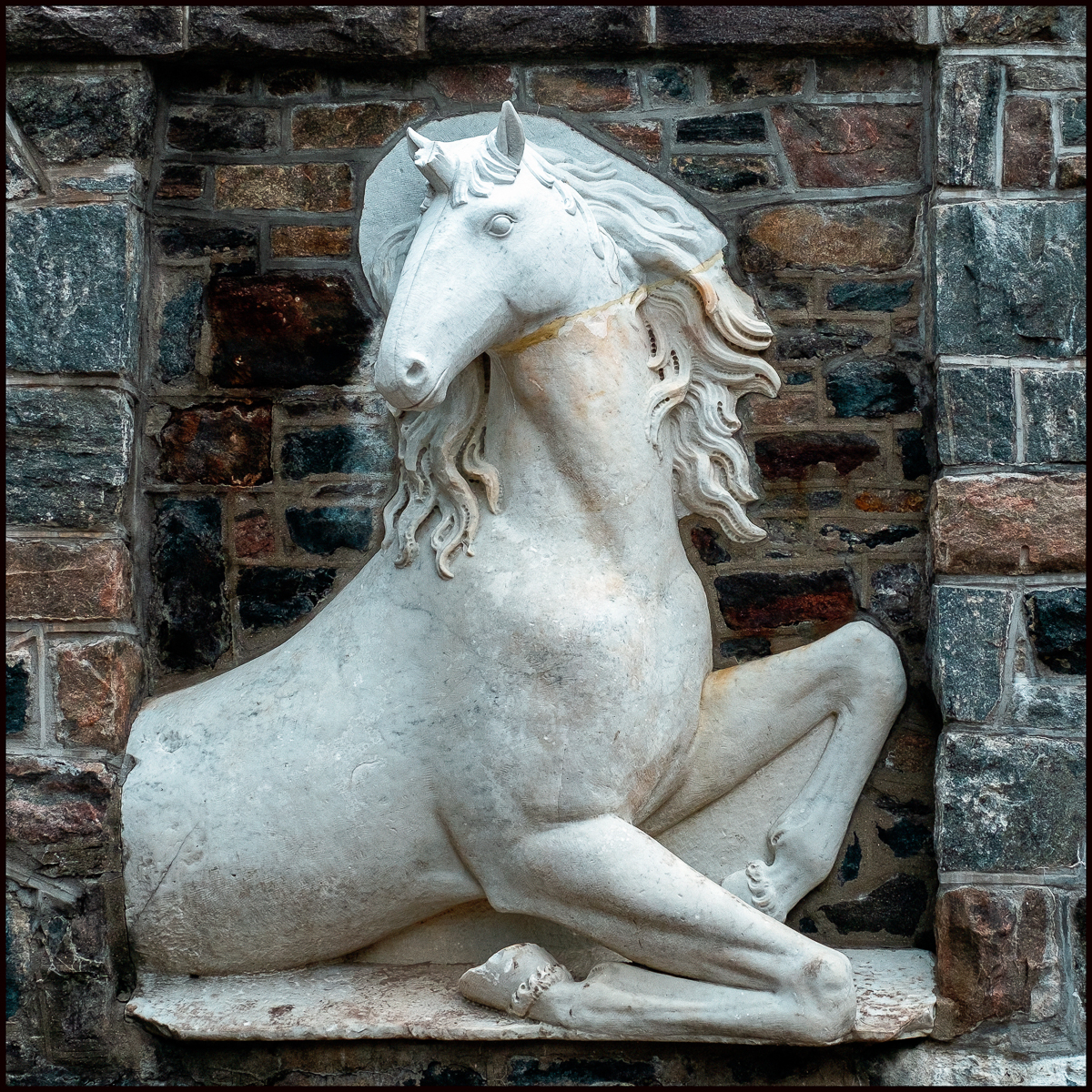
Opposite the gates along the Old Croton Aqueduct are a pair of monumental structures, a lion and a unicorn, symbols of the United Kingdom. From this point the mile-long carriage trail gradually climbs south up the hill past a ruined circular fountain at the lower switchback, past a meadow at the upper switchback, up to the site of the mansion, now demolished [for a glimpse of how it once looked see here. It’s a shame that it’s now gone].

.

Untermyer died in 1940. He had wished to give the gardens to the United States, to New York State or failing that, to the City of Yonkers, but because of the great cost of the upkeep of the gardens, which were not accompanied by an endowment, the bequest was initially refused by all three bodies. Finally, in 1946, 16 acres (6.5 ha) of the land was accepted as a gift by the City of Yonkers, and became a city public park. The mansion itself was eventually torn down.

Because of inadequate funding, much of the property was not maintained; a number of structures gradually fell into disrepair, and parts of the site became overgrown, reverting to woodland. In the 1970s an effort was made to restore the garden by Yonkers Mayor Angelo Martinelli, architect James Piccone and Larry Martin, but the campaign was short-lived and the property deteriorated again. In the 1990s community leaders such as Nortrud Spero and Joe Kozlowski and the Open Space Institute persuaded Mayor Terence Zaleski to purchase more of the original estate’s land with the help of the Trust for Public Land, resulting in the 43 acres (17 ha) of the park today.

Untermyer Park and Gardens was added to the National Register of Historic Places in 1974. Since 2011, the Untermyer Gardens Conservancy, a non-profit organization, has been working on restoring the gardens, in partnership with the Yonkers Parks Department. Grants from New York state of $100,000 in 2005 and $65,000 in 2009 helped to finance the renovation and rehabilitation of the park.(Wikipedia).

For more information on both the gardens as a whole and these statues in particular see “A Forgotten Part of a Once Forgotten Garden” by Barbara Israel. You can see some of the progress achieved here. In the article the unicorn is lacking a head. It has since been replaced as seen in the second picture below.

I’ve recently discovered a darker side to the Untermyr property. During the period when it was virtually abandoned and not maintained it is alleged that it became a base for satanic rituals involving, among others, infamous Son of Sam killer David Berkowitz. For more information see: Ritualistic Sacrifice and the Son of Sam: Satanic Worship in America’s Greatest Forgotten Garden: by Megan Roberts on Atlas Obscura.

First picture Taken with a Taken with a Fuji X-E1 and Fuji XC 16-50mm f3.5-5.6 OSS II and the last two with a and Fuji XF 35mm f1.4 R

Another trip into Manhattan – lunch at ‘Inside Park at St. Bart’s’

We had lunch at Inside Park at St. Bart’s, which occupies a portion of St. Bartholomew’s Church (seen in the background): a historic Episcopal parish founded in January 1835, and located on the east side of Park Avenue between 50th and 51st Street in Midtown Manhattan, in New York City. In 2018, the church celebrated the centennial of its first service in its Park Avenue home. In 1992, with the parish’s support, the St Bartholomew’s Preservation Foundation was established. After a two-year fund drive, restoration of the St. Bartholomew’s site began. Leaking roof drains were made watertight, the iconic dome was temporarily secured, and the Great Terrace and 50th Street wall were rebuilt. “Inside Park,” the site’s popular restaurant, also opened in 1992.


At Inside Park at St. Bart’s waiting for my visitor to arrive.


Detail of St. Bartholomew’s Church


Another detail of St. Bartholomew’s Church.

Taken with a Fuji X-E1 and Fuji XC 16-50mm f3.5-5.6 OSS II

Harley checks out the Henry Villard Monument

One of the more impressive sculptures in Sleepy Hollow Cemetery. It’s called The End of the Day’s Work

Henry Villard (born Ferdinand Heinrich Gustav Hilgard) grew up in a well-to-do family in Bavaria. He was a rebellious child, which his father tried to curb by sending him to military school. Then in 1853 and without his parents’ knowledge, he immigrated to the United States. To conceal his identity he changed his name to Villard. In the next few years he took a series of jobs at newspapers as he slowly made his way west. He got as far as Colorado and then took a job with a couple of New York papers following Abraham Lincoln’s campaign and eventual election. After the Civil War he took a series of correspondent jobs in Europe. Because he was fluent in German and English, he was hired as a negotiator of German interests in American railroad securities.

He acquired some German clients and traveled back to the United States. He went to Portland, Oregon, in 1874 and impressed with the natural wealth and transportation, he convinced his clients to invest in building a railroad. That railroad (with Henry Villard as president) eventually became the Northern Pacific Railway. Like many financiers, his interests changed and varied. He acquired the New York Evening Post and The Nation newspapers in 1881. He helped inventor, Thomas Edison merge his companies in the Edison General Electric Company, which became General Electric.

In later life, Villard became involved in philanthropic interests, giving large amounts of money to the University of Oregon, Harvard, Columbia, the Metropolitan Museum of Art, and the American Museum of Natural History.

Villard’s monument was executed by Vienna-born sculptor Karl Bittner in 1904. Although trained in classical styles, Bittner began to drift toward more modern forms. The Villard Monument was sculpted in 1904, and it exhibits the beginnings of forms that, decades later, would evolve into Art Deco and Moderne. The monument depics a man with a sledgehammer (perhaps a reference to Villard’s position as president of the Northern Pacific Railway) looking towards the stars. (Stories in Stone New York. A field guide to New York City area Cemeteries and their residents by Douglas Keister).

The rear of the monument reads:

HENRY VILLARD

BORN

HEINRICH HILGARD

AT SPEIER

RHENISH BAVARIA

APRIL 10TH 1835

DIED AT

THORNWOOD DOBBS FERRY

ON HUDSON

NOVEMBER 12TH 1900

IN VIEW OF THIS SPOT

JOURNALIST

CIVIL WAR CORRESPONDENT

SOMETIME SECRETARY

OF THE

AMERICAN SOCIAL SCIENCE ASSOCIATION

EARLY PROMOTER OF CIVIL SERVICE REFORM

COMPLETOR OF THE

NORTHERN PACIFIC RAILROAD

FINANCIER

GENEROUS FRIEND

TO LEARNING SCIENCE AND THE ARTS

TO SUFFERING HUMANITY

HIS BOUNTY WAS BOUNDLESS

AS THE SEA

HIS LOVE AS DEEP

Taken with a Sony A6000 and Canon 50mm f1.4 LTM (I think).

A Walk along the Hudson in Peekskill – ARC

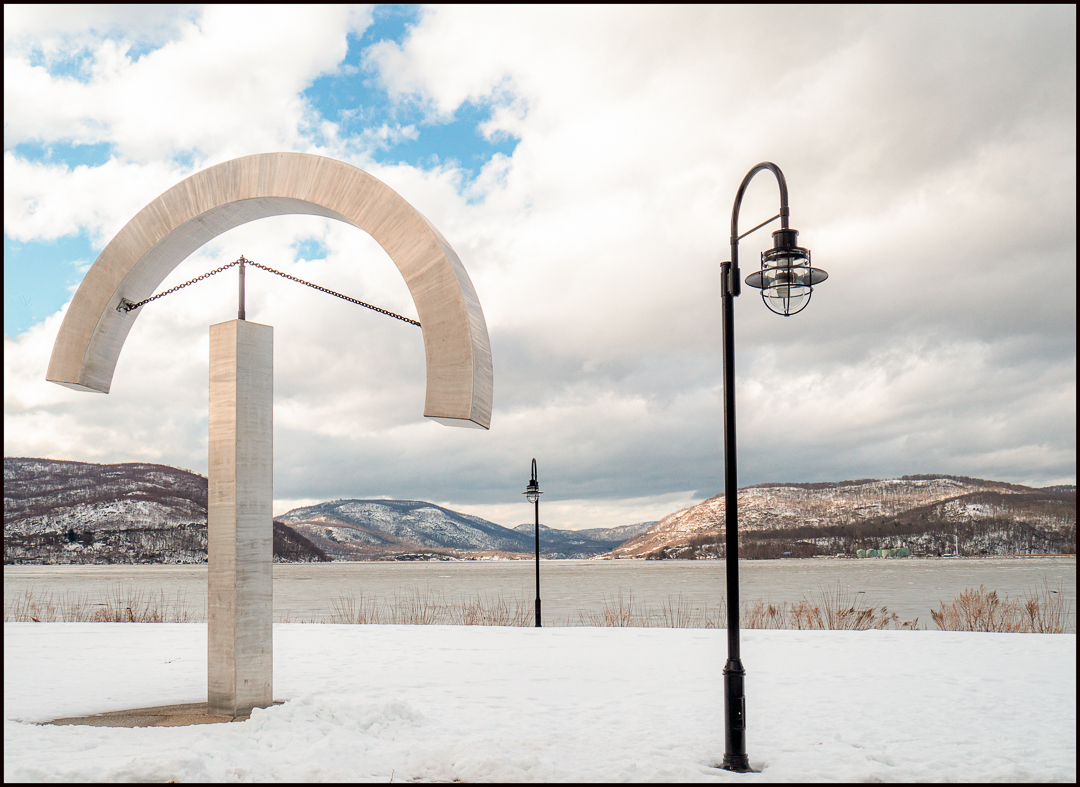
According the a nearby information plaque:

ARC by William Logan. Welded Aluminum and Steel. The form of this sculpture has been abstracted from river-going vessels and nautical moorings. Its center-of-gravity has been adjusted to give it buoyancy, enabling the sculpture to respond to the wind. Welded aluminum, steel chains and shackles reinforce the nautical vocabularly, while its form reflects Peekskill’s location on the river and the curvature of the surrounding hills. The support structure allows the “arc” to move with the breeze, tipping and feathering into the wind like a boat on a mooring, while the internal balast gives it a gently-rolling movement. The sculpture inherently indicates the wind direction, and provides a highly visible landmark designating the bend in the river at Peekskill Bay. 2014.

Taken with an Olympus OM-D EM-10 and Panasonic Lumix G Vario 14-42 f3.5-4.6 II