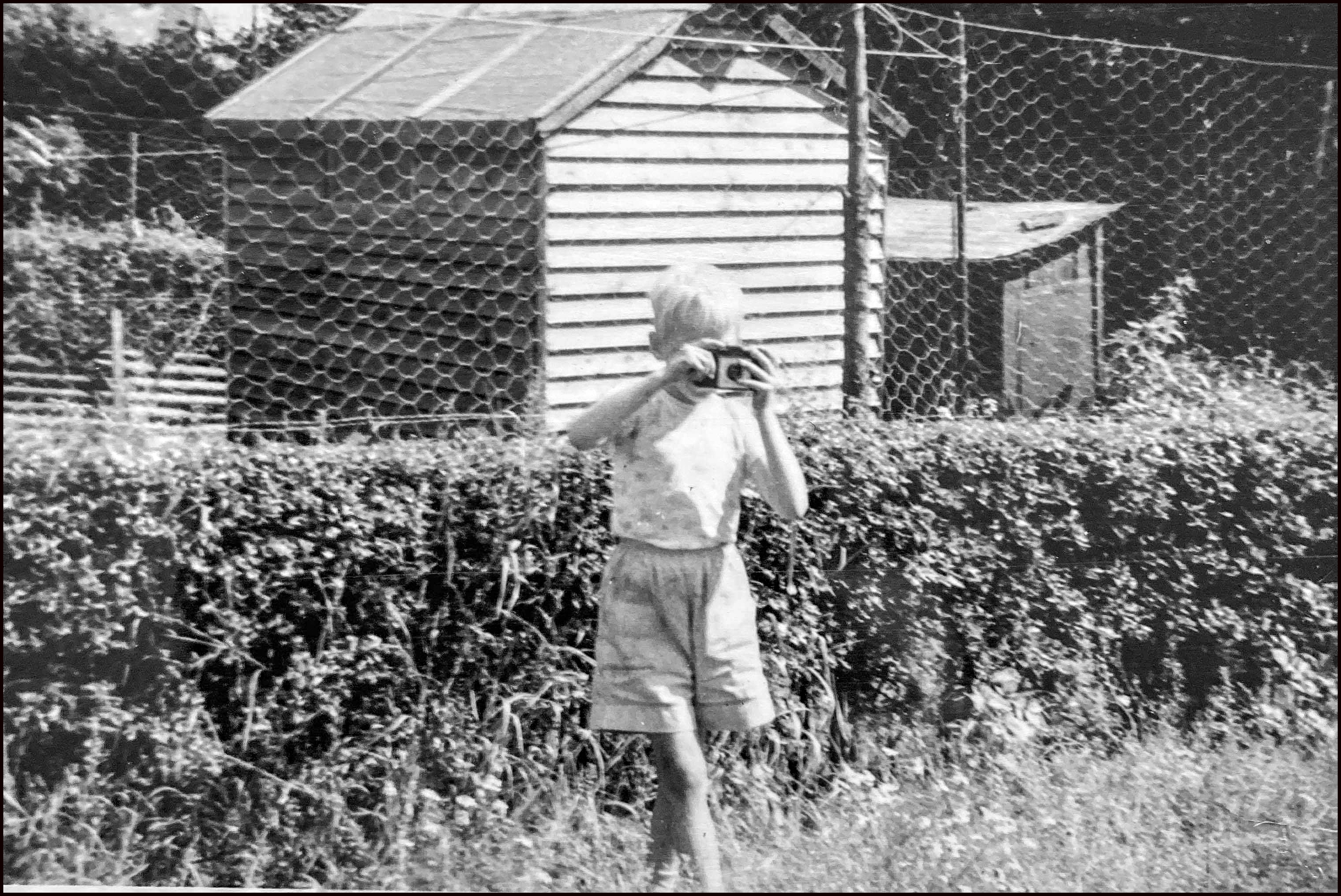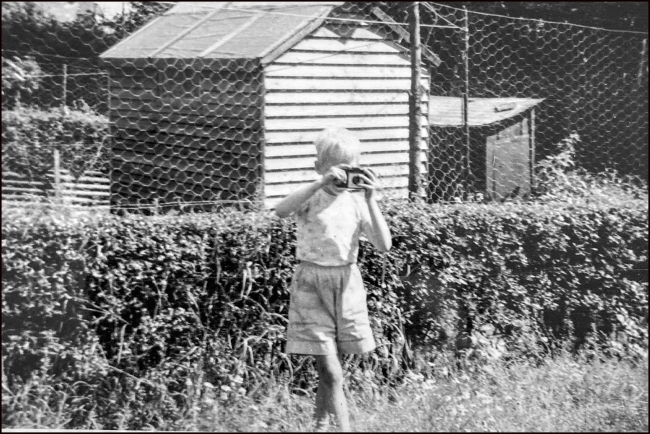
I recently made contact with a long lost niece (actually first cousin once removed but that’s too much of a mouthful). She’s been sending me old pictures that I’d never seen before. This is one that I particularly like. Yes that’s me. Look at the hair. And it’s taken my experience with cameras back a few years. Until quite recently I attributed my interest in photography to a camera that my wife, Eirah gave to me as a present around 1979. Then I came across a picture of my father and our dog (See: My First Camera). I remembered that a friend from high school had a camera (and even a darkroom) and that led me to ask mum and dad for a camera of my own, the one I used to take that picture. That took my interest back to when I was about 11, around 1963. Now I see this picture, which takes my experience with cameras back even further. According to my niece her dad was about 11 when this was taken, which would make me about 6. Coincidentally I connected with my high school friend on the same group where I found my niece. We did a video chat the other day. It has to be the first time I’ve spoken with him in 50 years.
Even though it’s very hard to see the camera I believe I can identify it. I think it’s a Kodak Brownie 127:
The Brownie 127 was, in the UK, an extremely popular plastic snapshot viewfinder model for 127 film made in England by Kodak Ltd. From introduction in 1952, over a million had been made by August 1954, and the series continued to sell many more millions. A few (~263,000) of the first model were exported to the US in 1953-4, where they were badged Brownie Starlet – and should not be confused with the more common Brownie Starlet.
The first version of the camera was made of a black Bakelite-type plastic and had a rounded shape, where the film carrier mechanism and viewfinder were attached to the top of the camera, which lifted out the base. The base carried the lens and shutter. The sides were stepped, and there were steps beside the viewfinder tube. The second version had vertical lines on the sides and a flatter top. There were many small changes of faceplate and detailing; some had cream controls, later models having grey. An experimental white version, with a silver top, was made and only sold in Jersey in the Channel Islands – in c.1959; it was not successful, as the colour dirtied very easily. This rare variant is frequently faked by painting black ones.
The third version of the camera was made of grey plastic and completely reshaped to have flat sides, angled corners, and square, 4x4cm images. The shutter speed and lens aperture were fixed; the only controls were wind-on and shutter release. The shutter had double-exposure prevention and flash sync, and a shoe for a special Kodak flash-holder (introduced for the Instamatic range) was added to the top. The shutter release was a large white square on the front, beside the viewfinder. (Camerapedia Wiki)
Coincidentally I have one in my collection.