Film Camera 2018/2 – Minolta STsi – Results

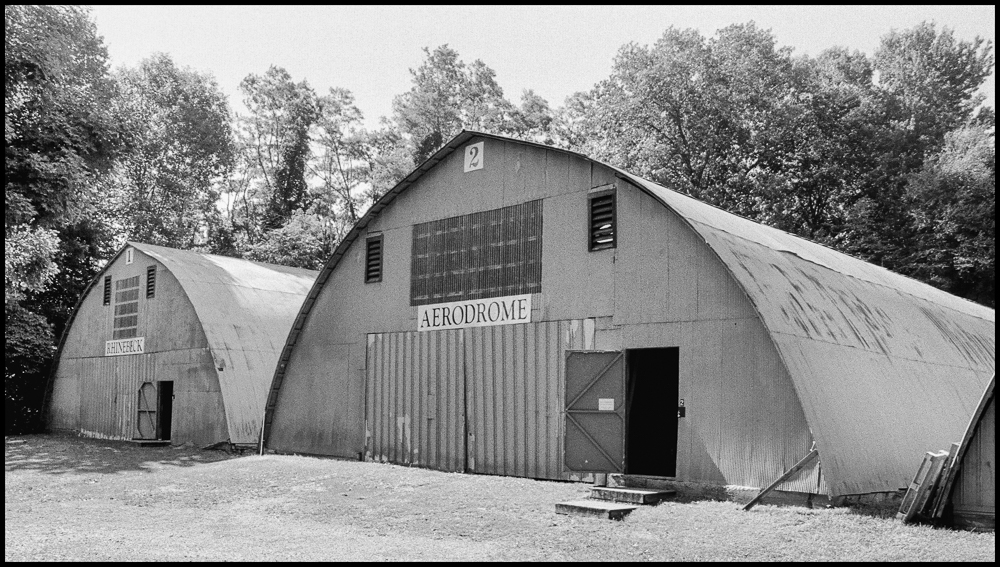
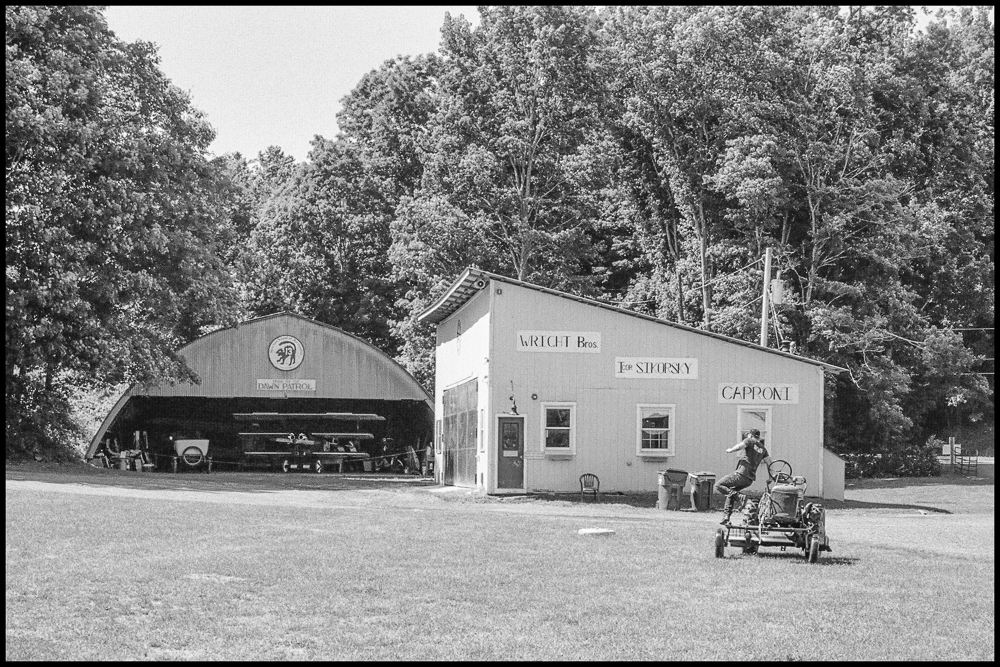
The pictures were taken at the Old Rhinebeck Aerodrome. Above two of the three hangers, which, in addition to the main display area, contain the collection of vintage aircraft. The bulk of the collection shares a building with the gift shop. These are two of three other hangers. The first contains aircraft from the the Pioneer Era (1900-1913). The second features aircraft from World War I (1914-1918); and the third (not shown) displays aircraft from the Golden Age (1919-1940).

For the purpose of trying out this camera I chose the Minolta AF 28-80mm f3.5-5.6. Before when I’ve done such ‘try outs’ I’ve mostly (but not always) used whatever film I happen to have lying around – generally some kind of inexpensive print film. If after use I’ve felt that the pictures would look better in black and white I’ve converted them. However, this time I decided to use a black and white print film – specifically Kodak Tri-X.

The first thing I noticed was that when I looked through the viewfinder the image was not as bright as I expected. In fact it looked tinted. Was there a filter on the lens – no. I’m at a loss as to why it looked like this, but it didn’t seem to have any impact on the results. Would I have noticed something if I’d used color film? (Update: I just tried the lens on my Sony A77II and the colors looked fine).

Otherwise the camera was easy to use. Because it’s small and light it was easy to carry around. In poorer light the AF could ‘hunt’ a bit, but nothing too bad. Generally the camera found and confirmed autofocus pretty quickly.

When I got the negatives/scans back I noticed that they were all very contrasty, but nothing I couldn’t tame in lightroom. Was this because it was a bright, sunny day and there were quite strong contrasts? Was it because Tri-X is by its nature quite contrasty? Could it have had something to do with the tint I was seeing through the viewfinder?

I found the camera pleasant to use and not once did I think “Oh how I wish that I had this feature or that feature that my more fully featured cameras have but this one doesn’t”. It may be an entry level camera, but it seemed to have everything I needed.

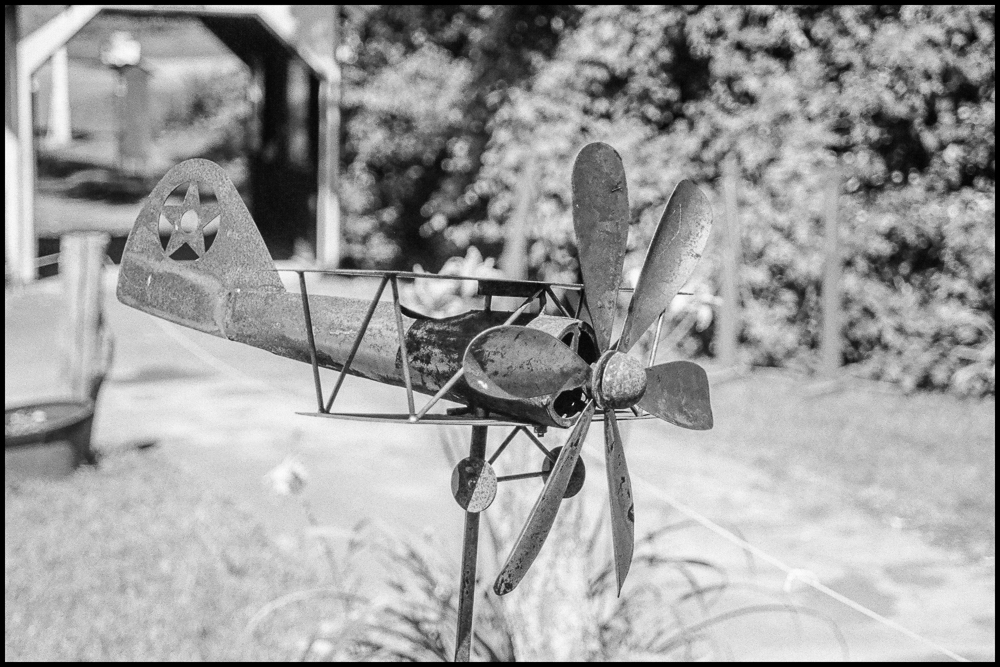
Aircraft mobile.

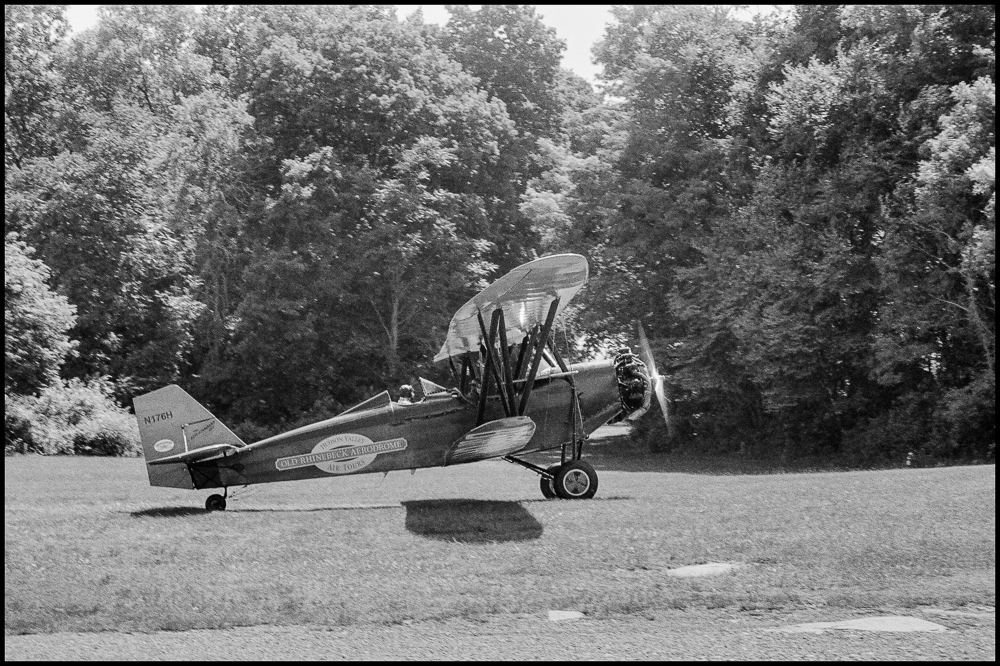
Since the airshows are on weekends I didn’t expect to see anything flying…until I heard the sound of this New Standard D-25 warming up. Here it is starting to taxi.

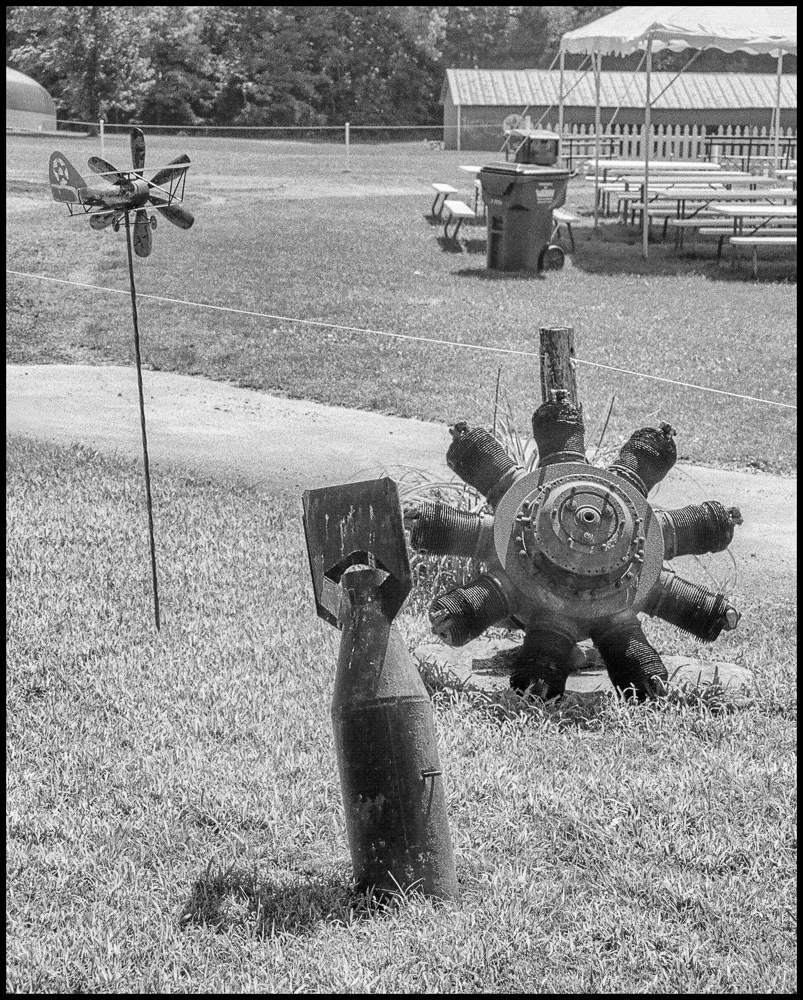
Bits and bombs.

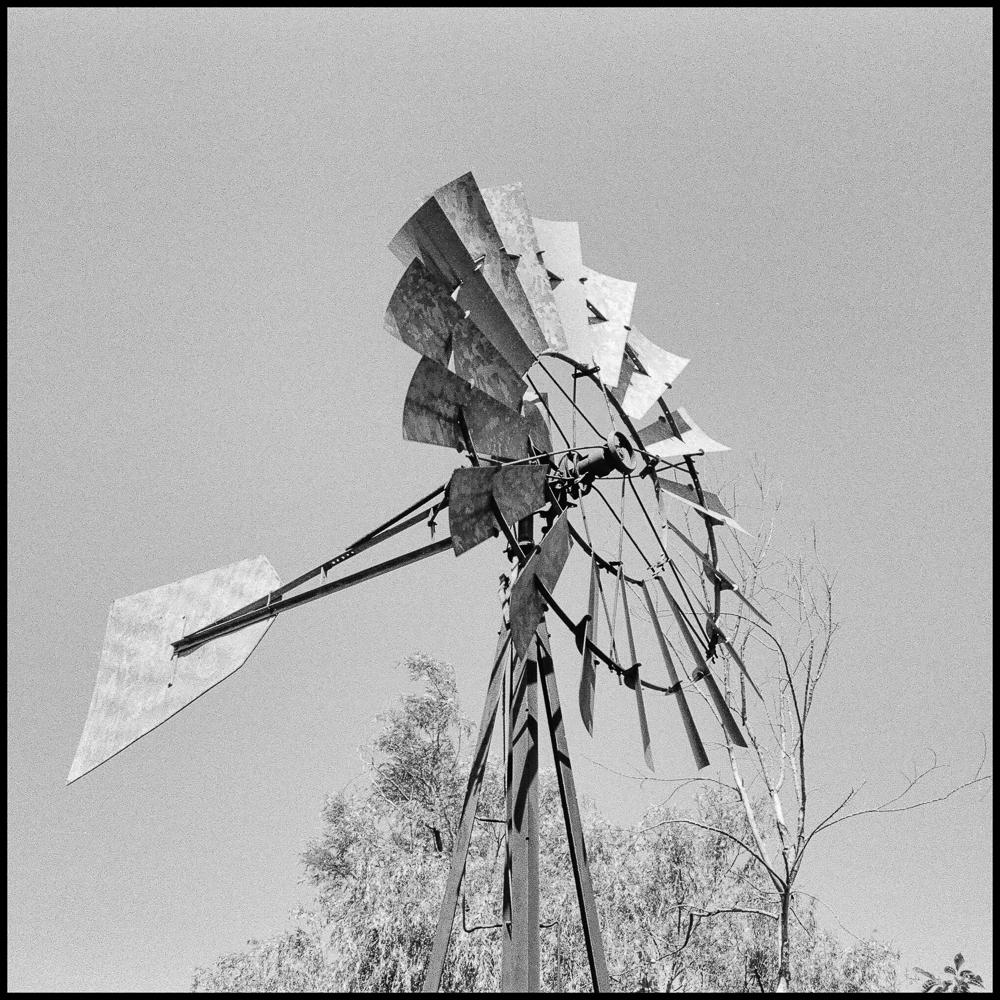
Windmill.

Man descending from a tractor with the Red Baron’s Fokker Tri-plane in the background.

See also the following posts taken with the same camera/lens/film combination:

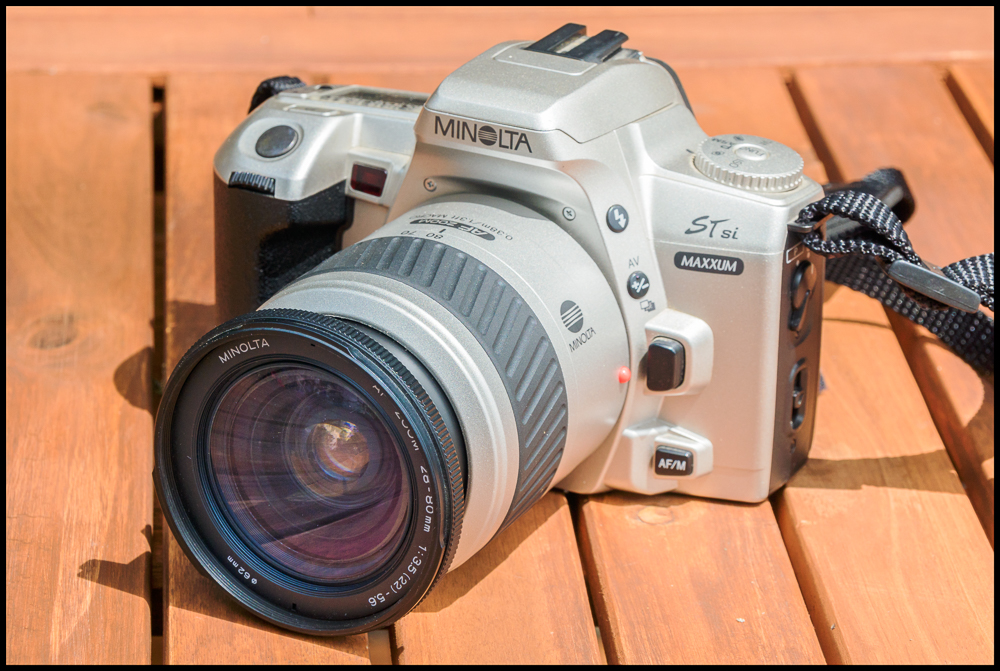
Film Camera 2018/2 – Minolta STsi

I wasn’t really interested in another Minolta body, but what caught my eye was what came with it: A Minolta AF 50mm F1.7 Lens; Minolta AF Zoom 28-80mm f3.5-5.6; Minolta AF Zoom 70-210mm f4.5-5.6 plus other assorted goodies – all for an extremely low price. I have an old A-mount camera (specifically a Konica Minolta Maxxum 5D). I’ve been thinking of giving it away to one of my grandkids (if any of them are willing to accept such old technology of course), but I didn’t want to sacrifice any of my Sony/Minolta lenses. These seemed to be a good solution.

According to camera-wiki.org The STsi was:

…an entry level autofocus 35mm film SLR camera using the Minolta AF mount, manufactured by Minolta and released in 1999. In the Americas it was known as Maxxum STsi and in Japan it was called α Sweet S (Alpha Sweet S).

The electronic controlled shutter is vertical travelling with speeds from 20s to 1/2000 sec, plus bulb and a flash sync of 1/90 of a sec. The metering is a TTL based system using a 8 segment silicon photo cell. It has a sensitivity of 1 to 20 EV and in spot mode 4 to 20 EV (ISO 100, 50mm f/1,4. Metering is based on using DX encoded film, which can also be manually set from 6 to 6400 ISO in 1/3 inc. The exposure modes include, program, aperture priority, shutter priority, manual exposure along with settings for portrait, landscape, close-up, sport, night. The film transport has a motorized drive with film automatically advancing after exposure. Drive modes includes single frame, continuous for up to 1 fps, self-timer and multiple exposure. The built-in flash has a GN of 12. The camera is powered by two CR2 batteries.

For a full list of specifications see here.

As you’ll see from the specs it’s quite small and light, somewhat ‘plasticky’ feeling (as I suppose were most of the cameras from this era) but nonetheless with quite a solid feel. A dial on the top left of the camera allows you to select from various options: manual ISO selection; Flash options; Exposure modes – it has the usual array of exposure modes including Programme, Aperture priority, Shutter priority and Manual selected by using the ‘func’ button in the center of this dial in conjunction with the dial on the front right of the camera. Options for drive mode and wireless flash are also controlled from here. Scene modes are available including: portrait, landscape, macro, sport and night. There’s also an option for spot metering. If you get stuck and want to return to the programme mode just press the large button marked ‘P’. On the left near the lens barrel there are two buttons, one to pop up the flash and the other for exposure compensation. On the bottom left you find a switch to toggle between manual and autofocus. The fairly large and bright viewfinder displays the following information: Autofocus frame; LEDs for AE lock, aperture, shutter speed, flash ready. On the left side of the body there’s a dial to switch between regular and panorama mode. Mine has a date back, which I’ll never use.

Although this might be an entry level camera there’s plenty of functionality to play with. It’s much less spartan than the Canon EOS 888 I looked at last September (see September Film Camera – Canon EOS 888).

So now to try it out.

Picture taken with a Sony A77II and Tamron A18 AF 18-250mm f3.5-6.3.

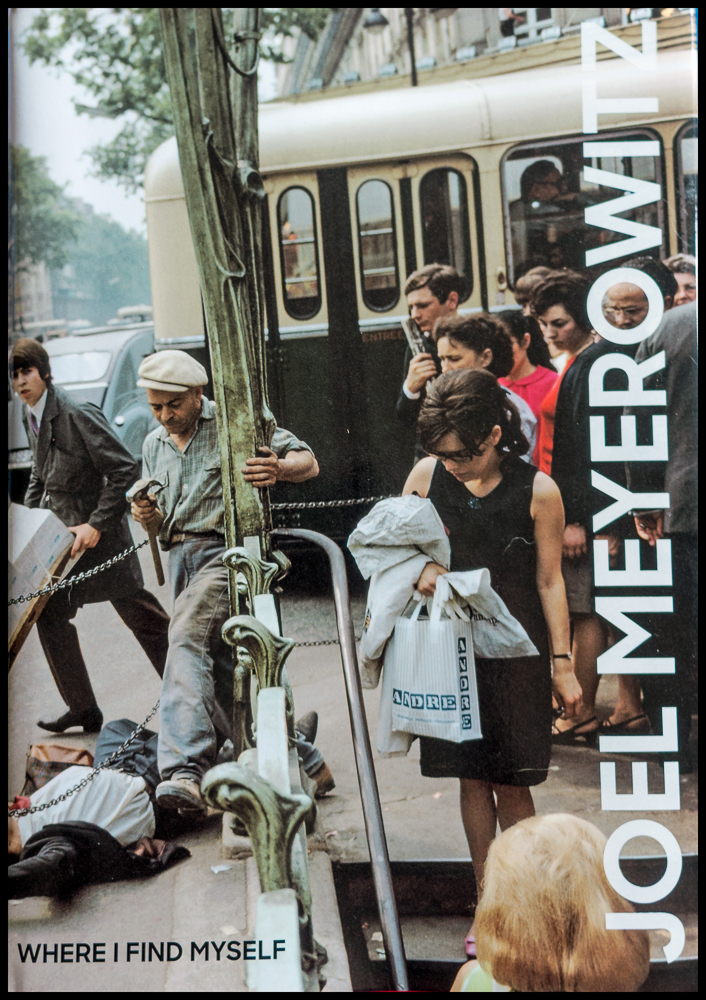
Joel Meyerowitz: Where I find myself. A lifetime retrospective

I just got my hands on a copy of this marvelous book. I won’t go into detail because there are many excellent reviews available online including:

It”s a large and heavy book that I found I either had to place on a table, or even better on a book stand. I found the quality of the reproductions to be excellent. I believe that Mr. Meyerowitz was heavily involved in the production of the book and the selection of images.

The choice of starting with the most recent work first and then working backwards (rather than the more usual starting with the oldest and working forward) was interesting, but after going through the book I found that I wanted to start at the end (i.e. with the oldest work) and read backwards towards the beginning. I found that this helped my understand how his work had evolved over time.

An evolved it certainly has. I find this one of the most impressive things about Mr. Meyerowitz: the way he has frequently re-invented himself. Many photographers find their niche and then stick with it for the rest of their careers. Not Mr. Meyerowitz. He started off in black and white and then became an early advocate of color. He began as a street photographer, but then moved into other genres including landscapes, portraits, still life. He started out using a 35mm camera, but later espoused large format. His reasoning for these changes is nicely explained in the book.

I was particularly impressed with his most recent work: a series of still life photographs. I’ve always liked still lifes, but have taken surprisingly few. The book has inspired me to try to do more.

There’s also an interesting Interview with Joel Meyerowitz: Where I find myself on Lenscratch.

A great book. I thoroughly enjoyed it!

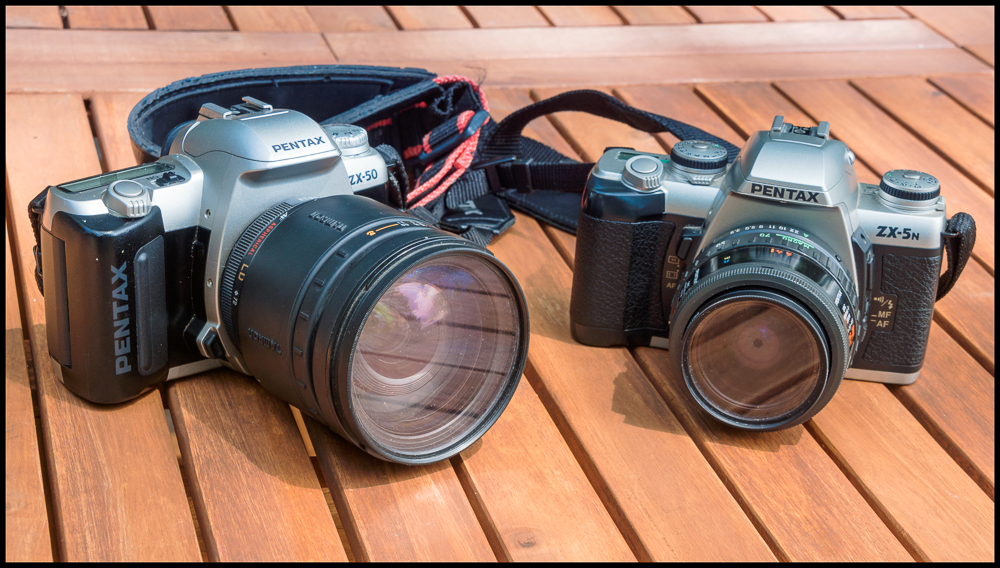
A couple of Pentax autofocus SLRs

For a while now I’ve been developing a liking for autofocus SLRs. There are two reasons for this: 1) I seem to have completely missed the autofocus SLR era going directly from a manual focus Canon AE-1 to digital; 2) Nobody seems to want to lower end models so they’re often ridiculously inexpensive.

So when I saw these two Pentax AF SLRs, each with its own lens, going for a low price I couldn’t resist. It was fairly obvious that the seller knew little about cameras so I was taking a chance, but seemed to be worth a gamble. I already had an adapter for Pentax lenses so if worst came to the worst I could use them with my Sony NEX 5n.

The two cameras are a Pentax ZX-5N and a ZX-50 and the lenses a SMC Pentax-F Zoom f3.5-4.5 35-70mm and a Tamron AF Aspherical LD 28-200mm f3.8-5.6.

When they arrived the bodies had a very solid feel to them and seemed to be in excellent shape. Unfortunately, the worst did come to the worst. The ZX-5N was dead on arrival. The mirror was stuck in limbo and after some research I discovered that this is a common problem with the ZX series cameras. Apparently a plastic part in the mirror motor breaks rendering the mirror inoperative. Parts are no longer available so there’s not much you can do about it. The ZX-50 seemed at first as if was working until a pressed the shutter release. Then there was a ‘whirring’ sound just like the ZX-5N was producing so I guess it was the same problem.

So neither of the bodies worked so on to trying out the lenses. I quickly got my adapter and tried both lenses on the Sony NEX 5N. They both fitted and worked well – phew!

So if there’s a message here it’s probably that it’s wise to avoid Pentax ZX series cameras, attractive though they may be.

I’ve tried out the lenses a bit more extensively now, but that’s the subject for another post.

Taken with a Sony A77 II and Tamron A1 AF 18-250mm.

Little Moreton Hall, the Dale Family and Francis Frith

I’d always known that there was a connection between Little Moreton Hall and my family. For example I knew that my Grandfather had lived there as a tenant and that my father’s half brother had managed the property after it was handed over to the National Trust. I hadn’t realized the extent of the connection, however.

We recently had a visit from a cousin that (apart from a brief encounter at my parents’ funerals) I hadn’t seen in about 40 years. His wife has an interest in genealogy and has been looking into the history of the family. This prompted me to do a little research for myself. According to Geni

The fortunes of the Moreton family declined during the English Civil War. As supporters of the Royalist cause, they found themselves isolated in a community of Parliamentarians. Little Moreton Hall was requisitioned by the Parliamentarians in 1643 and used to billet Parliamentary soldiers. The family successfully petitioned for its restitution, and survived the Civil War with their ownership of Little Moreton Hall intact, but financially they were crippled. They tried to sell the entire estate, but could only dispose of several parcels of land. William Moreton died in 1654 leaving debts of £3,000–£4,000 (equivalent to about £12–16 million as of 2010), which forced his heirs to remortgage what remained of the estate. The family’s fortunes never fully recovered, and by the late 1670s they no longer lived in Little Moreton Hall, renting it out instead to a series of tenant farmers. The Dale family took over the tenancy in 1841, and were still in residence more than 100 years later. By 1847 most of the house was unoccupied, and the deconsecrated Chapel was being used as a coal cellar and storeroom. Little Moreton Hall was in a ruinous condition; its windows were boarded up and its roof was rotten.

Abraham carried on the preservation effort begun by Elizabeth Moreton until he and his son transferred ownership to the National Trust in 1938. The Dale family continued to farm the estate until 1945, and acted as caretakers for the National Trust until 1955.

So it seems that my family lived there for over 100 years! Somehow I had the idea that the Moreton’s had continued to live in the hall with my family living in a farm somewhere on the property. It seems, however, that this was not the case. They actually lived in the hall and my cousin passed on to me some pictures taken during the period they were there. Apparently he got them from the National Trust. My favorite is the one below. The caption in the filename reads: “Possible Dale girl taken in 1893”.

The connection may go back even farther. See below.

Source: Wikimedia

Source: Wikimedia

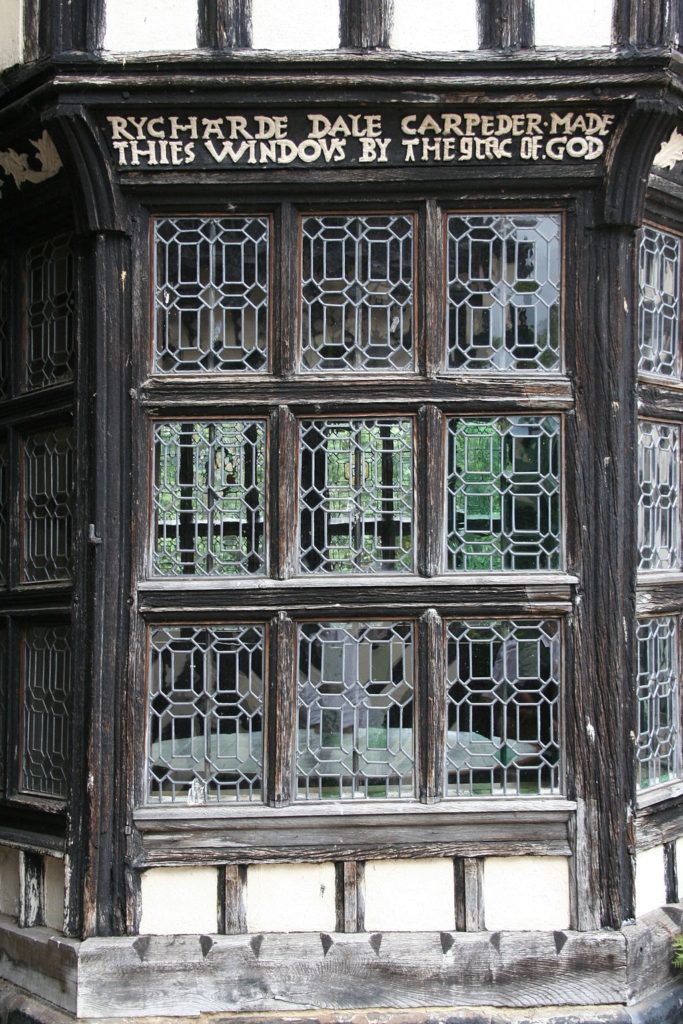
The full inscription reads: “”God is Al in Al Thing: This windous whire made by William Moreton in the yeare of Oure Lorde MDLIX Rychard Dale Carpeder made thies windous by the grac of God.” The Roman numeral MDLIX represents the Arabic numeral 1559. Are we related to this Richard Dale or not? Well, we don’t know at the moment.

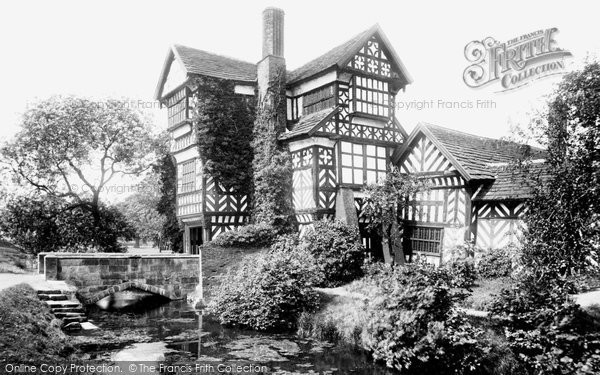
So where does Francis Frith come in. I was aware of Francis Frith, the photographer. I’ve even posted on this blog about him (See: Frances Frith). While I was ‘googling’ for information on Little Moreton Hall I came across the photograph at the top of this page. The date on it reads 1902 so it couldn’t have been taken by Mr. Frith as he died in 1898. So what’s going on?

According to Wikipedia:

When he had finished his travels in the Middle East in 1859, he opened the firm of Francis Frith & Co. in Reigate, Surrey, as the world’s first specialist photographic publisher. In 1860, he married Mary Ann Rosling (sister of Alfred Rosling, the first treasurer of the Photographic Society) and embarked upon a colossal project—to photograph every town and village in the United Kingdom; in particular, notable historical or interesting sights. Initially he took the photographs himself, but as success came, he hired people to help him and set about establishing his postcard company, a firm that became one of the largest photographic studios in the world. Within a few years, over two thousand shops throughout the United Kingdom were selling his postcards.

His family continued the firm, which was finally sold in 1968 and closed in 1971. Following closure of the business, Bill Jay, one of Britain’s first photography historians, identified the archive as being nationally important, and “at risk”. Jay managed to persuade McCann-Erikson the London advertising agency to approach their client Rothmans of Pall Mall on 14 December 1971 to purchase the archive to ensure its safety. Rothmans went ahead and acquired the archive within weeks.

Frith was re-launched in 1975 as The Francis Frith Collection by John Buck, a Rothmans executive, with the intention of making the Frith photographs available to as wide an audience as possible.

On 25 August 1977, Buck bought the archive from Rothmans, and has run it as an independent business since that time – trading as The Francis Frith Collection. The company website enables visitors to browse free of charge over 180,000 Frith photographs depicting some 7,000 cities, towns and villages. In 2016 the company completed a two-year project to scan the entire archive and now holds over 330,000 high resolution digital scans. These will be added to the website at the rate of 5,000 to 10,000 per month, starting in October 2016 – see Frith web site for new images added each month.

The agency continues to this day.

I also came across a comment on the above picture on the Frith agency site, which reads as follows:

Wonderful Memories – a Memory of Congleton.

My great grandfather – Charles Dale was living at Moreton Old Hall when this photograph was taken.

His family, the Dales, had become tenant farmers for Moreton Old Hall in the 1860s and the Hall was the farmhouse that was provided. Thomas and Ann Dale had 15 children – Charles was the youngest, so the size of the Hall would have been greatly appreciated.

I remember being told about secret doors and invisible panels and how the children used to love playing hide and seek.

Ann Dale used to open the door of the Hall to tourists even in the early 1900s. I’ve been told about people having afternoon teas, provided by Ann and her daughters, on the front lawns of Moreton Hall. They said that her scones were something to die for and people still spoke about them 50 years later.

Ann and subsequently her children farmed the farm until it was passed into the care of the National Trust

A memory shared by Lyn Smith on Dec 30th, 2008.

I, too, remember the secret rooms and panels. As a child I used to go into one of these rooms before the tourists arrived, wait and them pop out from behind a secret panel appearing seemingly from nowhere.

Interestingly, one of the tea rooms at the hall is to this day called “Mrs Dale’s Tearoom” described as:

Our licensed, waited-service tea-room offers daily hot specials, seasonal soups, freshly made sandwiches, high-teas, delicious cakes and scones and a great children’s offer, along with a variety of hot and cold beverages and local wines and beers.

Here’s the 2018 menu. It also provides some additional information on the Dale family as well as some interesting historical photographs.