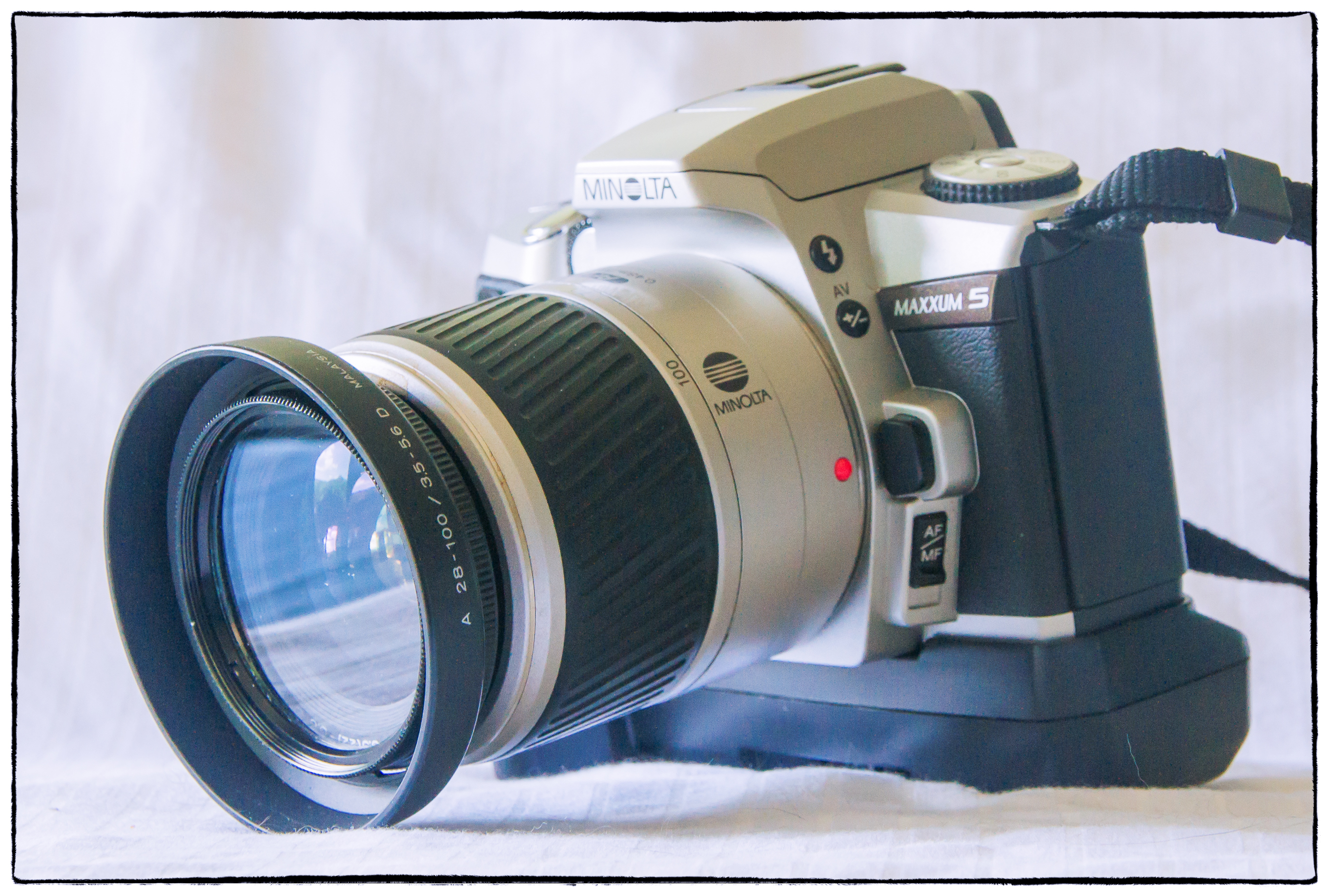
May Film Camera – Minolta Maxxum 5

I don’t recall how I managed to acquire this camera. It could be that someone gave it to me. I’ve mentioned before that I missed the entire autofocus fim era so it might be that reading a good review and finding a decently priced one prompted me to get it. Or it could be that it came with a lens that I could use on my Sony Alpha DSLR. I already have a number of Konica/Minolta/Sony lenses for the DSLR so maybe I thought that having a reasonably inexpensive, later model Minolta AF film camera would be nice (to go with my Nikon N90s, Canon EOS 650, and Canon EOS Elan IIe all of which I love to use).

It’s a Minolta Maxxum 5, the less expensive sibling of the Maxxum/Dynax 7 and 9 cameras, which still command significantly more money. My copy came with a Minolta 28-100 AF lens f3.5 (22)-f5.6 D lens, a strap, a Tiffen UV filter, and a lens hood. It’s also the data back version. (I don’t like data backs and so immediately turned it off) and has a BP-200 battery pack.

It’s very small and is quite light. I like the look and feel of it. While obviously designed to meet a low price point (i.e. lots of plastic) it feels quite solidly made. Because it’s an inexpensive camera, however, this doesn’t mean that it lacks features – quite the contrary. It has a top shutter speed of 1/4000; bracketing; continuous and 7-point autofocus; exposure compensation; automatic (from DX coding) or manual selection of ISO from 6-6400; and multiple exposure capability. It also has an interesting reset button, which returns all settings to default if you mess something up. Powerful, but perhaps a little bewildering are the 14 customizations, which allow you to set up the camera how you want it. They cover such areas as flash settings, leaving the film leader out, spot metering options, metering patterns, etc. Unfortunately you’ll probably need a “cheat sheet” to remember what they are as they are all referenced by number.

The top display shows all of the set options at a glance. Other controls for flash and exposure compensation, spot metering and selecting AF points are conveniently placed. The camera has a built in pop-up flash, which I doubt I’ll use (I’m terrible at flash photography and prefer to use available light). There are also buttons, which select (in conjunction with turning the command dial) scene modes (portrait, landscape, macro, action, night) and drive mode (single frame advance, continuous frame advance, self timer and remote control) options. To the bottom right on lens mount is a depth of field preview button, and on the left a manual/autofocus toggle button. On the right side of the body is a port for a wired remote. It’s the same as the port on my Sony Alpha 500 DSLR so I can use the wired remote with both cameras.

The camera also has “Eye Start” and begins to focus as soon as you lift it up. I don’t like this feature and immediately turned it off. Focus and exposure setting can be locked using a half press of the shutter button.

I found the mode dial initially a little confusing. For example to select aperture priority you have to turn the dial to PASM, then press and hold the central “func” button while turning the control dial on the front. This then cycles through the available options (seen on the top screen). When you reach ‘A’ you let go of the ‘func’ button and you’re all set. It’s not particularly difficult or time consuming – just different from what I was used to (i.e. selecting the programme mode directly from the dial itself). Other settings on the dial include bracketing options; audio signal; eye start, custom settings; ISO; AF options (A,C,S); red-eye reduction.

The viewfinder of the Maxxum 5 is bright and the display on the bottom shows just the essentials: focus pattern, focus confirmation, shutter speed, aperture and exposure setting.

It has a decent sized grip and was very pleasant to use. It would be easily possible to build a substantial system (body and older Minolta AF lenses) at very little cost. Definitely a very likable camera.

I’ll post some results later.
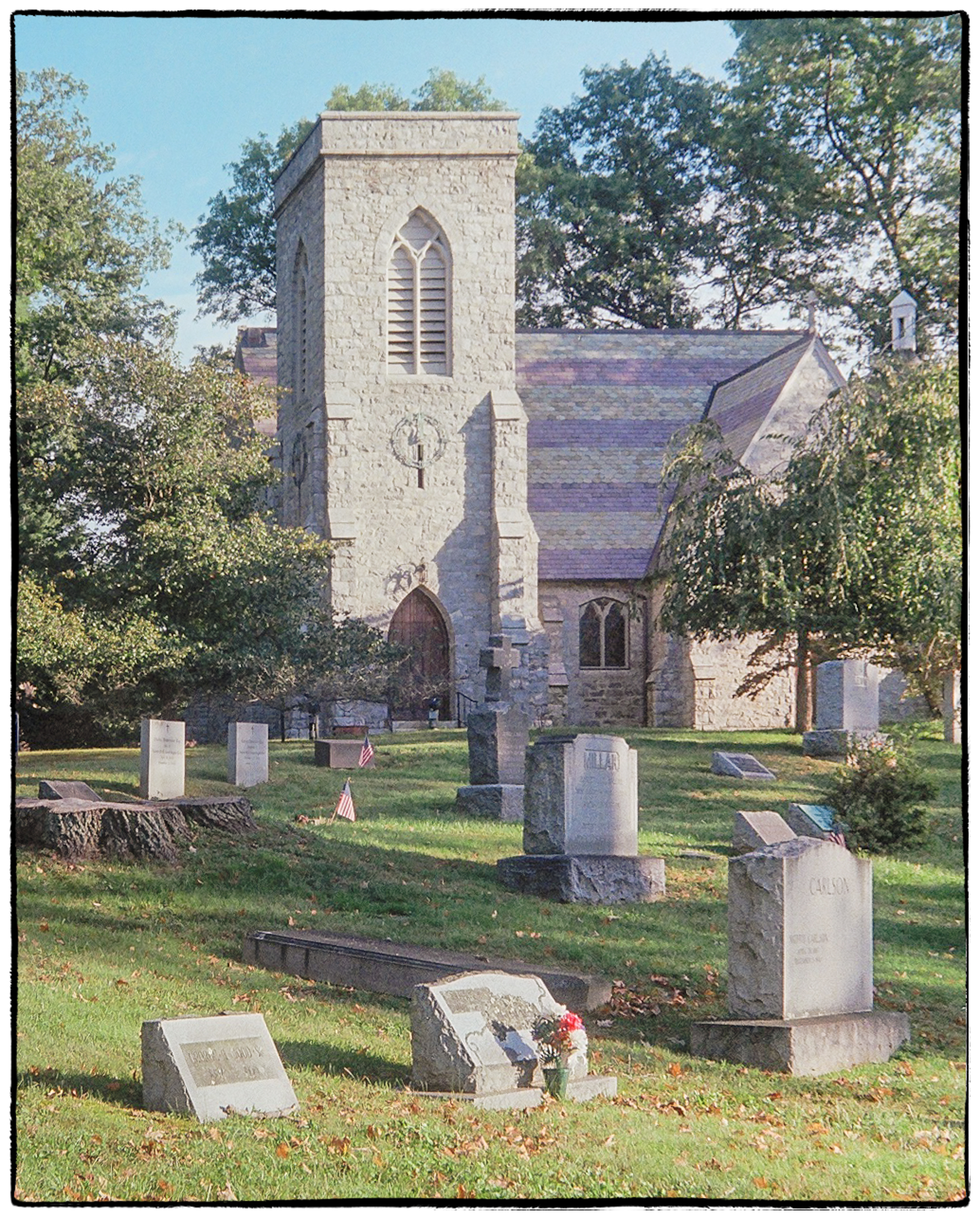
St. Philip’s Church in the Highlands, Garrison

Yet another film photograph. I’ve always loved this church – largely because it doesn’t really seem to belong in the US. I’ve seen so many like it in my own country (the UK) that seeing this one really makes me feel at home, and a little nostalgic. In fact the church resembles, to a certain extent, St. Mary’s church in Sandbach, where I grew up.

This one has a rich history. According to Wikipedia:

The church was originally established ca. 1770 when St. Peter’s Church in Peekskill was granted charter by King George III. The wardens, Beverley Robinson and Charles Moore, decided to establish a parish to the north, in the area known as Four Corners, to serve families in that area. After a short period in another church and a parishioner’s home, a small wooden chapel was built where the present church stands. The current graveyard was also started at the same time. The new complex was possibly named St. Philip’s in honor of the Philipse family, original patentees of the area and Robinson’s in-laws.

The Rev. John Doty, the first rector of both churches, left for Nova Scotia after a few years as he was a staunch Loyalist in an area increasingly divided over revolutionary politics. Robinson, too, declined an invitation from his friend John Jay to swear allegiance to the newly created United States, and actively worked to support the British by organizing the Loyal American Legion and coordinating intelligence-gathering efforts. His lands and home were eventually confiscated by the new government of New York, and he left for England after the war, never to return.

A similar fate would befall half of St. Philip’s families, and the church was so despised locally for its Tory associations that legend has it a mob came together to burn it down at one point during the later years. They were supposedly dissuaded from doing so by George Washington himself, who stood at the door and said “That, sir, is my church!” In gratitude the stained glass window in the church’s vestibule depicts him.

A new pastor, the Rev. Charles Frederick Hoffman, arrived in May 1860. The completion of the Hudson River Railroad through nearby Garrison Landing had made the community more accessible to New York City and a desirable place to live for some of the most socially prominent families of the day, many of whom were congregants. Hoffman saw that the growing church needed a new building.

His congregation responded. Henry Belcher donated three acres (1.2 ha) for the building and grounds, and others raised $10,000 for its construction. The design came from another worshipper at St. Philip’s, Richard Upjohn, already famous for Manhattan’s Trinity Church. The new structure, a one-story Gothic Revival building of gray granite, was finished in 1861 and consecrated the next year.

In the decades afterwards, a carriage house and shed were built near the church. At the turn of the century, a parish house was built.

The picture was taken with a Fed 2 rangefinder camera and Fed 50mm f3.5 collapsible lens (based on the Leitz Elmar). I believe the film was Kodak Gold 400.

For a more complete history of St. Philips Church see (in a variety of different formats) History of St. Philip’s church in the Highlands, Garrison, New York, including, up to 1840, St. Peter’s church on the manor of Cortlandt by Chorley, E. Clowes (Edward Clowes), 1865-1949

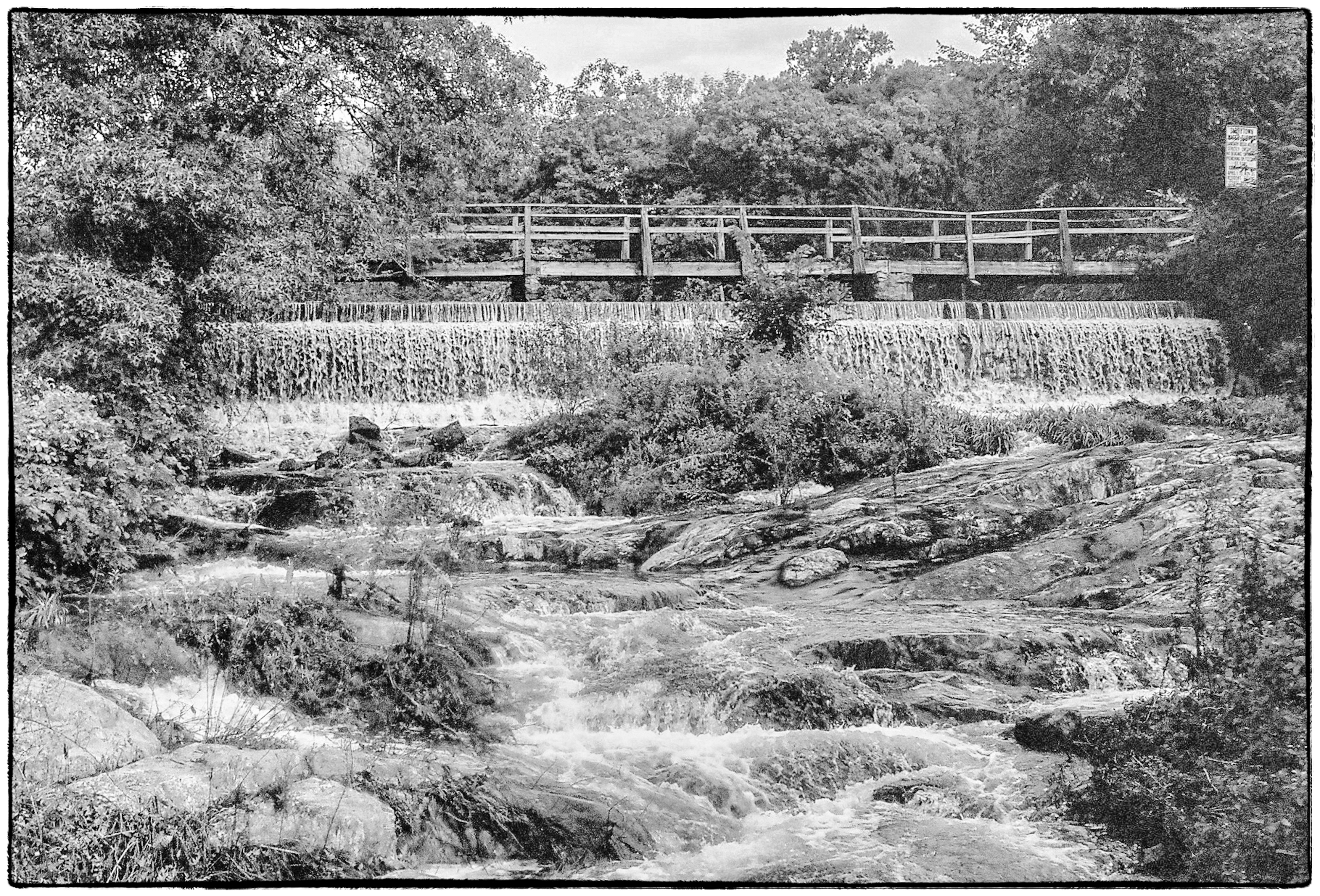
Tarrytown Reservoir

As I recall this was taken in the early days of my camera collecting (September, 2011 I think) with a Zorki 4 rangefinder camera and a 50mm f/2 Jupiter-8 Former Soviet Union lens – one of the earlier chrome models. I believe the film used was Kodak T-MAX 400, but I’m not entirely sure. I believe this to be so because I have a note saying that it is. However, it doesn’t look to me like a picture taken with a Jupiter-8. It looks to me more like the other lens I was using around that time: an Industar 61.

Rickshaws, Kathmandu, 1999

Taken during a visit to Nepal in 1999 probably with a Canon AE-1 camera and I can’t recall what lens. I say Canon AE-1 because the only other camera I had at that time was a Minolta Hi-Matic 7sii. Some of the other pictures in this batch could not have been taken with the wider than normal lens on the Minolta, so by process of elimination it must have been the Canon and probably a zoom lens of some kind.

Blue and White

My wife collects blue and white china, and over the years she’s acquired quite a lot – from a variety of countries we’ve visited. She recently decided to share some of this with friends via a new Facebook page she’s made. Consequently she asked me to take a few pictures. Above blue and white on our coffee table with catmint. Here are a few more:

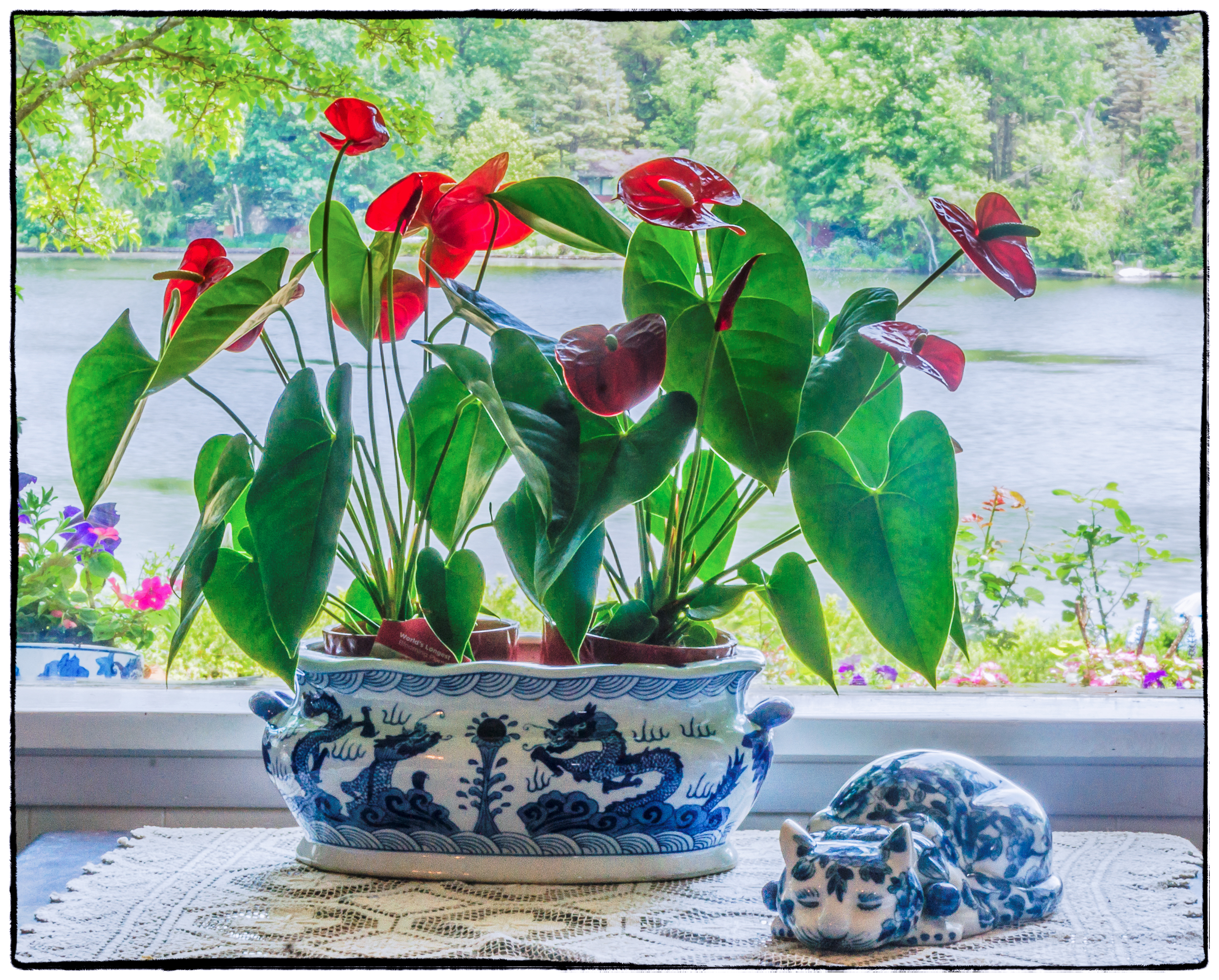
Anthurium in planter with cat.

Blue and white with orchids

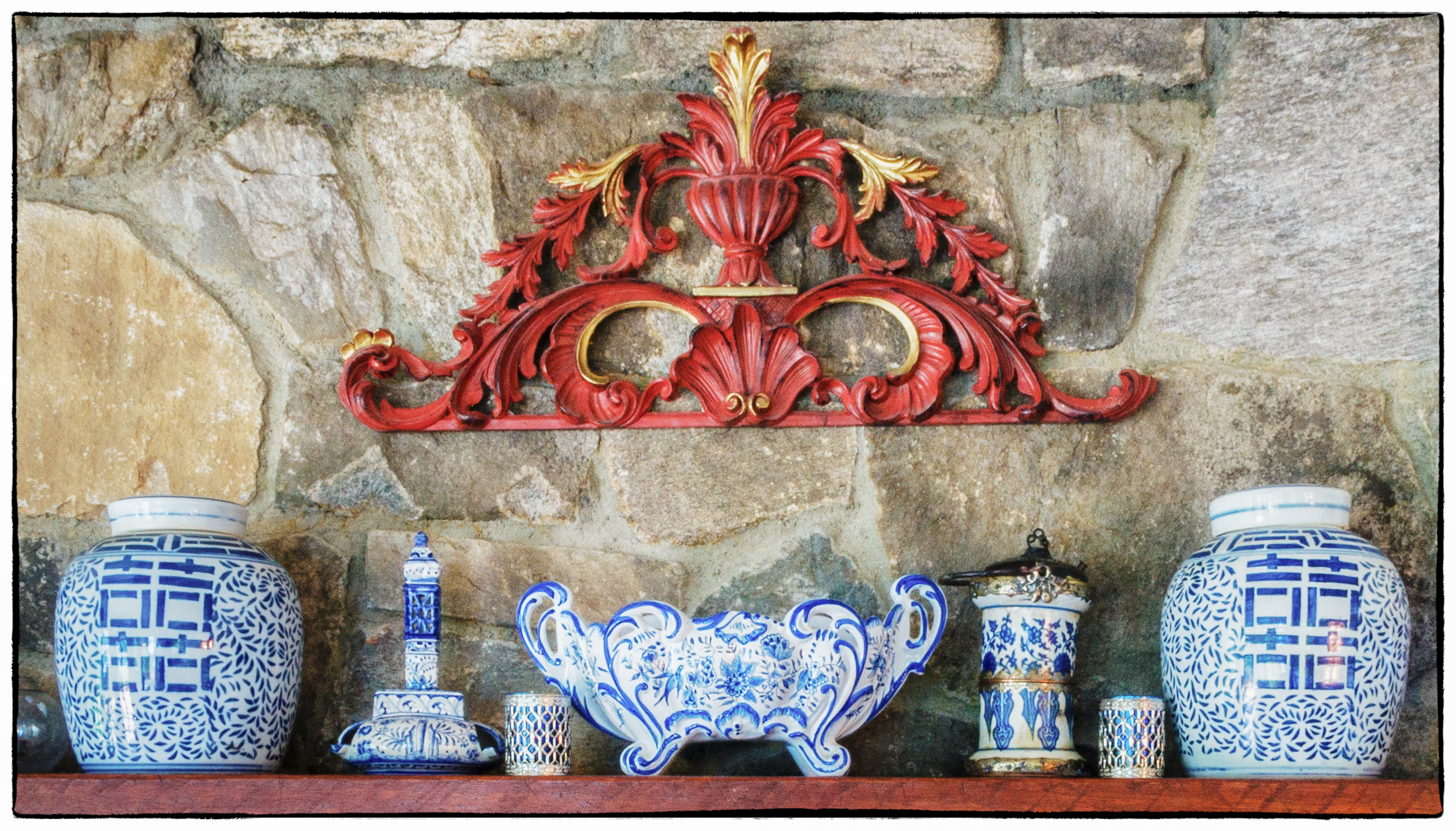
Blue and white on the mantle.

Large blue and white bas relief tile.