An Excursion to the Dutchess County Fair – Tower 34

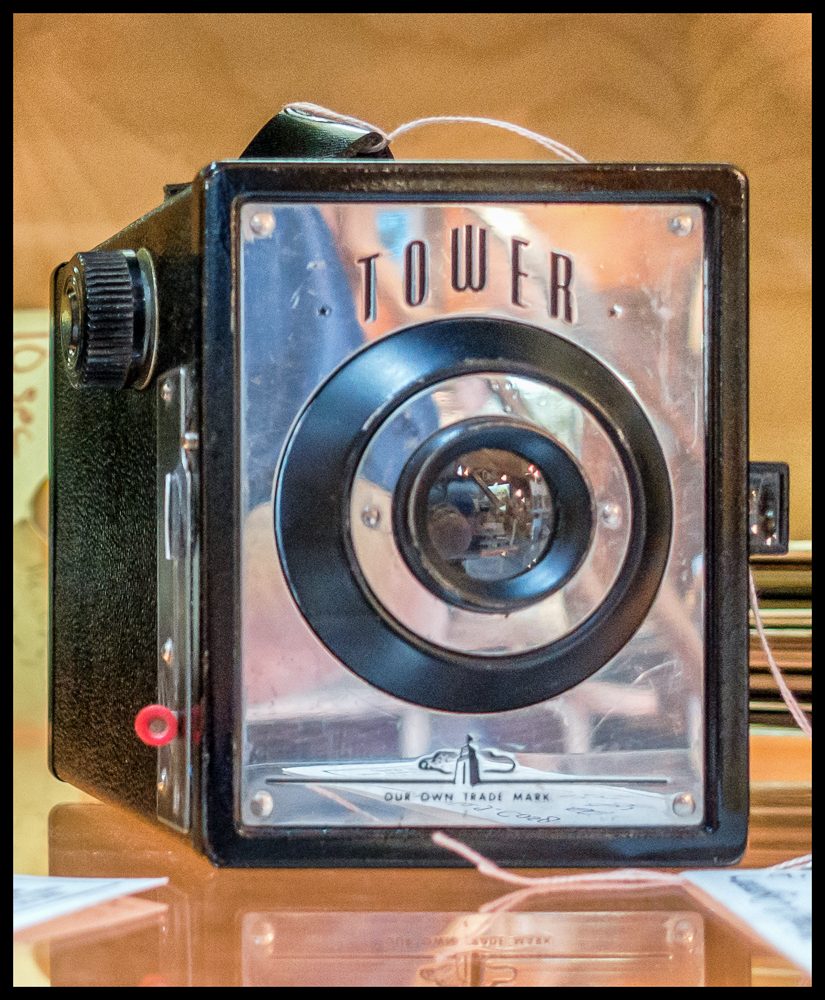
This was the camera I eventually chose (See: An Excursion to the Dutchess County Fair – An Antiques Store in Rhinebeck). There were a couple of later brownies that also take 120 film on the shelf, but in the end I decided to go with this one. It just seemed so shiny!

According to Collectiblend:

The Sears & Roebuck Tower 43 (sic. should read 34) box camera was first listed in 1948 and production ceased in 1951. The front face of this box camera is entirely chrome as is the lens ring escutcheon. This camera uses 120 type film and was sold in very great quantities by correspondence thanks to the seasonal catalogs of Sears and Roebuck. It is Ansco which manufactured it for Sears. This accounts for when it is opened, the film recommended is format 120 or B2, and B2 is the name of the 120 film by Ansco/Agfa. An optical finder is on right side of the camera and occupies the depth of the camera. The camera also has a red window in the back cover for frame count using the paper backing of the roll film, a frame advance knob that is pulled out to release the film carriage, a red shutter release lever, a two socket flash attach point, a pull out aperture tab with two stings (f/8 to f11), a shutter speed of 1/50 of a second, and it came with a leather handle. The camera originally sold for about $8.50 and $2.50 for the flash unit.

Taken with a Sony RX-100 M3.

An Excursion to the Dutchess County Fair – An Antiques Store in Rhinebeck

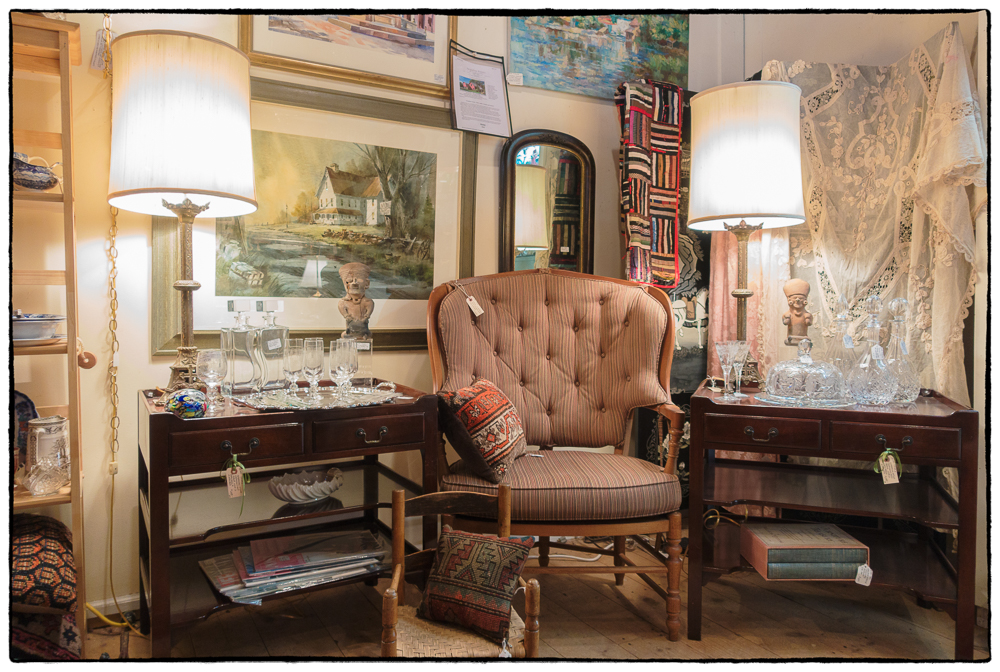
We first visited the Beekman Arms and Delamater Inn Antique Market.

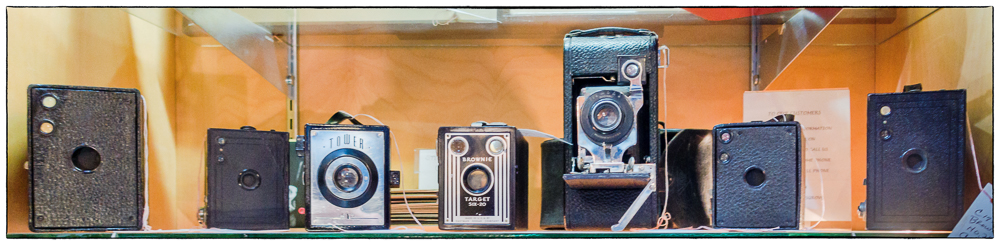
I love antiques stores, so many interesting objects and of course there’s always the chance that I’ll bump into an interesting old camera or two. I’d seen a couple of old SLRs that I wasn’t interested in and then came across a whole shelf of them that were of considerable interest!

I’m not usually interested in old box cameras, but somewhere along the line I’d acquired an original Kodak Brownie (See: Kodak Brownie). Unfortnately, it takes 117 rollfilm, which is no longer available so I can’t use it.

So I’ve been on the lookout for a box camera, which takes 120 film and here were a few of them.

Did I get one? I certainly did, but you’ll have to read the next post to find out which one.

Taken with a Sony RX-100 M3.

An Excursion to the Dutchess County Fair – Overview

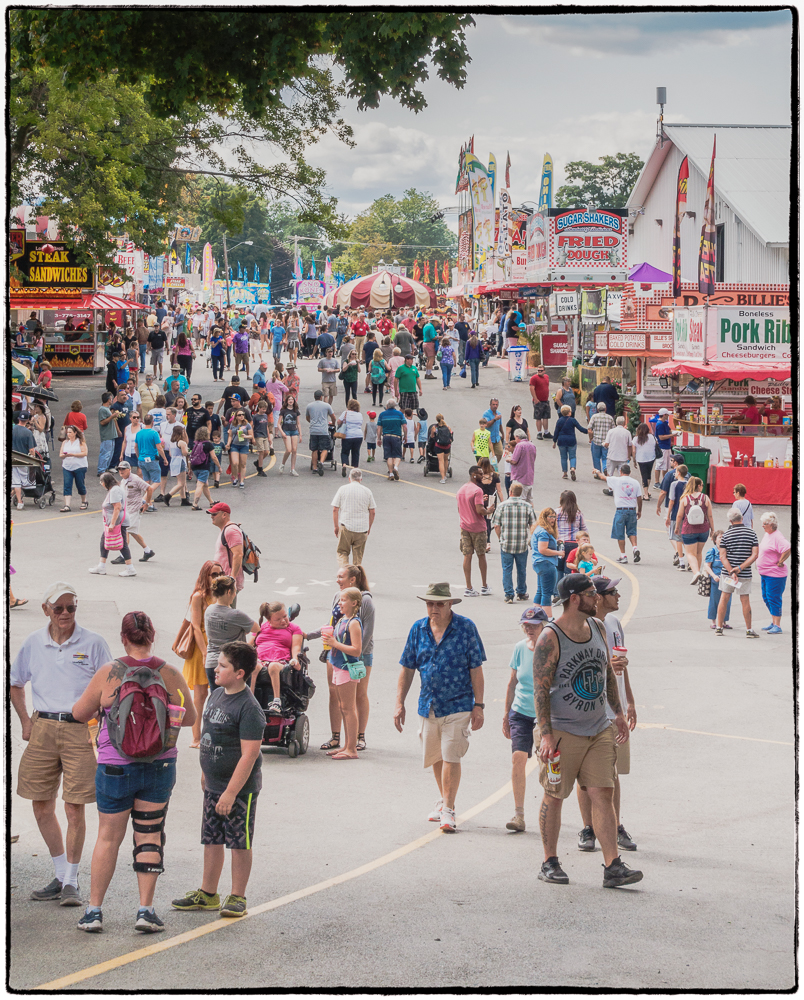
Last August we went to the Dutchess County Fair with some friends.

According to the fair’s website:

The Dutchess County Agricultural Society was formed in 1842 on a $157.00 grant from the New York State Legislature. The Society’s purpose was “to continue the development of agriculture, household manufactured items, and domestic produce.”

1842 – The First Official Fair

The first official fair was held in Washington Hollow in 1842. Many followed in that same location which is currently occupied by the barracks of the NYS police. The fair was also held off and on in Poughkeepsie in the area of what is now Mill and Catherine Streets.

By the 1900’s, the fair had suffered considerable financial challenges. This caused the cancellation of the 1916 and 1918 fairs. In 1917, the fairgrounds in Poughkeepsie was used to mobilize people on the home front on behalf of the men involved in the war effort.

In 1919 there was much question as to the future of a fair in Dutchess County. The directorate of the Society was reorganized and a new location was chosen, Springbrook Park in Rhinebeck. The relocation to the present location proved successful and subsequent fairs to this time have remained on the same location.

The Weather, Gas Restrictions, the War

Weather always affects the fair. Both the fairs of 1927 and 1928 were cancelled due to heavy rains and flooding. The Society was once again plunged into heavy debt. The subsequent Depression years continued to negatively influence the growth of the fair. The 1942 fair was cancelled due to the War.

After the 1945 fair, gas restrictions were lifted with the end of the War. The “incredible” receipts from the ’45 and ’46 fairs allowed the Society to repay its debts and make an investment in the future. After nearly 100 years of ups and downs, the Dutchess County Fair was in good shape.

In 2011 the fair was forced to close early due to hurricane Irene and an earthquake.

The Largest Agricultural 6-Day Fair in New York

In 1950, the reincorporated Dutchess County Agricultural Society, Inc. purchased Springbrook Park and renamed it the Dutchess County Fairgrounds. The facility has since grown to 147 acres. Construction on the fairgrounds over the years has been constant and impressive.

Today, the largest agricultural 6-day fair in New York State has a physical plant that is the recognized as one of the most beautiful in the country.

Our friends used to live in Staatsburg, NY not far from where the fair takes place so of our first stop was to take a look at their former house. After that we looked at some antique stores in Rhinebeck, had lunch there and took a quick look at the town. Then finally we went off to the fair.

And if by some chance there are some fellow Brits reading this the use of ‘Dutchess’ rather than ‘Duchess’ is not a mistake. That’s what the county is called. Apparently it’s old usage. The word originated c.1300, from Old French duchesse, from Late Latin or Medieval Latin ducissa, feminine of dux (for duke). It was often spelled ‘dutchess’ until the early 19th century.

Taken with a Sony RX-100 M3.

’76 House – Is it Haunted?

A couple of people have asked me if the ’76 House is haunted. According to an article in the Orangetown Daily Voice it is. The article states:

…ghost sightings and paranormal activity are commonplace at the popular establishment.

They occur, in fact, frequently enough that in staff meetings “when a glass or piece of cutlery falls off a table, someone just gets up to put it back,” said Taylor.

There are reports from staff and patrons seeing apparitions, said Taylor, retelling what Robert Norden, the restaurant’s owner for 30 years, told him about the phenomena.

The alleged figures people have reported seeing are a man dressed in military-style clothing, like a Redcoat uniform (Note: or perhaps like the one in the picture above?), among “full-grown apparitions,” particularly in the dining room that was used as the old jail.

“People in the room have seen apparitions walking through the walls and when they walked over to look for themselves there would be nobody there,” said Taylor.

“The old jail used is one of the areas we use for the main dinner for our events. It was Andre’s prison. It’s got a very interesting history. People could sit in there and it could be very warm, yet they go stone cold in the room.”

Paranormal experts have gone in with their electronic recording devices and picked up data in the room, he claimed. Much of this activity centers on a corner table, according to Taylor.

“On a serious note, you never know what awaits you. Things change. Spirits come and go from that location. It could be a (deceased) patron who would go in once a month and that’s the place they go back to. It’s not just war men. There are children there as well that have no relevance whatsoever with the Revolutionary War. When you go there the paranormal experience is so unique.”

Rudy Zayas, the general manager of ’76 House recalled some of the odd things staff has seen over the 10 years he’s been working there.

On table two he’s seen a candle lit that he’s sure was put out the night before.

“We make sure everything is closed for the night before we leave. Sometimes I come in the morning and find it lit.”

Things mysteriously move on the table as well, Zayas continued. Staff routinely wipe down and set silverware in place and places a lantern on a pewter plate as a centerpiece.

“The lantern rolls down the table sometimes to a different spot. At first staff thought people were playing games with each other but after awhile realized nobody was doing it.”

And one night at table 11 on the other side in a corner of the same dining room he thinks he saw a ghost.

“I was turning the lights off and it was just me and the bartender still here. After I turned off the light I saw a man sitting at a table in the front of the dining room. I told her to buy him a drink and turned the light back on for the customer. She turned to me and said, “There’s no one there.'”

Taken with a Sony RX-100 M3.