Documentary in Dispute

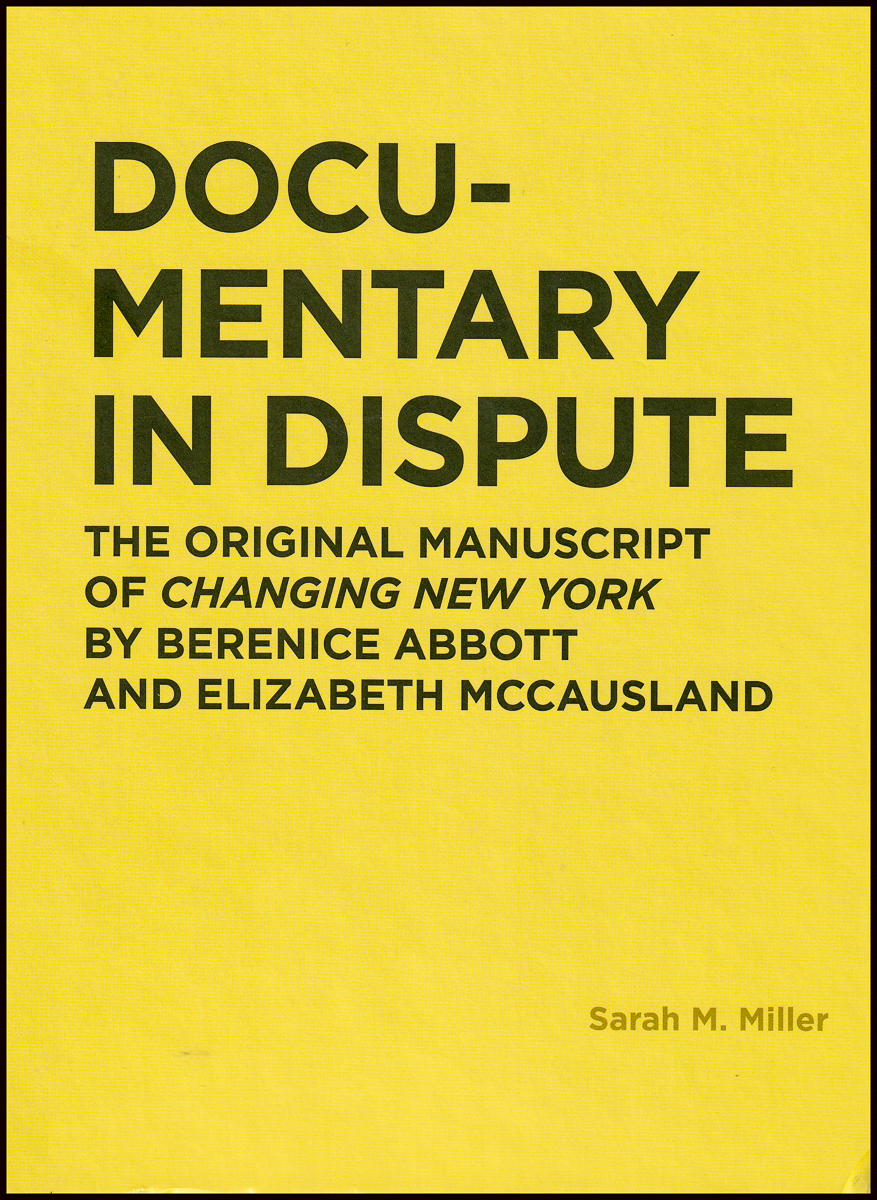
Berenice Abbott knew my idol Eugène Atget in Paris (See: Eugène Atget and Berenice Abbott) and was instrumental in saving his work after his death and making it known more broadly . Atget spent considerable time photographing a Paris, which was rapidly disappearing. On her return to New York Abbott wanted to do the same for New York. Unfortunately, things didn’t work out as planned.

The publisher’s summary describes the book as follows:

The recreation of a landmark in 1930s documentary photography.

The 1939 book Changing New York by Berenice Abbott, with text by Elizabeth McCausland, is a landmark of American documentary photography and the career-defining publication by one of modernism’s most prominent photographers. Yet no one has ever seen the book that Abbott and McCausland actually planned and wrote. In this book, art historian Sarah M. Miller recreates Abbott and McCausland’s original manuscript for Changing New York by sequencing Abbott’s one hundred photographs with McCausland’s astonishing caption texts. This reconstruction is accompanied by a selection of archival documents that illuminate how the project was developed, and how the original publisher drastically altered it.

Miller analyzes the manuscript and its revisions to unearth Abbott and McCausland’s critical engagement with New York City’s built environment and their unique theory of documentary photography. The battle over Changing New York, she argues, stemmed from disputes over how Abbott’s photographs—and photography more broadly—should shape urban experience on the eve of the futuristic 1939 World’s Fair. Ultimately it became a contest over the definition of documentary itself. Gary Van Zante and Julia Van Haaften contribute an essay on Abbott’s archive and the partnership with McCausland that shaped their creative collaboration.

In my opinion this is a very accurate summary of the book. Will be of interest to anyone interested in the work of great photographers. The machinations (on the part of the publisher and others), which prevented this book being published in its original form are a real eye opener. Wonderful book! I really enjoyed reading it.
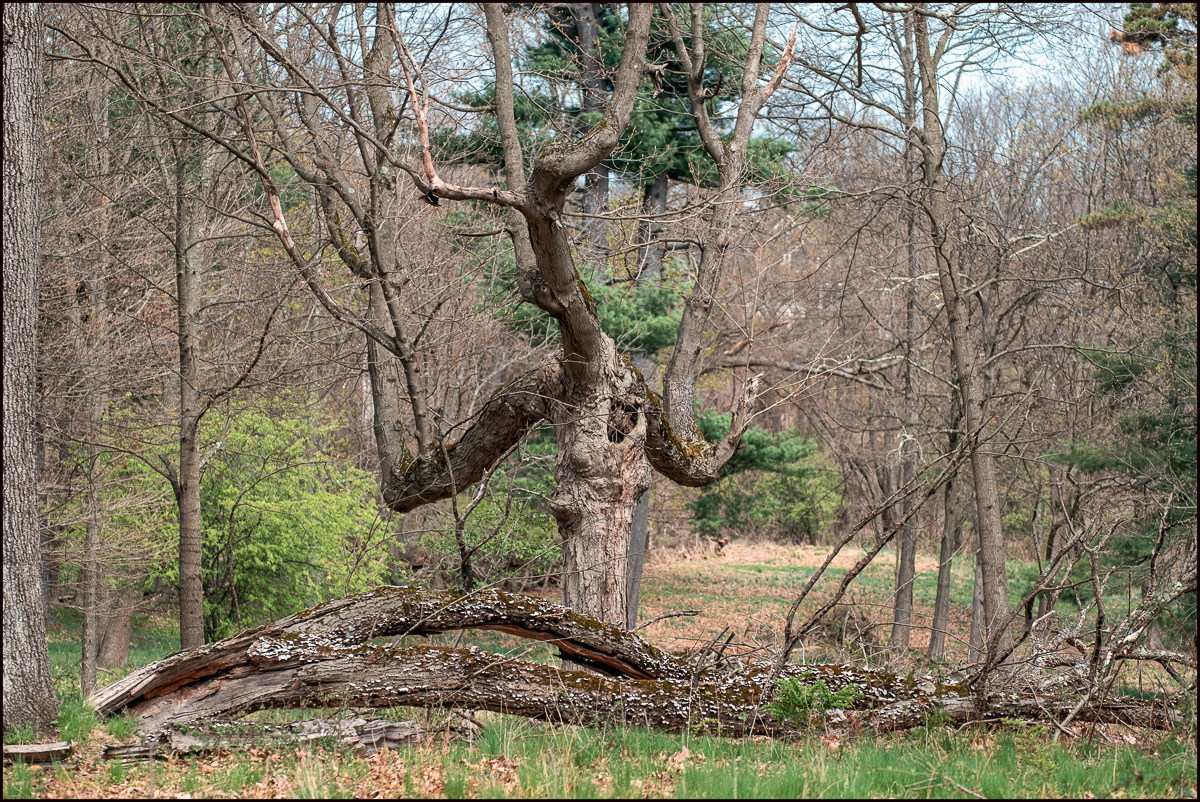
Around the Neighborhood – Treeman Lives!

Last November I posted about strangely human looking tree that I called Treeman (See: Around the Neighborhood – Treeman). I’m pleased to report that, despite tree limbs and in some cases entire trees falling around him/her/it, he/she/it made it through the Winter unscathed. Had even one of the major limbs fallen the whole effect would have been spoiled.

Taken with a Fuji X-E and Fuji XF 55-200mm f3.5-4.8 R LM OIS

Cat on a Balcony

My new cat, Isa is a house cat and doesn’t like to go outside. However, like my previous cat, Gypsy (also a house cat who didn’t like to go outside) she’s willing to go out onto the balcony outside my bedroom.


On the prowl

Enjoying the sun.

Cleaning time

Unfortunately my dog, Harley also loves being on the balcony

Is she going to let him pass by

Taken with a Sony A7IV, Sony FE 28-75 f3.5-5.6 OSS and Tamron Di III VXD A056SF 70-180mm f2.8.
.

More flowers in the woods

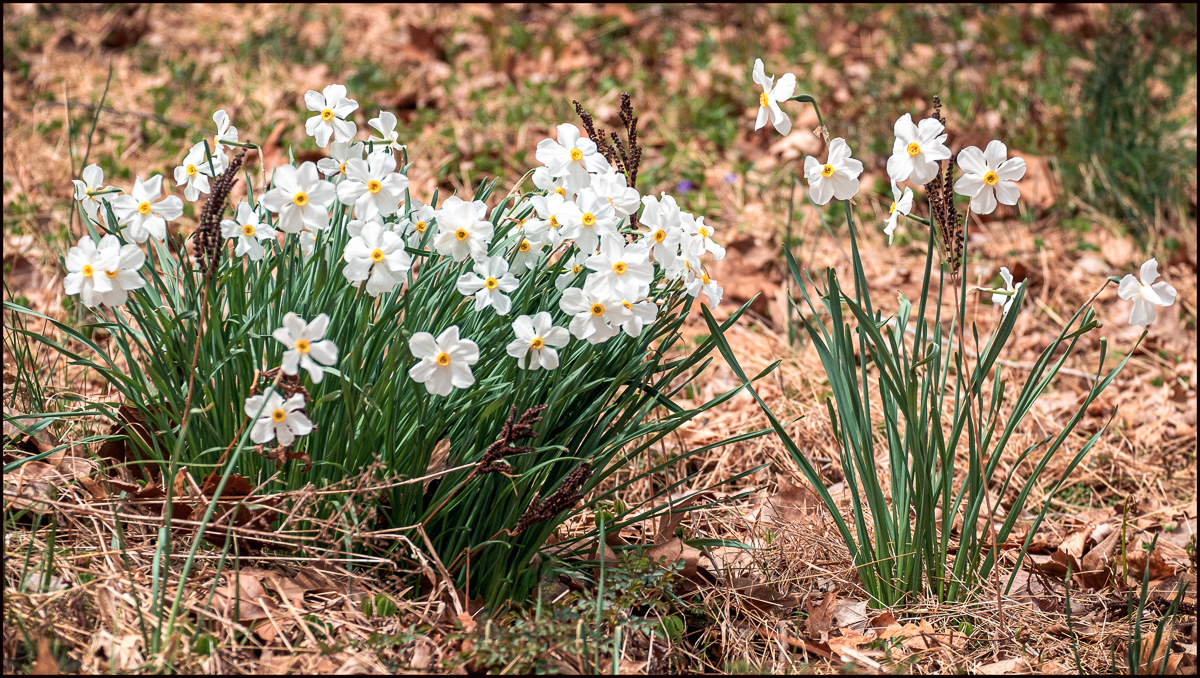
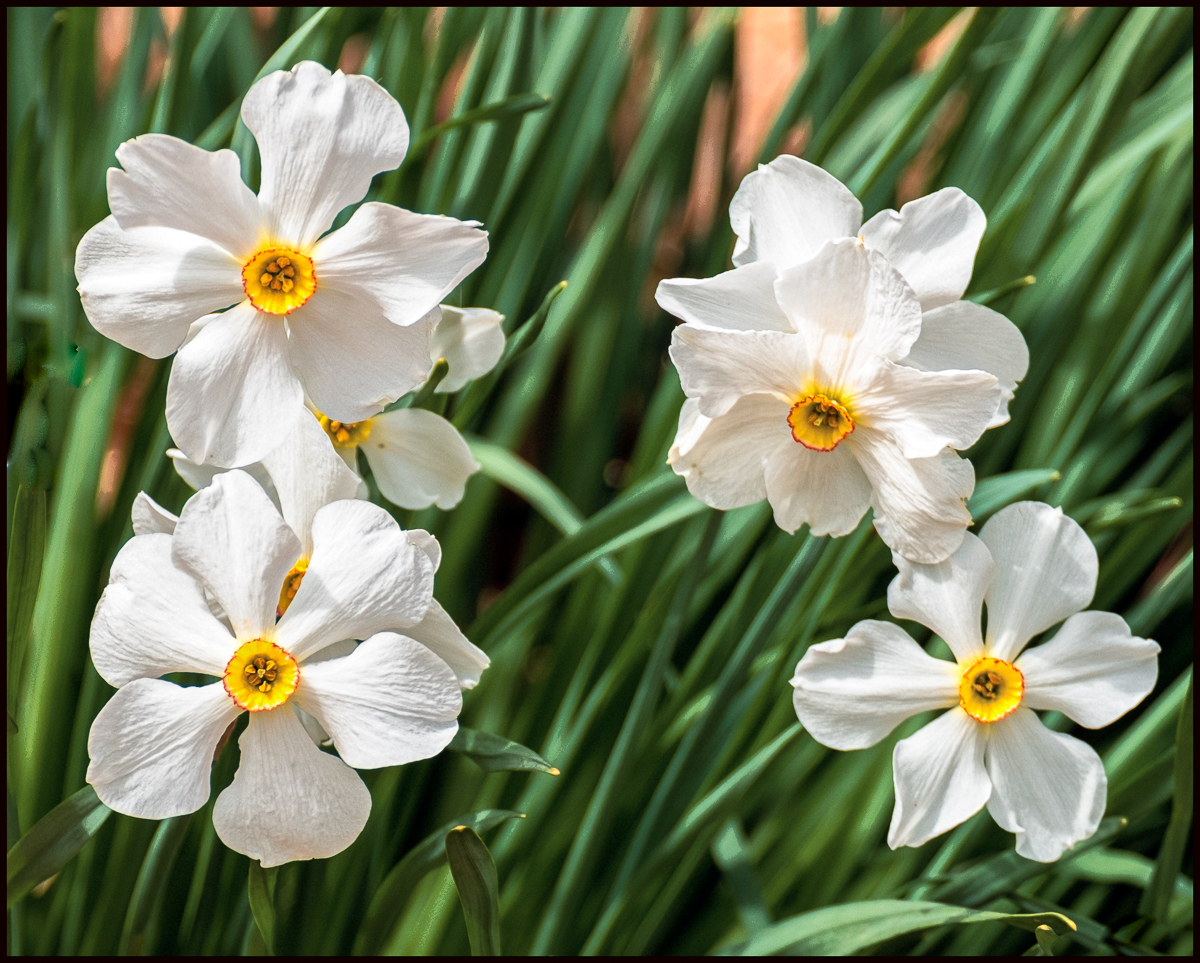
In an earlier post (See: Daffodils in the Woods) I mentioned that I’d come across some clumps of daffodils in the woods. These were only a short distance away from the daffodils. They must have just bloomed because I’d never seen them before. In the landscape they’re so striking that I don’t think I would have missed them. I don’t know much about flowers but some internet searching leads me to believe that they are Poet’s Narcissus (a relative of daffodils). Whatever they are I really like the way they look.

Narcissus poeticus, the poet’s daffodil, poet’s narcissus, nargis, pheasant’s eye, findern flower or pinkster lily, was one of the first daffodils to be cultivated, and is frequently identified as the narcissus of ancient times (although Narcissus tazetta and Narcissus jonquilla have also been considered as possibilities). It is also often associated with the Greek legend of Narcissus. It is the type species of the genus Narcissus and is widely naturalized in North America.

For anyone (like me) who doesn’t know the story of Narcissus:

Narcissus, in Greek mythology, the son of the river god Cephissus and the nymph Liriope. He was distinguished for his beauty. According to Ovid’s Metamorphoses, Book III, Narcissus’s mother was told by the blind seer Tiresias that he would have a long life, provided he never recognized himself. However, his rejection of the love of the nymph Echo or (in an earlier version) of the young man Ameinias drew upon him the vengeance of the gods. He fell in love with his own reflection in the waters of a spring and pined away (or killed himself); the flower that bears his name sprang up where he died.

Taken with a Fuji X-E3 and Fuji XF 55-200mm f3.5-4.8 R LM OIS