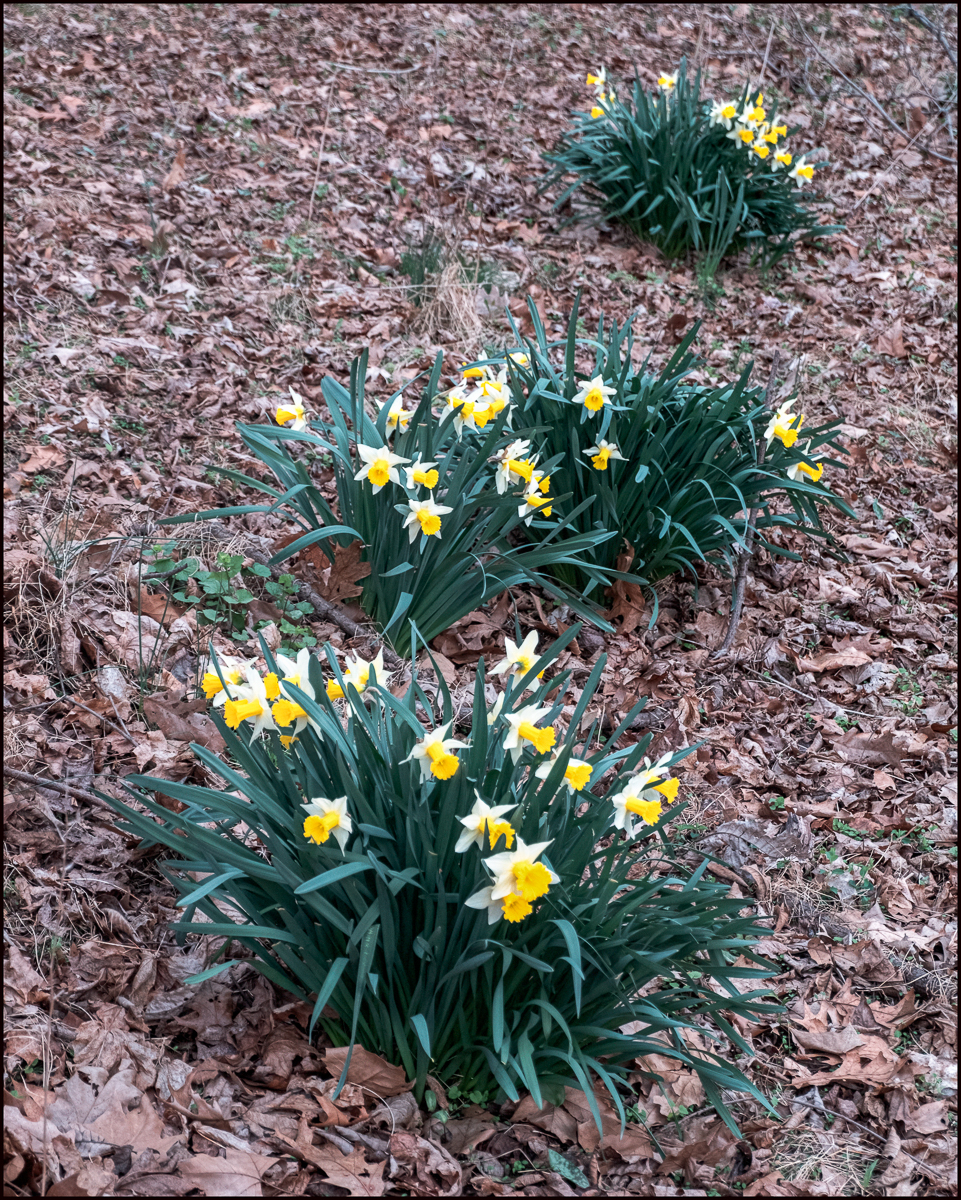
Daffodils in the woods

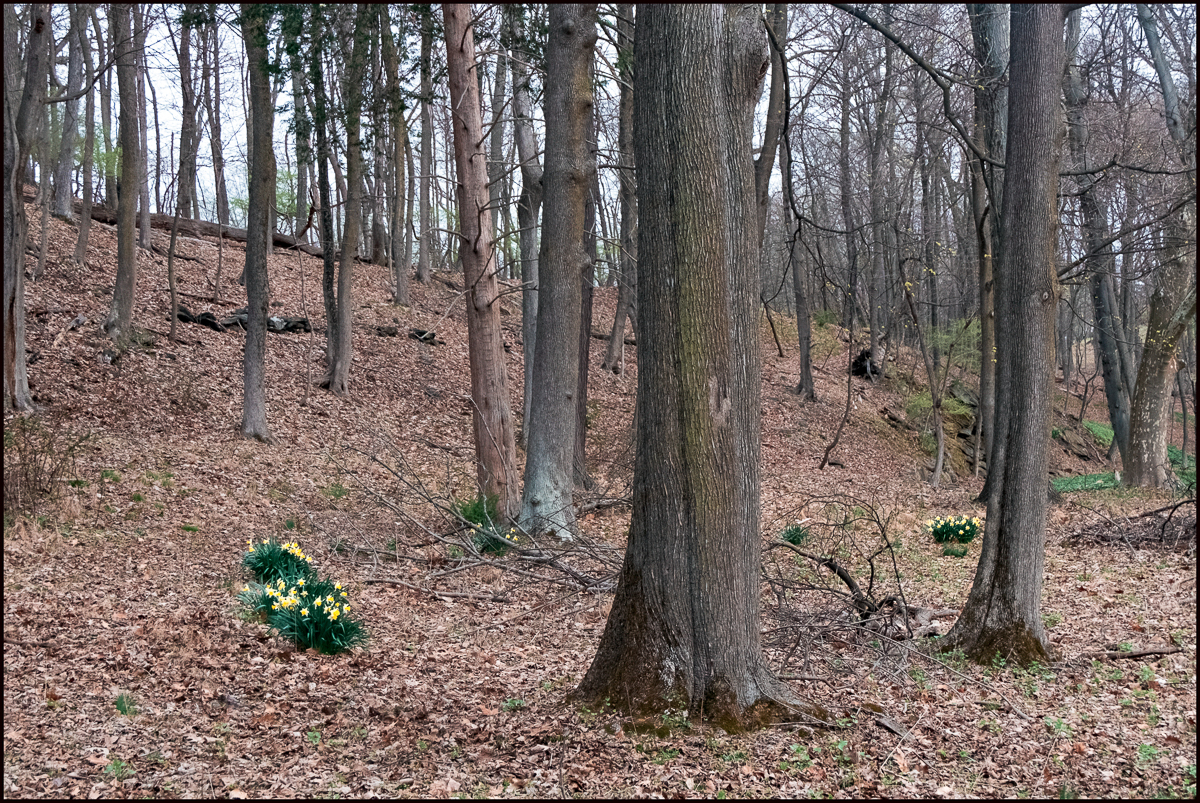
When I came across these daffodils in a nearby woodland (see photo below for context) my first reaction was to wonder how they got there. I always thought that daffodils grew from bulbs and I imagined that it would be difficult for the bulbs to easily transfer to the wild. Then I came across this:

First, the wild daffodil can reproduce by generating seeds, which is a sexual method of reproduction. The flowers must be fertilized by an outside source in order to create these seeds, and pollen is required for this process. There are two important parts to a typical plant that are necessary for this type of reproduction. The pistil contains the stigma and the female gamete, where the daffodil’s ovule is found. On the stamen of a plant, pollen is produced, which contains the male gametes. When pollen is transported from one plant to another, it drops into the stigma and fertilizes the ovules of the plant, inside its ovary. A seed then develops from the fertilized ovule. When the daffodil blooms die, the tiny black seeds are dry and ready for dispersal. The seed pod (ovary) of the daffodil cracks open, and seeds either fall to the ground or are transported by wind or animals to a new location.

Essentially any insect or organism can serve as a pollinator for the daffodil. It really doesn’t matter how the pollen gets in the stigma, it just has to come in contact with it in order to start fertilization.

From seeds, daffodils take a very long time to grow into a full plant. It can take from five to seven years for a daffodil to bloom from a planted or dispersed seed.

So there you have it: unless someone deliberately planted them in this woodland they must have grown from seeds.
Taken with a Fuji X-E1 and Fuji XC 16-50mm f3.5-5.6 OSS II
The Continuing Saga of my Cat’s name

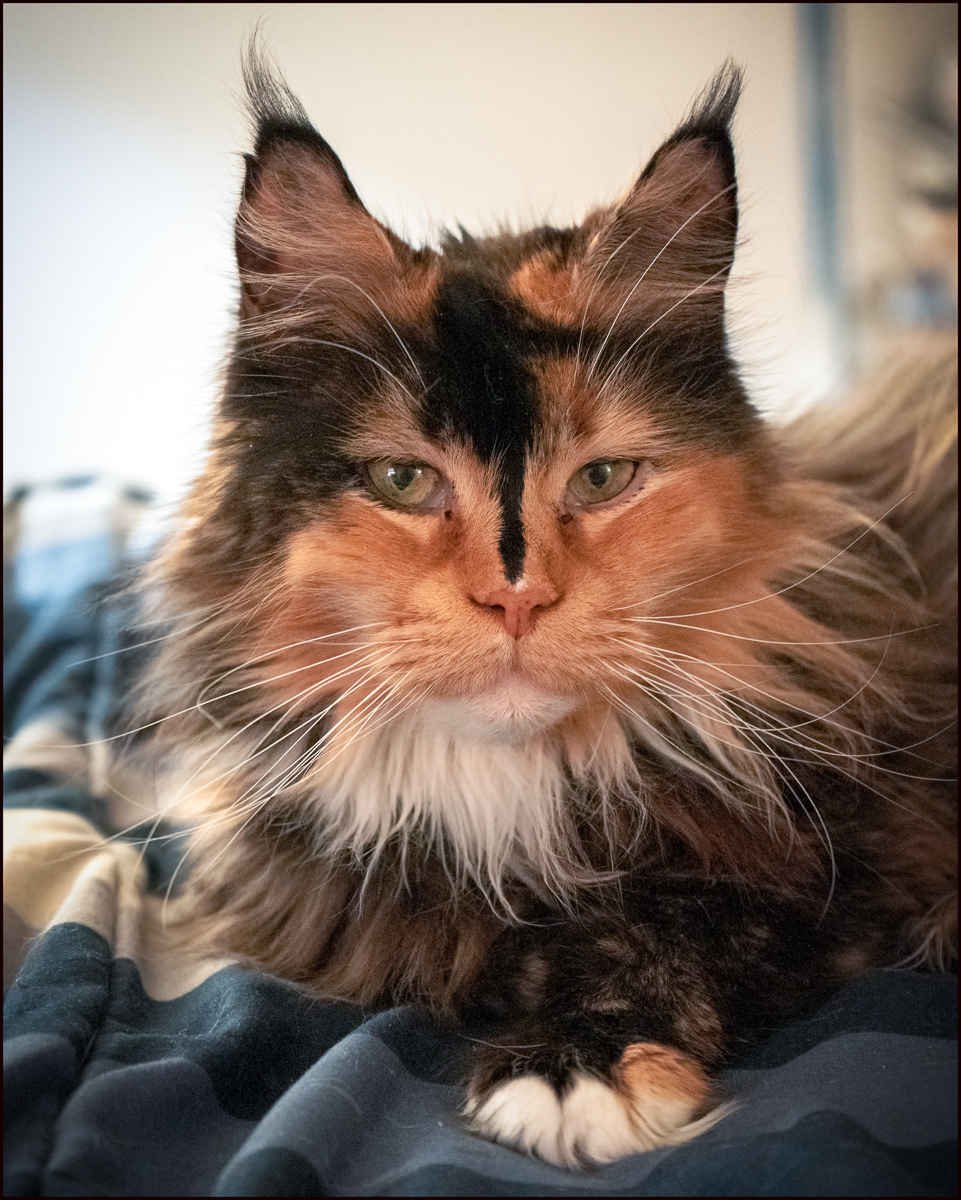
In an earlier post (See: A New Cat) I mentioned that I had a new cat whose name I planned to change. This is how things have evolved:

My previous cat, Gypsy passed away about a month ago. She was well over 17 years old and had no health problems before so she had a long and, I think, happy life.

I didn’t know whether or not I wanted to get another cat, but then I saw a post in a Facebook group. It seems that the person posting had once worked with someone who had passed away. She went to the memorial service and spoke to the deceased’s two sisters. It turned out that the deceased had left behind six Maine Coon cats. I’ve always loved Maine Coons and had always wanted to have one and I couldn’t resist. I contacted one of the sisters who invited me to come over, take a look at the cats and pick one that I liked. So off I went. I chose a cat and the sisters told me her name was Sophie, a name I didn’t much care for. I took the pictures and shared them with friends and family. Nobody thought she looked like a Sophie, which as it turned out she wasn’t. The sisters had got their cats mixed up and the one I chose was actually called Ramona, another name I didn’t really like.

I asked for suggestions and people referred to her as powerful; exotic, regal; mystical; ancient goddess A couple of people suggested Isis. I’ve been fascinated by ancient Egypt since I was a child. I love Egypt and I’ve been there several times. Then I read that Isis was known as the goddess of the moon. As goddess of life and magic, she protected women and children – so a UNICEF connection. But then it occurred to me (and a couple of other people) that Isis might be confused with a certain Islamist militant jihadist group of the same name rather than the ancient Egyptian goddess.

I did a bit more research on the goddess, Isis and found this:

“The English pronunciation used, /ˈaɪ.sɪs/), comes from the pronunciation of the Greek name, Ίσις, which changed the Egyptian name by adding a final “-s” because of the grammatical requirements of Greek noun endings.The Egyptian name was recorded as ỉs.t or ȝs.t. It meant ‘(She of the Throne)’. However, the true Egyptian pronunciation is not known because their writing system left out vowels. Based on recent studies, the reconstructed pronunciation of her name is *ʔŪsat (ooh-saht). Later, the name in Coptic dialects was “Ēse” or “Ēsi”.To make it easier to say, Egyptologists choose to say the word as “ee-set”. Sometimes they may also say “ee-sa”. This is because the last “t” in her name was a feminine (female) suffix which is known to have been dropped in speech in the last stages of the Egyptian language.” (From the oracle Wikipedia).

So I’ve decided to call her ‘Isa’

Taken with a Sony A7IV and Sony FE 28-75 f3.5-5.6 OSS.

An odd shaped building

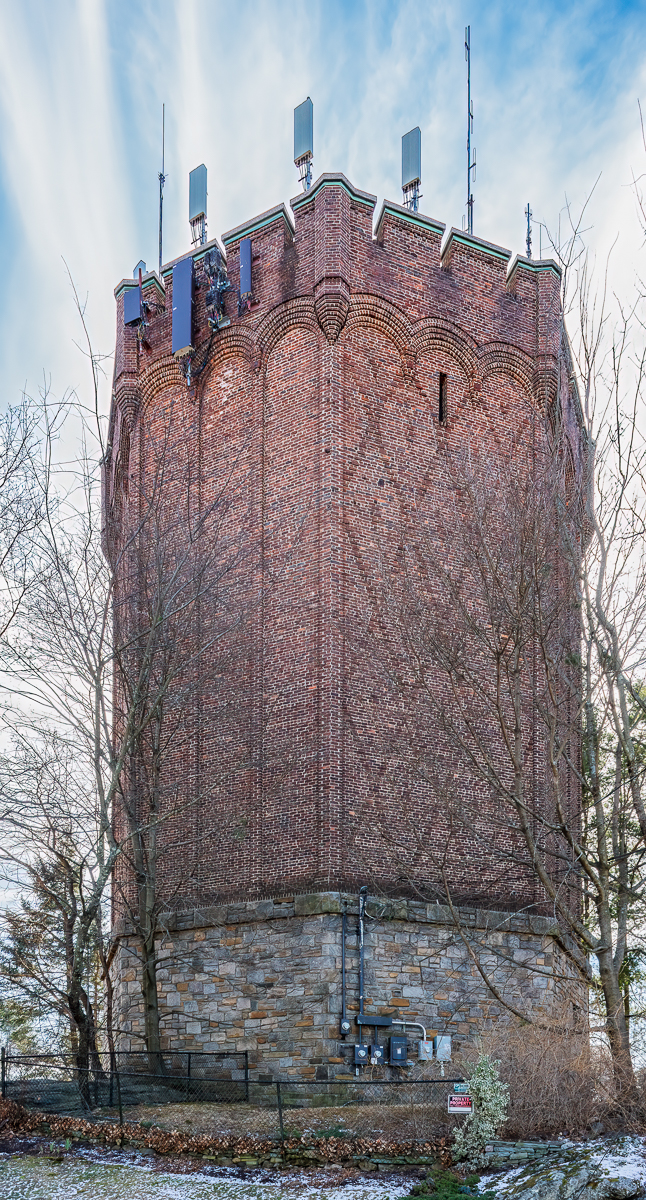
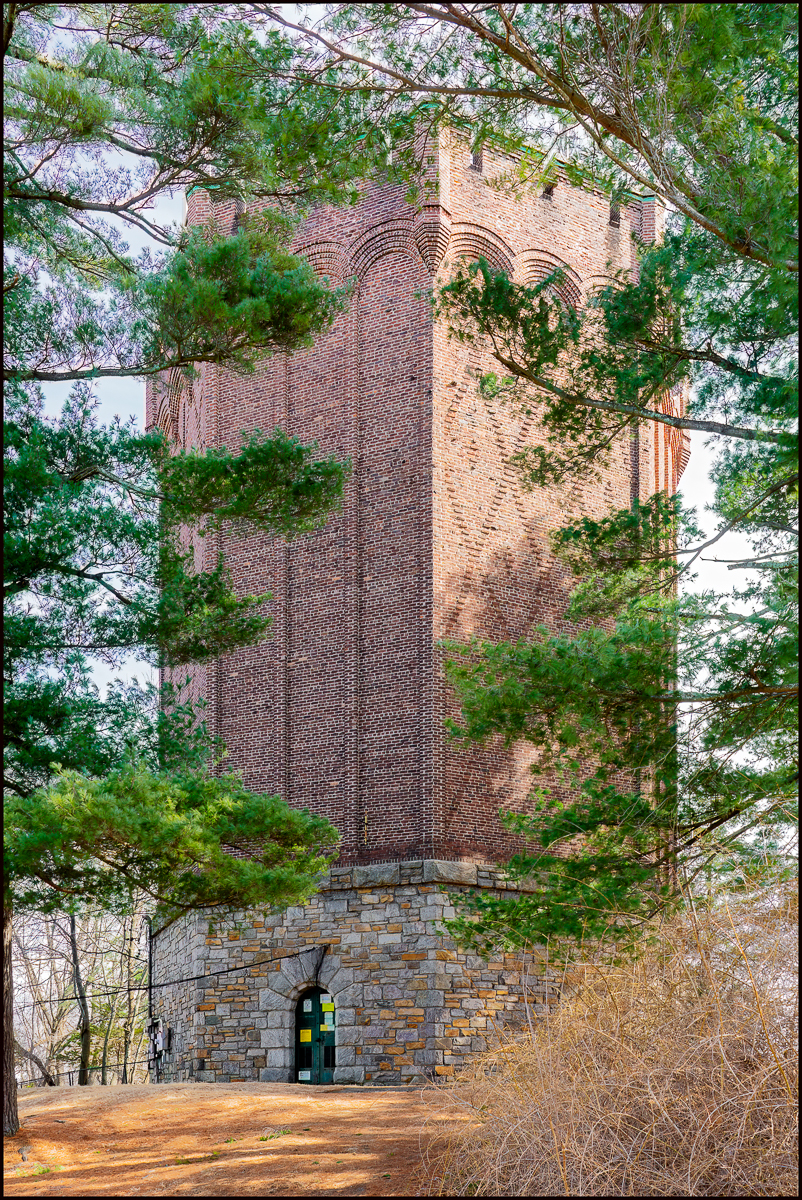
I’m always looking for interesting locations where I can walk and take photographs. One technique I use is to browse Google Maps looking for parks, walking trails or anything else interesting. On this occasion I spotted an odd, hexagonal shaped building. My curiosity was piqued and the building was quite close so I decided to walk over and take a look at it.

At the moment it seems to serve as a base for antennae of various kinds, but it looks old enough to once have been something else. As I was standing, observing the building a woman and her dog walked by. On discovering that she lived nearby I asked if she knew what it was. She replied that she thought that it might have been a water tower.

Searching the internet for additional information has so far not yielded any results.

Taken with a Sony A7IV and Sony FE 28-75 f3.5-5.6 OSS.

Easter Sunday Dinner with friends Antonio and Marili.

Impressive table setting featuring beautiful tulips from the garden.


I loved the Easter bunny.


Of course there have to be Easter Get Cracking


The evening started with one of Marili’s wonderful cocktails. She’s a well known mixologist and her creations are always different and scrumptious. I was particularly fascinated by the ‘Guarapo de Piña’, a very refreshing drink made in this special vessel from fermented pineapple peel. It was delicious and very refreshing. In this case bourbon was also added. Yummy! The only problem was that it was so light and refreshing that you wanted to have more.


The pièce de résistance: Venezuelan Polvorosa de Pollo. The chef described it as: “This is the most amazing chicken pie you will ever taste. It’s a classic Venezuelan dish that dates back to colonial times. It has over 20 ingredients. And the dough is like a short bread. This was a two day event on my part, and we will be having it for the week. I followed the recipe of Armando Scannone the dean of Venezuelan cuisine, in his classic cookbook “Mi Cocina”. Delicious.


Another view of the Polvorosa de Pollo with its top crust on.


Polvorosa de Pollo with beans, eggs and plantains.

Taken with Apple iPhone 8II