During my walk along Lexington and Third avenues I came across a number of statues.
Above: The statue of Edwin Booth in Gramercy Park, erected in 1918, is one of the most notable features of the Park. The Shakespearean actor, who is seen depicted as Hamlet, was one of the most celebrated actors of the 19th century. His achievements, however, were overshadowed by his brother John Wilkes Booth, who assassinated President Abraham Lincoln in 1865. Decades following the incident, Edwin Booth founded the Players Club, on Gramercy Park South, as a place for actors and other creatives to congregate. Every year, on November 13th (Booth’s birthday), members of the club place a wreath on the statue. Incidentally it’s impossible to get closer to the statue than this as Gramercy Park is private (one of only two in New York City, the other one being Sunnyside Gardens Park in Queens) and only people residing around the park who pay an annual fee have a key.

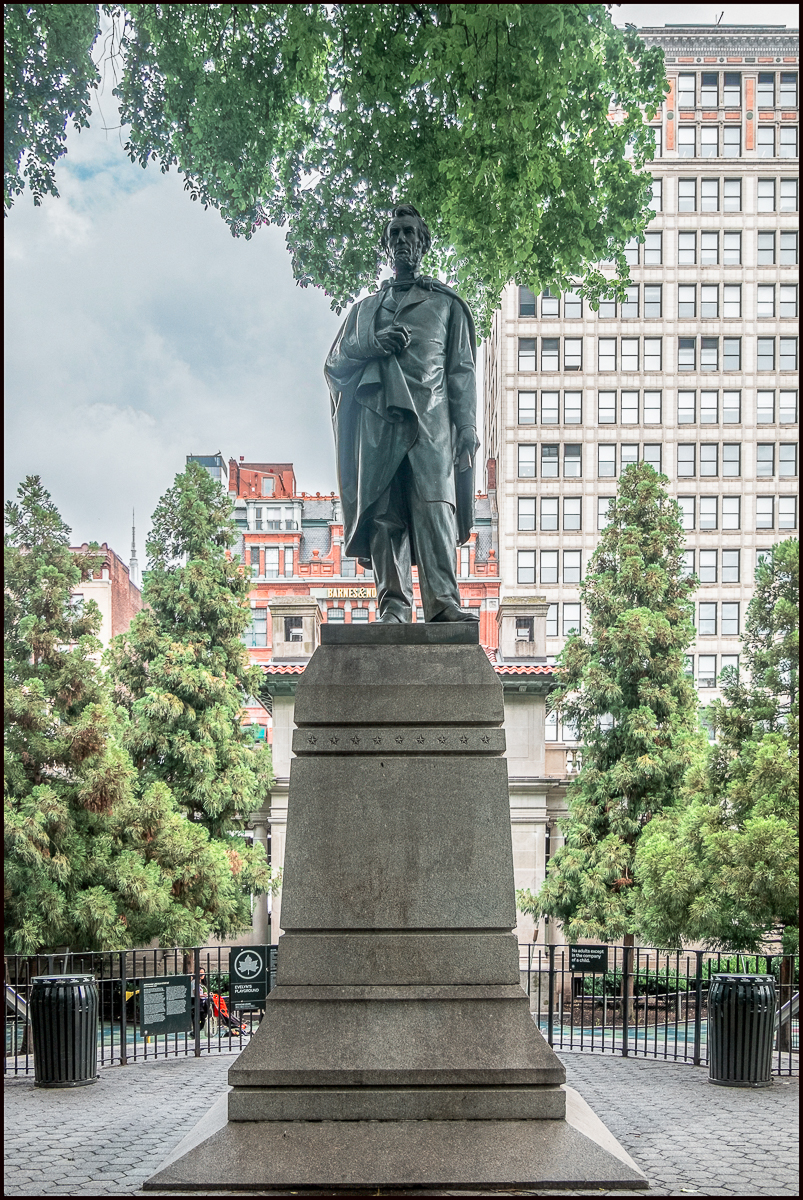
As the statue above was the brother of Abraham Lincoln’s assassin it is perhaps appropriate that the next one should be a picture of Lincoln himself. One of three sculptural renditions of Abraham Lincoln (1809–1865) in New York City’s parks, this larger-than-life bronze by
Henry Kirke Brown (1814–1886) stands vigil on a busy crossroads at the north end of Union Square Park.
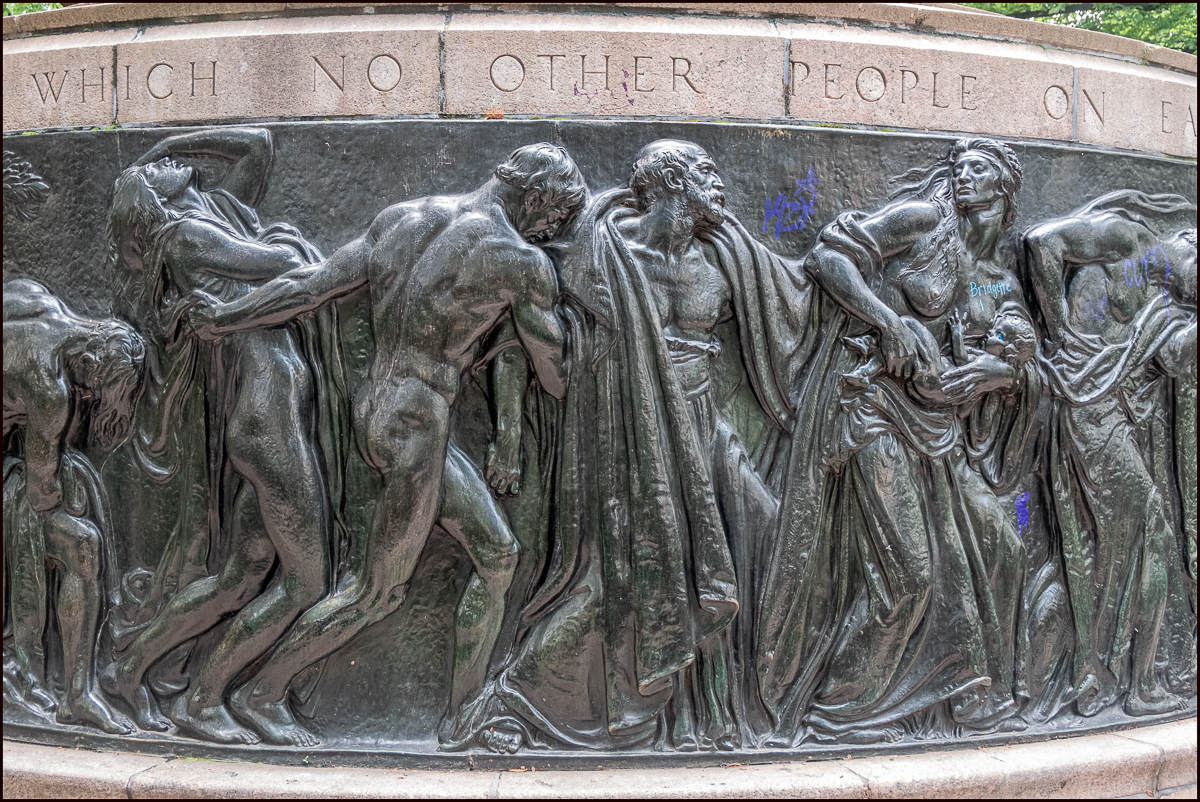
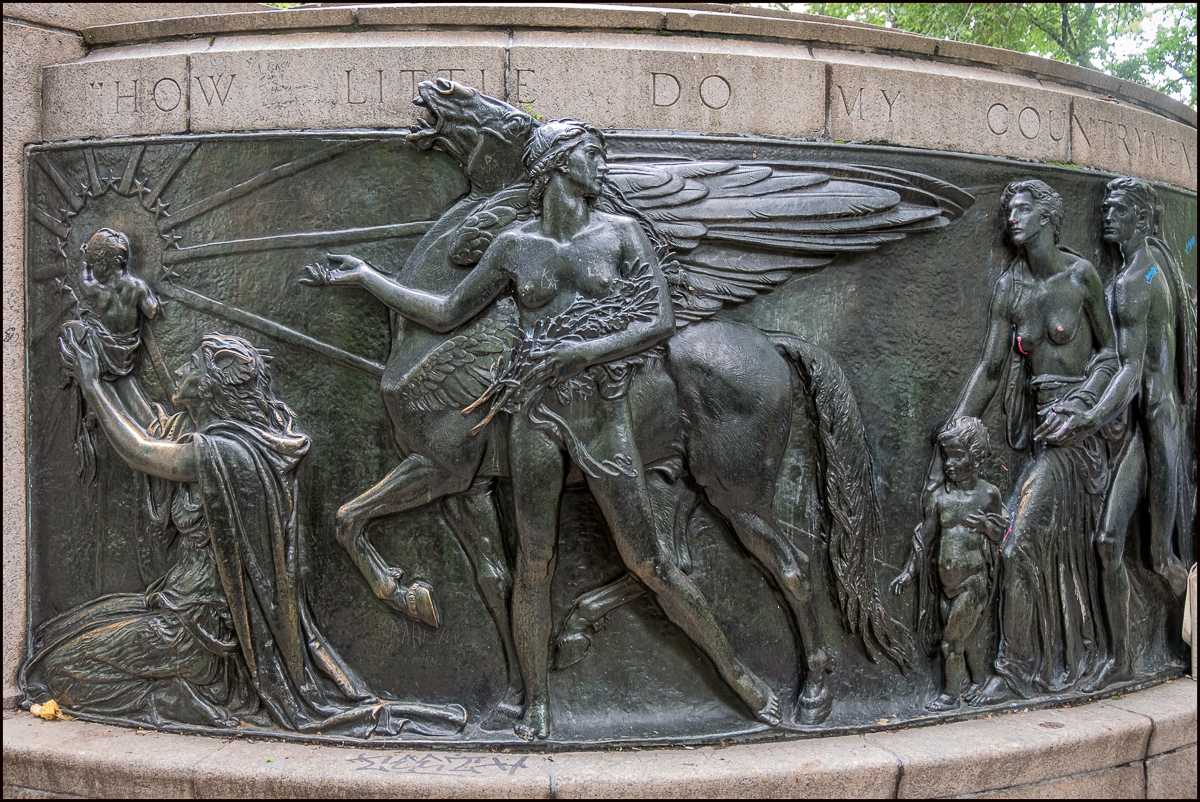
This and the next picture depict details of the frieze around the base of the Murphy Memorial Flagpole. The intricate bas-reliefs and plaques were completed in 1926 by sculptor
Anthony De Francisci (1887–1964), and feature a procession of allegorical figures representing democracy and tyranny, the text of the Declaration of Independence, and emblems from the original 13 colonies. The enormous flagpole, said to be one of the largest in New York State, is capped with a gilded sunburst.
The Independence Flagstaff was a gift of the Tammany Society, and replaced a flagstaff built during the tenure of Tammany president Charles F. Murphy (1858–1924), a boss in the infamous political machine. After Murphy’s death, Tammany supporters wanted to dedicate this bigger and better flagstaff to Murphy. Public sentiment prevented honoring a symbol of Tammany corruption in a manner commensurate with Lincoln and Washington at Union Square Park, and by the time the Murphy Flagpole was dedicated on July 4, 1930, to commemorate the 150th anniversary of the Declaration of Independence, it was referred to as the Independence Flagstaff. The flagstaff has been restored extensively through the years, most recently in 1987 when the stone pedestal was renovated and the flagpole reinstalled.


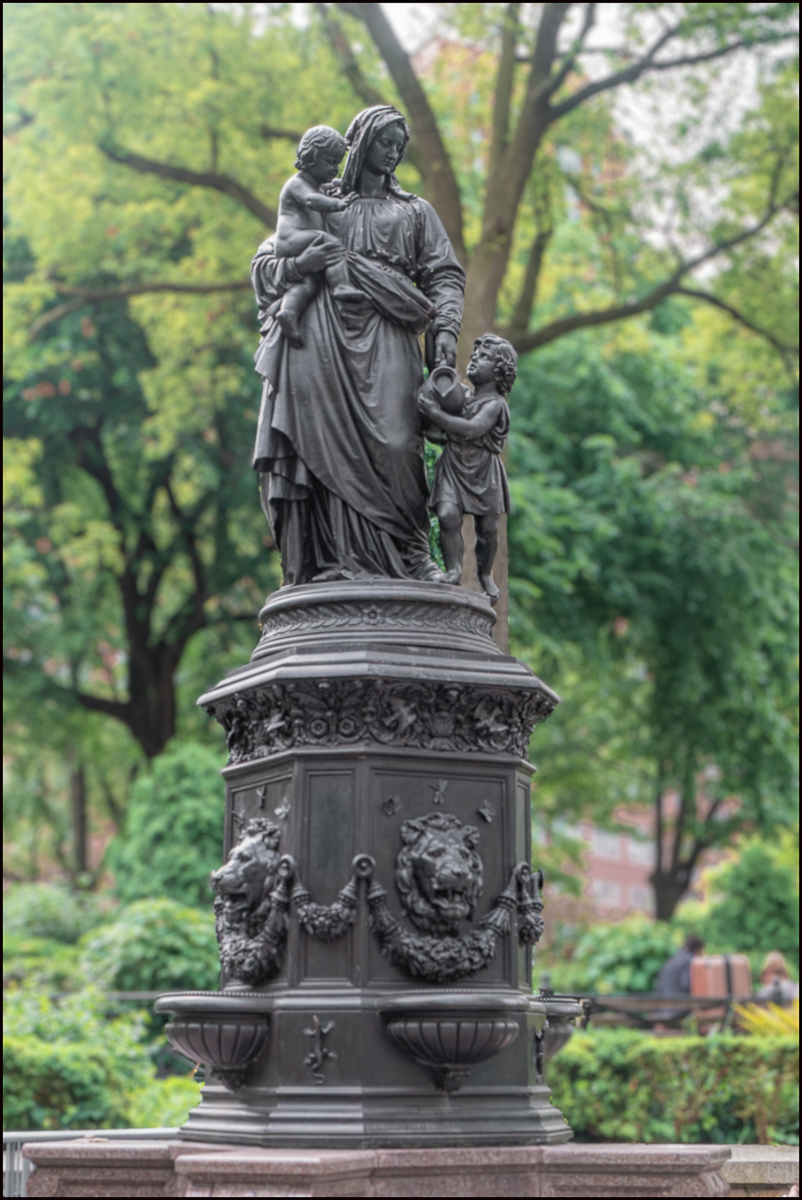
The James Fountain. The Fountain was sculpted by Karl Adolph Dondorff and was dedicated in 1881. Daniel James donated the Fountain to serve as a cure for alcoholism. It was one of a number of temperance fountains that were constructed in the city because temperance advocates believed that clean water could cure the affliction of alcohol. Tin cups, that have since been lost to time, were chained to the fountain for people to use.
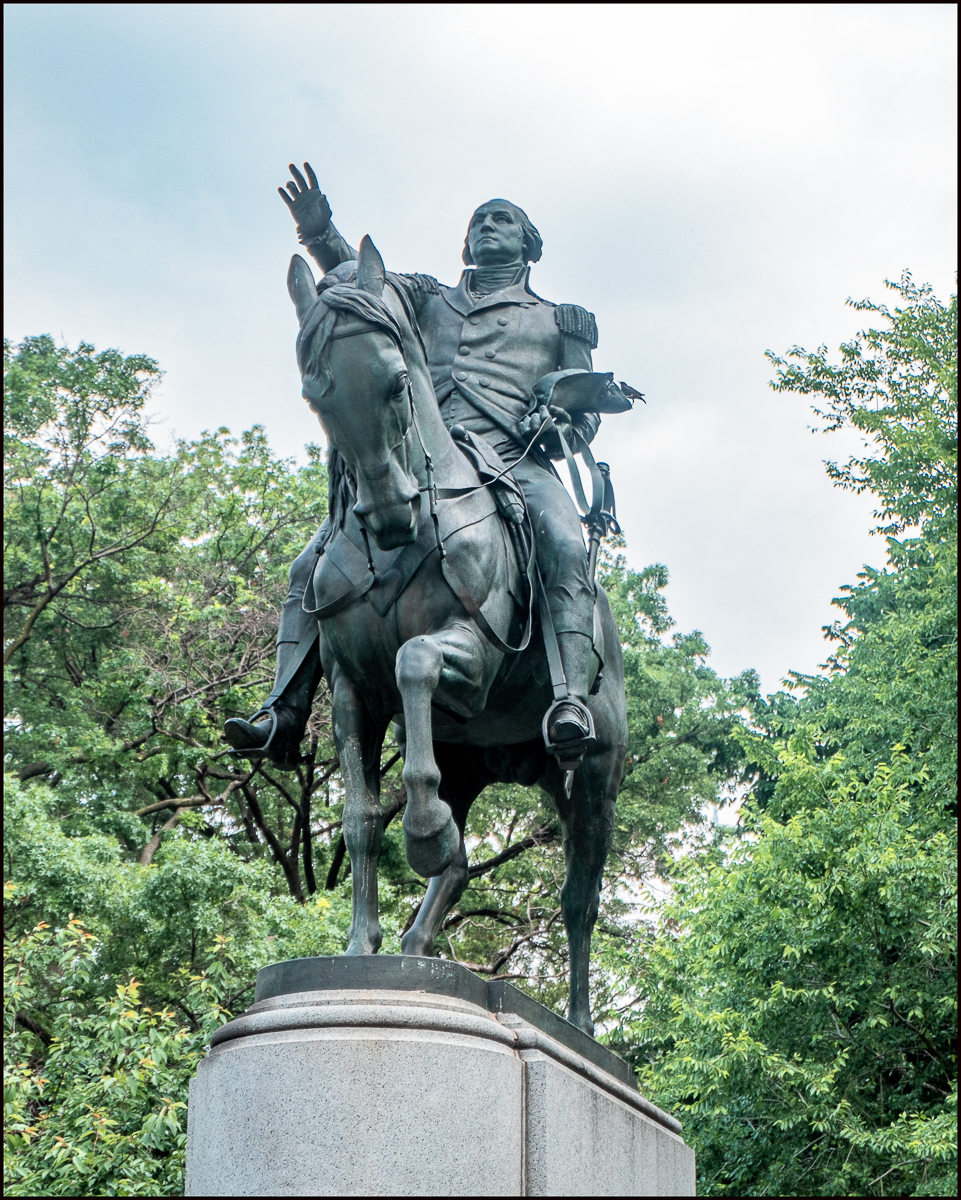
Equestrian statue of George Washington. Washington is depicted reclaiming the city from the British on November, 25, 1783, Evacuation Day (the day the British evacuated the last of their troops from New York City). The statue was dedicated on July 4, 1856, and is the oldest statue owned by the New York City Parks Department. It was sculpted by
Henry Kirke Brown and
John Quincy Adams Ward and the base was designed by
Richard Upjohn. The placement of the statue was an homage to an 1873 event in Union Square honoring Washington’s leadership in the Revolution. Apparently there are also statues of Gandhi and the Marquis De Lafayette in Union Square Park, but I must have missed them.
I came across this statue on Irving Place. It had no identifying marks and for a while I was mystified.
According to Wikipedia:
The East 17th Street/Irving Place Historic District is a small historic district located primarily on East 17th Street between Union Square East and Irving Place in the Union Square neighborhood of Manhattan, New York City. It was designated by the New York City Landmarks Preservation Commission on June 30, 1988, and encompasses nine mid-19th century rowhouses and apartment buildings on the south side of East 17th Street, from number 104 to number 122, plus one additional building at 47 Irving Place just south of 17th Street.
An unfounded local legend claims that writer Washington Irving, for whom Irving Place is named, lived in the house in the foreground house, 122 East 17th Street, also known as 49 Irving Place; also in the photo is 47 Irving Place.
Most of the houses in the district were built in the aftermath of the opening of Union Square in 1839, after which the area became one of the most sought-after residential districts in the city. The houses were primarily made in the Greek Revival and Italianate styles, while later apartment buildings in the district were in the Renaissance Revival style. By 1938, all the single-family dwellings in the district had been converted into apartment buildings.
One of the most significant structures in the district is 122 East 17th Street, also known as 49 Irving Place, which was built in 1843-44 as one of three Greek Revival row houses, along with 47 Irving Place and another no longer extant. It was extended along 17th Street c.1853-54, at which time Italianate features were added. Additional changes were made c.1868-70. Despite a historical plaque on the 17th Street facade, there is no historical evidence for the local legend that Washington Irving lived in this house, although his nephew, Edgar Irving, did live next door at 120 East 17th Street, and had a son named Washington Irving after the writer. Elsie de Wolfe and Elisabeth Marbury, called by The New York Times the “most fashionable Lesbian couple of Victorian New York” lived here from 1892–1911, and de Wolfe may have been instrumental in spreading the Irving rumor.
Of course the name of the area should have given it away. The bust is of Washington Irving. I could have kicked myself when I finally figured it out. I live quite close to Irvington-on-Hudson (the town is named after the famous author of course) and have recently been there for lunch on the river and to visit the Armour-Stiner house. I’ve been fascinated by Irving’s “Legend of Sleepy Hollow” since I was a child and have frequently visited his house, Sunnyside and his grave in the family plot in Sleepy Hollow Cemetery. I should have known it was Irving.
Taken with a Fuji X-E3 and Fuji XC 16-50mm f3.5-5.6 OSS II