A Birthday Present


In an earlier post (See: Croton Landing – Killdeer) I expressed an interest (with some reservations) about trying bird photography:

I’m quite interested in wildlife photography, but I’ve always shied away from it. There are a couple of reasons for this. First I lack the patience. Second I don’t really have the right “gear”. While I would normally make the point the “gear” shouldn’t matter that much in this case I think it does. It seems to me that without a very long and fast telephone lens taking pictures of distant animals is very difficult. And acquiring such a lens seems to be very expensive. This picture was taken at the entirely inadequate 70mm equivalent maximum zoom of the Sony RX-100. It was then heavily cropped.

Still it did stimulate my interest. Maybe I’ll see if I can find an old Minolta AF lens at a reasonable price. Then I’ll only have to come to terms with the “lack of patience” issue. It might be a good challenge.

In pursuit of this goal my wife bought me this lens for my birthday. It’s a Sigma 400mm f5.6.

I realized that it wouldn’t be a good lens in low/dull light and when it arrived we were going through a period of gloomy, rainy days so I decided to wait for a sunny day to try it out. Unfortunately, there were no birds around so I did a few test shots around our garden.

It’s quite a solid lens, but at the same time not all that heavy (all of the pictures in this post were hand held). As many of the reviews I’d read pointed out it’s really an f8 lens as anything wider than that suffers from lack of sharpness. All of the pictures here were taken at f8 or smaller. It also has really bad chromatic aberration, which thankfully can be corrected fairly easily in Lightroom.

It has a built in lens shade and a sliding cover over the manual focus ring (so you don’t damage the lens by trying to manually focus the lens when the camera is in autofocus mode I imagine). It also has it’s own tripod mount. Mine also came with a polarizing filter.

I’d read that there might be compatibility problems with modern Sony cameras, but I didn’t have any problems with my Sony A77II. I’d also read that had been problems related to stripping the gears on the autofocus motor so, as advised in the articles I’d read I set the AF drive speed to slow. So far so good.

All things considered I was quite pleased (particularly since it was my first attempt with this lens). The results were better than I’d thought they would be. Now to find some birds.


Blossoms on one of our trees.

Newly acquired garden statue.

Our dog Harley.

A garden ornament.

Another garden statue. We’ve had this one for decades.

A tulip.

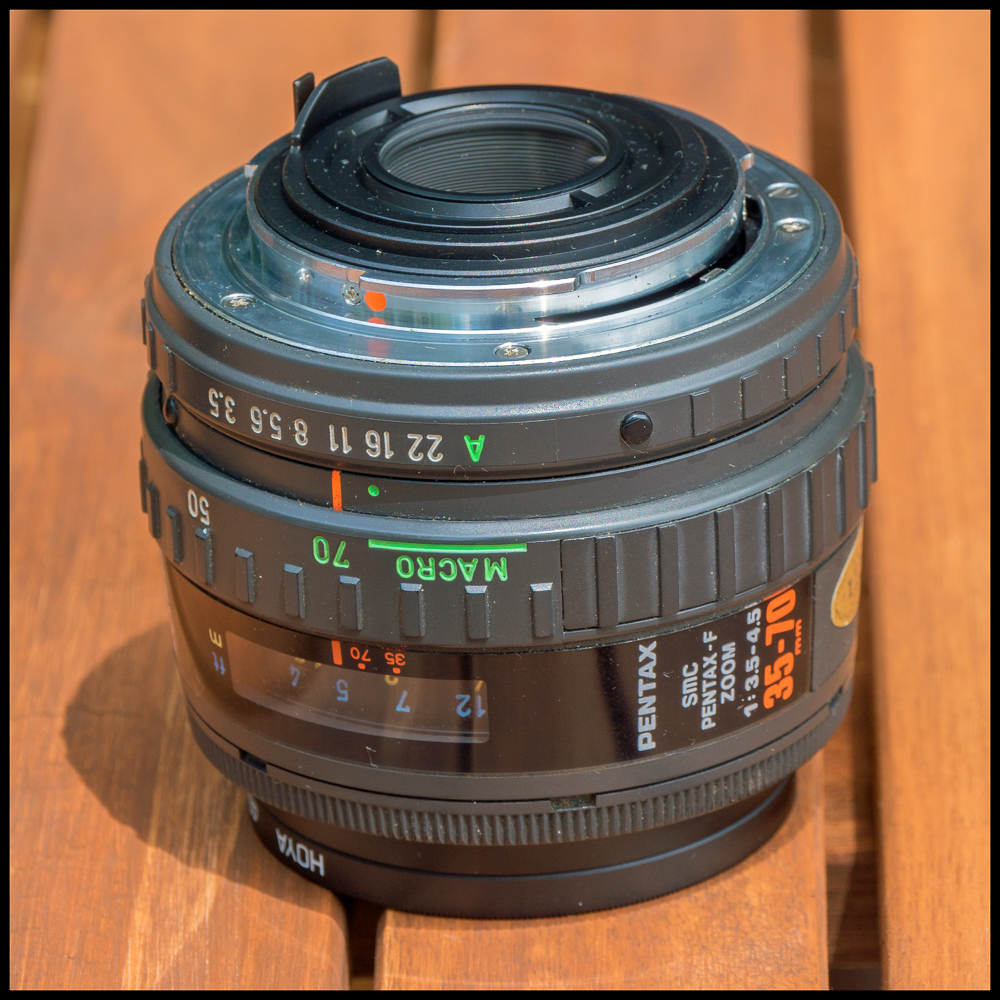
smc pentax-f 35-70mm f3.5-4.5

This is the second of the lenses that came with my ill-fated acquisition of two Pentax autofocus film bodies (See : Tamron AF Aspherical LD 28-200mm f3.8-5.6).

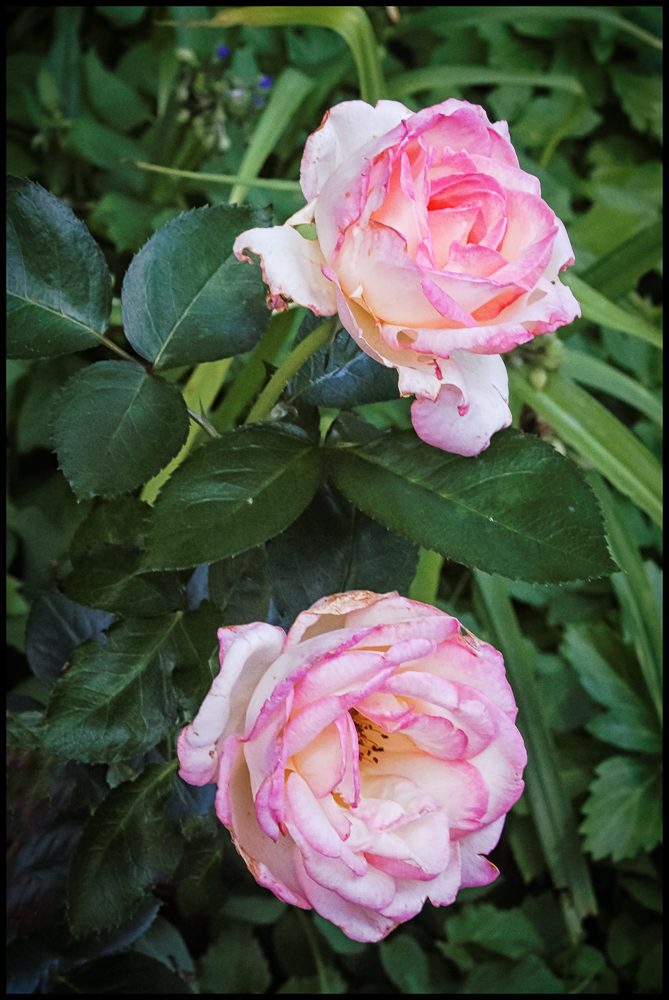
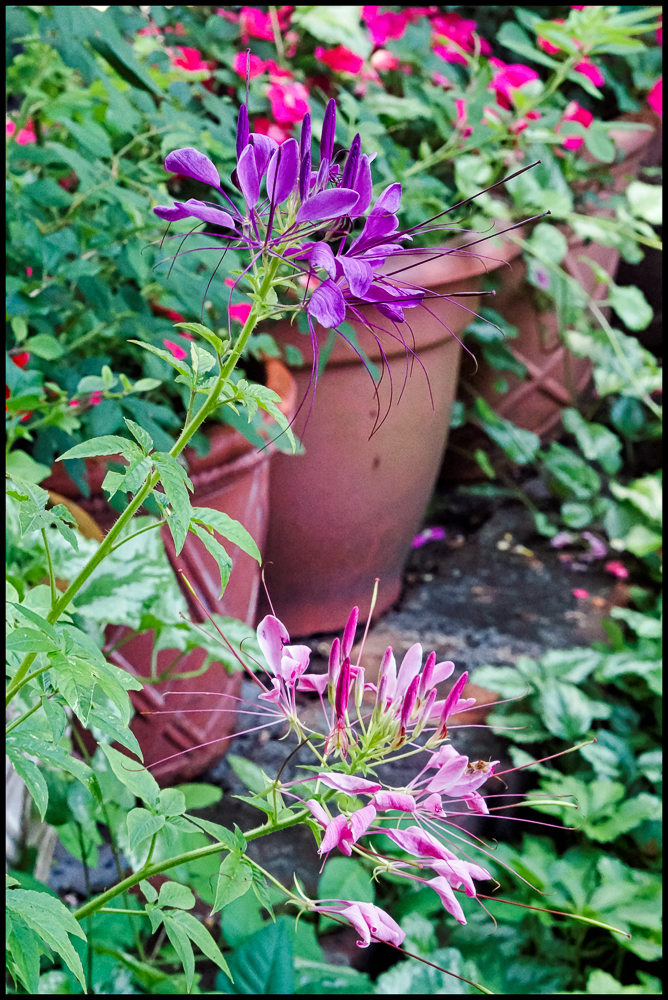
I rather like it. It’s small, light and pretty sharp throughout. Like the Tamron it’s a bit ‘plasticky’, but still feels well made and reliable. I found the colors to bit a bit flat, but nothing that a little extra contrast and saturation couldn’t cure

The zoom range is a little awkward. Because of the crop factor it’s around 52-105mm so you completely lose the wide end. The tele end provides a useful range for portraits though.

It’s not the fastest lens I’ve ever come across, but then again it’s far from being the slowest too. Autofocus is reputed to be good, but since I’ve only used manual focus (on a Sony NEX 5n) I’m unable to comment.

When I was editing the pictures I realized that something was different. At first I didn’t know what it was, but after a while I figured out that for some reason I’d set the camera for jpg rather than RAW (which is what I always use). It was now too late to do anything about it (I wasn’t going to go back and take all the pictures again) so I’ll just have to live with the lack of flexibility that comes from editing jpegs.

For more pictures taken with this lens see:

Picture of lens taken with a Sony A77 II and Tamron A18 AF 18-250mm f3.5-6.3. Pictures of flowers taken with smc pentax-f 35-70mm f3.5-4.5 on a Sony NEX 5n.

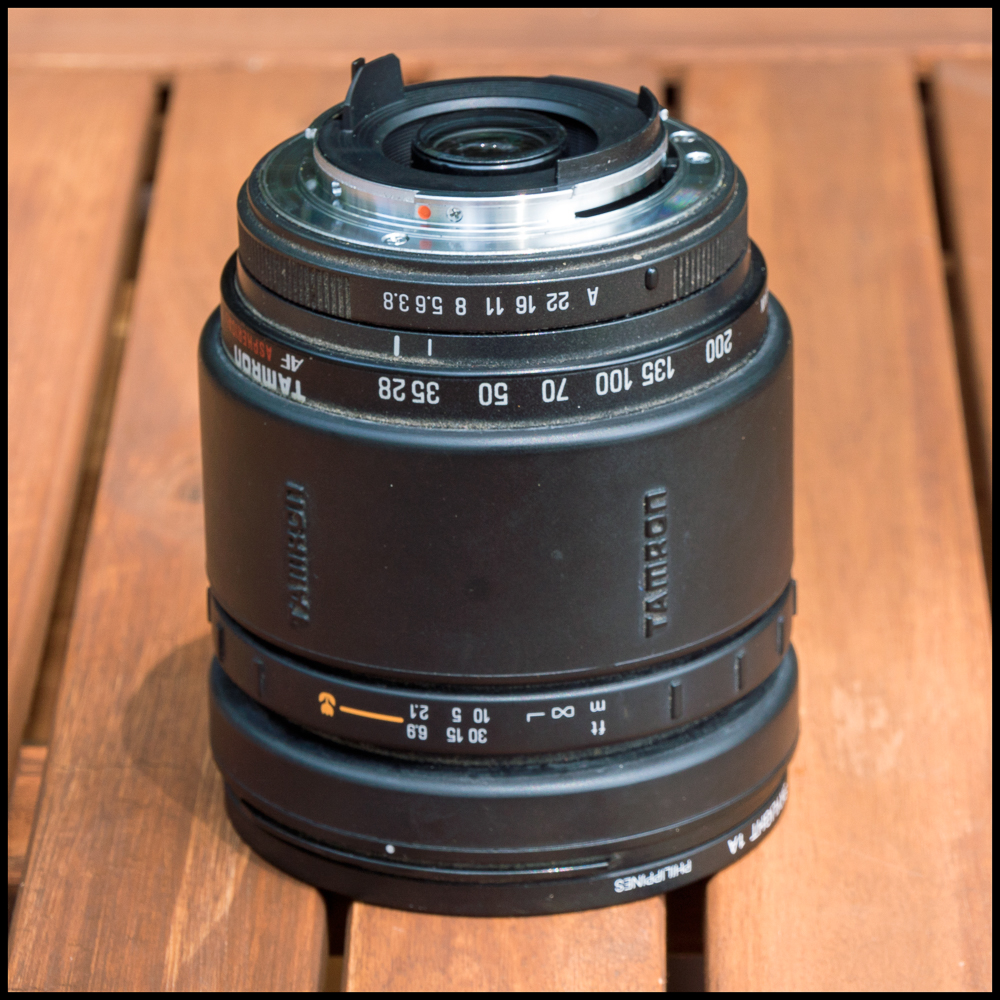
Tamron AF Aspherical LD 28-200mm f3.8-5.6

In an earlier post (See: A couple of Pentax autofocus SLRs) I mentioned that I had acquired a couple of inexpensive Pentax AF SLRs with lenses. The bodies were pretty much dead on arrival, but it seemed to me that the lenses were in working condition.

I was right: both of the lenses work fine. This is the first of them. I’m unable to comment on the lenses autofocus performance as I used it on a Sony NEX 5N where only manual focus was possible. Maybe in the future I’ll try it out on my one and only Pentax AF film body

It’s a typical superzoom lens. It has a useful range (28-200mm), although less useful than it might be on a crop sensor where it becomes a 35mm equivalent of around 42-300mm. You gain on the tele end, but pretty much lose all wide-angle capabilities.

It’s a bit ‘plasticky’, but nonetheless feels solid and well made. It’s fairly small and light for this kind of lens. The zoom lens on mine was a little stiff, but not too bad. With use it will probably loosen up. There’s something about the manual focus ring that I like though. I don’t know why.

Image quality if pretty much what you’d expect from a lens of this type. It’s fairly soft wide open (particularly so at the long end) but improves when you stop down and by f8 it’s OK. The lens tends to flare quite a lot when pointed towards a light source so a lens hood it definitely in order. The lens originally came with a hood, but my second hand copy didn’t include it. There’s a lot of chromatic aberration and both pincushion and barrel distortion at various points of the zoom range. Contrast seemed a little low and the colors seemed a little muted. Most of the above can easily be corrected in post production however. I shoot everything in RAW so I have to edit my pictures in any case.

Providing your expectations are not too high this is a decent enough lens. Of course to pack such a long zoom range into such a small, lightweight package requires significant compromises. What you gain in terms of convenience and ease of use you lose in terms of image quality. If you can accept these compromises then you’ll probably like this lens. If you can’t then you certainly won’t.

For me I quite like it. I spend quite a lot of my time walking the dog in the woods around where I live. For these walks I much prefer to have a single superzoom lens than to have to carry around a multitude of single focal length or shorter zoom lenses.

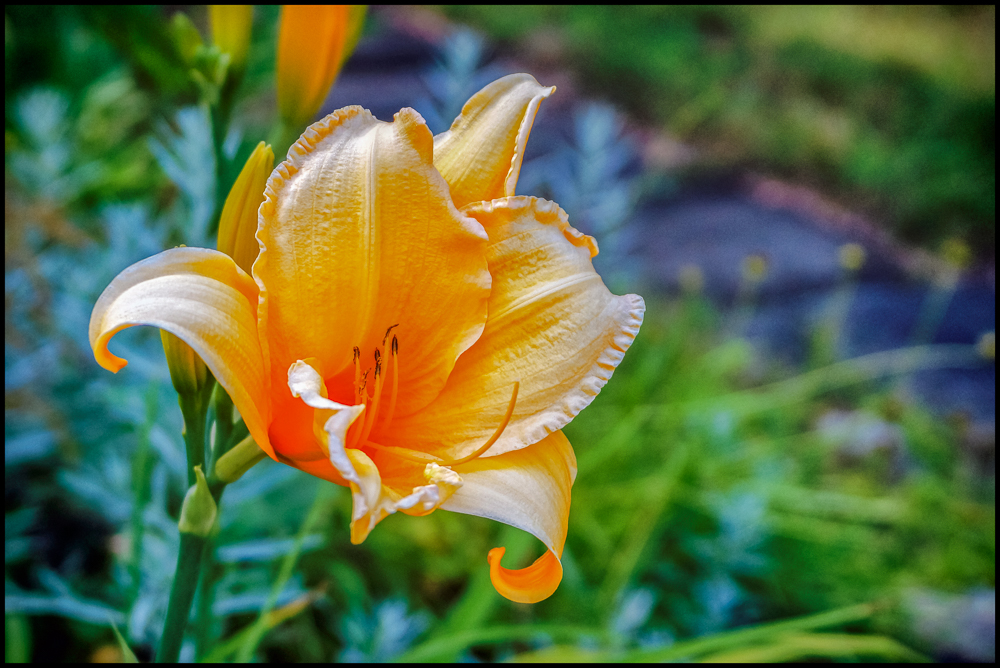
Below a picture shot using this lens of a lily in our garden.

For more pictures taken with this lens see:

Taken with a Sony Nex 5N and Tamron AF Aspherical LD 28-200 f3.8-5.6

Film Camera 2018/2 – Minolta STsi

I wasn’t really interested in another Minolta body, but what caught my eye was what came with it: A Minolta AF 50mm F1.7 Lens; Minolta AF Zoom 28-80mm f3.5-5.6; Minolta AF Zoom 70-210mm f4.5-5.6 plus other assorted goodies – all for an extremely low price. I have an old A-mount camera (specifically a Konica Minolta Maxxum 5D). I’ve been thinking of giving it away to one of my grandkids (if any of them are willing to accept such old technology of course), but I didn’t want to sacrifice any of my Sony/Minolta lenses. These seemed to be a good solution.

According to camera-wiki.org The STsi was:

…an entry level autofocus 35mm film SLR camera using the Minolta AF mount, manufactured by Minolta and released in 1999. In the Americas it was known as Maxxum STsi and in Japan it was called α Sweet S (Alpha Sweet S).

The electronic controlled shutter is vertical travelling with speeds from 20s to 1/2000 sec, plus bulb and a flash sync of 1/90 of a sec. The metering is a TTL based system using a 8 segment silicon photo cell. It has a sensitivity of 1 to 20 EV and in spot mode 4 to 20 EV (ISO 100, 50mm f/1,4. Metering is based on using DX encoded film, which can also be manually set from 6 to 6400 ISO in 1/3 inc. The exposure modes include, program, aperture priority, shutter priority, manual exposure along with settings for portrait, landscape, close-up, sport, night. The film transport has a motorized drive with film automatically advancing after exposure. Drive modes includes single frame, continuous for up to 1 fps, self-timer and multiple exposure. The built-in flash has a GN of 12. The camera is powered by two CR2 batteries.

For a full list of specifications see here.

As you’ll see from the specs it’s quite small and light, somewhat ‘plasticky’ feeling (as I suppose were most of the cameras from this era) but nonetheless with quite a solid feel. A dial on the top left of the camera allows you to select from various options: manual ISO selection; Flash options; Exposure modes – it has the usual array of exposure modes including Programme, Aperture priority, Shutter priority and Manual selected by using the ‘func’ button in the center of this dial in conjunction with the dial on the front right of the camera. Options for drive mode and wireless flash are also controlled from here. Scene modes are available including: portrait, landscape, macro, sport and night. There’s also an option for spot metering. If you get stuck and want to return to the programme mode just press the large button marked ‘P’. On the left near the lens barrel there are two buttons, one to pop up the flash and the other for exposure compensation. On the bottom left you find a switch to toggle between manual and autofocus. The fairly large and bright viewfinder displays the following information: Autofocus frame; LEDs for AE lock, aperture, shutter speed, flash ready. On the left side of the body there’s a dial to switch between regular and panorama mode. Mine has a date back, which I’ll never use.

Although this might be an entry level camera there’s plenty of functionality to play with. It’s much less spartan than the Canon EOS 888 I looked at last September (see September Film Camera – Canon EOS 888).

So now to try it out.

Picture taken with a Sony A77II and Tamron A18 AF 18-250mm f3.5-6.3.