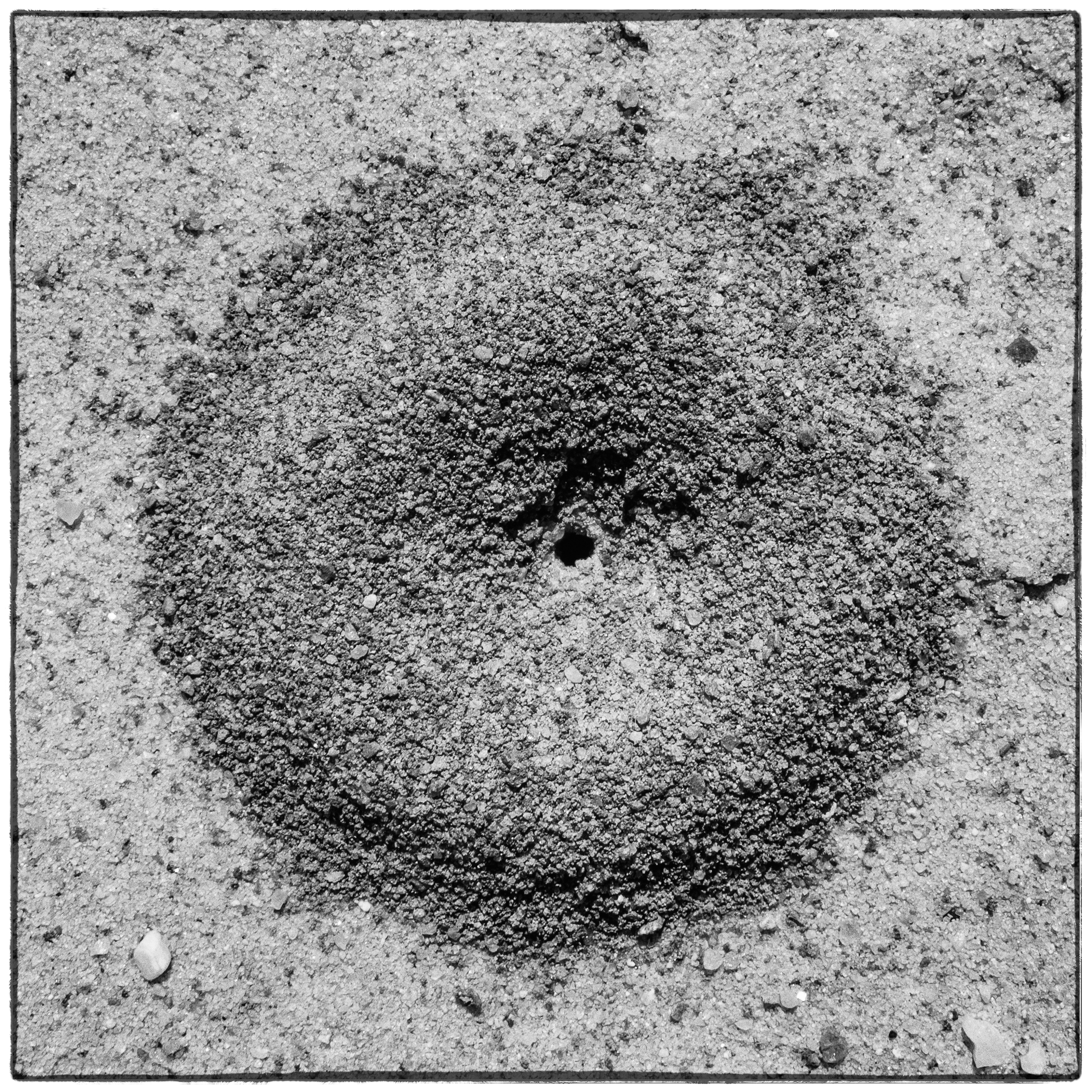
Volcano on the sand

I thought at first that these small volcano-like mounds were made by some kind of animal, maybe a worm. However, I’m beginning to think otherwise.

I came across this article on Exploring the Sand on the Coastal Care site. It describes something very similar to what I found (there are even photographs and illustrations, which look at lot like the picture above):

The movement of the tides up and down the beach every half day or so is a highly visible process carefully watched by fishers, beach buggy enthusiasts and joggers alike. While all these obvious changes are occurring on the beach, important but much less visible things are happening beneath the surface. As the tide goes out, air replaces water between the sand grains. As the tide comes up, water replaces air. The beach is a giant bellows, alternately taking in and expelling air. As the air passing through the sand, a great variety of features form within the sand as well as on the surface of the beach.

You can watch for yourself as air is forced out of the beach. The best time and place to see this is at mid to upper incoming tide levels on the upper beach near the high tide line. If conditions are right, streams of bubbles can be seen through the thin water film of the uppermost wave swash, especially as the swash begins its return to the sea.

When the tide has left the bubble area high and dry, a careful look (on hands and knees) will reveal that some of the nail holes resemble tiny volcanic cones. With a magnifying glass and imagination, we call these features volcanoes. The uppermost part of the hole flares out and is rimmed by a tiny circular mound of sand (Fig. 5.5). The flow of air through the holes was strong enough to remove some sand at the surface and pile it around the rim. Again, if you are watching the swash zone at the right time you can see the tiny eruptions from the holes that expel water and the sand that produces the rim.

Taken with a Sony RX-100 M3

On White Pond

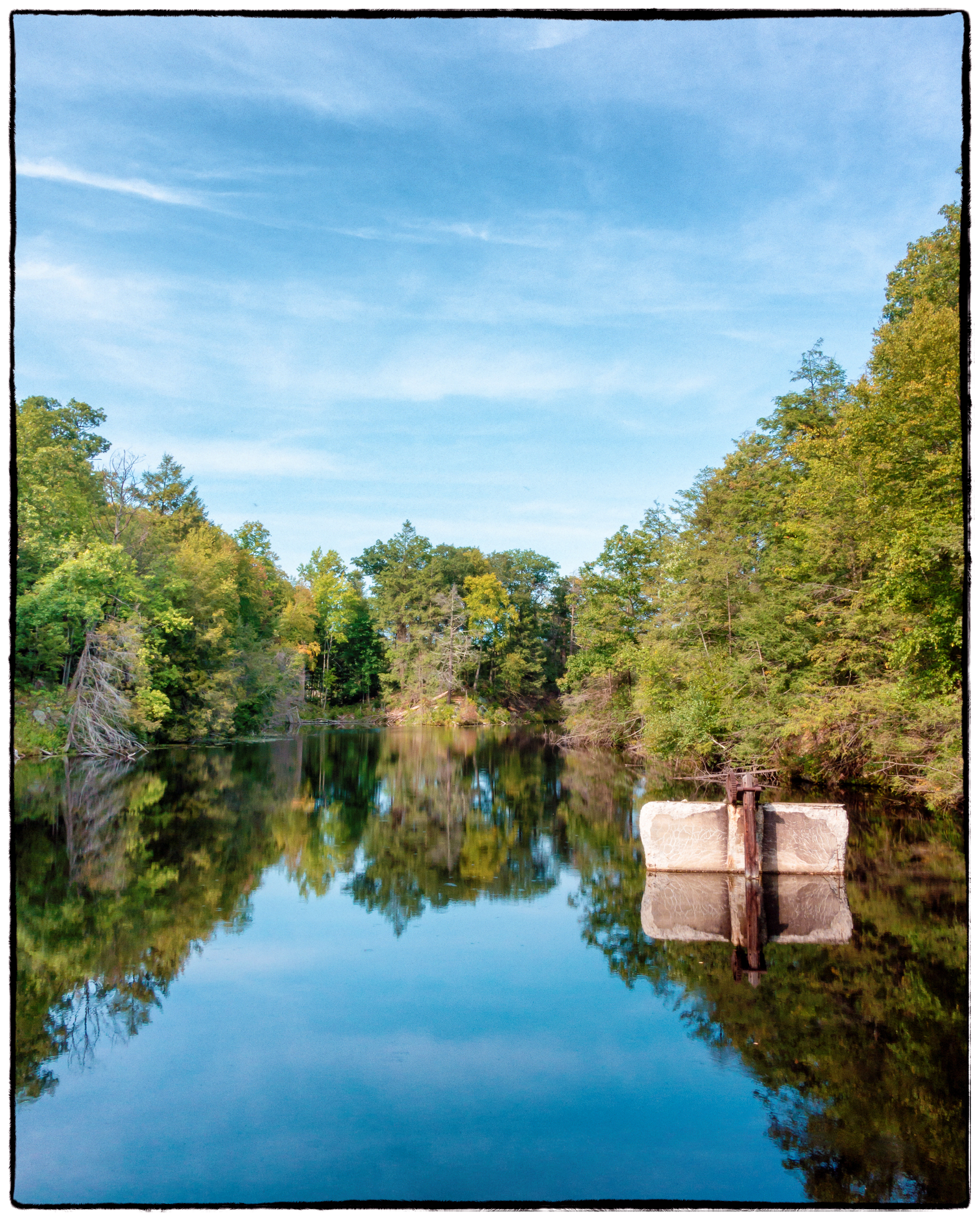
Although White Pond is quite close to our house, I wasn’t aware of its existence until yesterday.

The walk starts by a small jetty (see above). As we passed by someone was fishing.

Before the trail enters the woods there are some great views of the pond.

After a while the trail goes away from the lake and into the woods. Where it once had been flat and clear it now becomes rocky, with abundant roots. This is bad news for me as I have a history of tripping over roots and rocks. In one case I managed to split open my nose and break my glasses. I had to make sure to lift my feet higher than I normally do to avoid them. Because of the recent rain the rocks were also rather slippery. If that wasn’t enough it’s the time of year when acorns start to fall. There was a constant “rain” of acorns during our walk. I kept thinking that one of them would fall on my head, but luckily none did.

The trail doesn’t seem to be well maintained. A lot of trees had fallen across it and they haven’t been cleared away. Some you could go around, some you just had to climb over.

The inevitable stone walls that you find everywhere in the woods around here.

The equally inevitable boulders.

The trail winds around the pond and ends on a road. After I’d finished walking I went along the road. I don’t think I’d recommend walking on it, particularly if you have a dog or small children.

We didn’t actually get to the end of the trail. We came across one large downed tree too many. It was too big to climb over, and I couldn’t any easy way around it. We’d walked for about 45 minutes and it seemed as good a time as any to turn around and retrace out steps.

Taken with a Sony RX-100 M3

Rose on our dock

This rose grows in a pot on our dock. I liked the pastel color of the rose and the muted greens of the leaves. I also, perhaps strangely, found the rust on the white railing appealing. All of this set against the blurred blue of the lake in the background.

Taken with a Sony Alpha A77II and Tamron AF 18-250mm f3.5-6.3.

Another walk in the woods

We went for another walk in the woods yesterday, this time once around Pelton Pond (see picture above) and then down the Roaring Brook Trail for a while. All told it took about one hour 45 minutes. When I’ve been here in the past I’ve seen signs of beaver activity (e.g. gnawed trees), but now I see no evidence of beavers and their lodges are falling apart. I guess the beavers have relocated permanently. That’s a pity because I’ve never actually seen one.

It was a sunny day with temperatures in the mid 70s and it was a very pleasant walk. But as is often the case you mostly see the usual trees, boulders, stone walls etc. I’d been reading an article about taking pictures in the woods and one of the things it recommended was to keep a lookout for splashes of color, which is what I did.

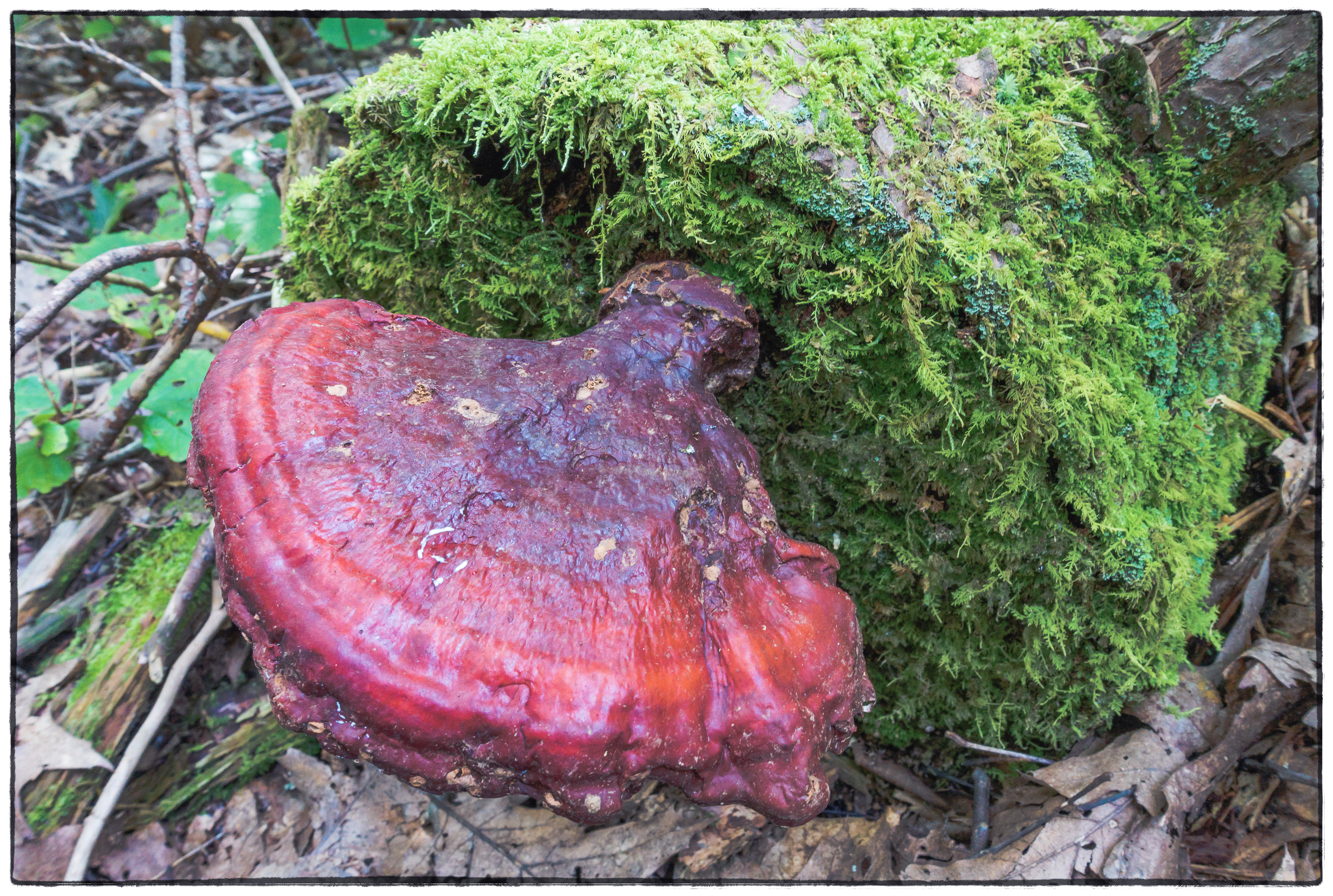
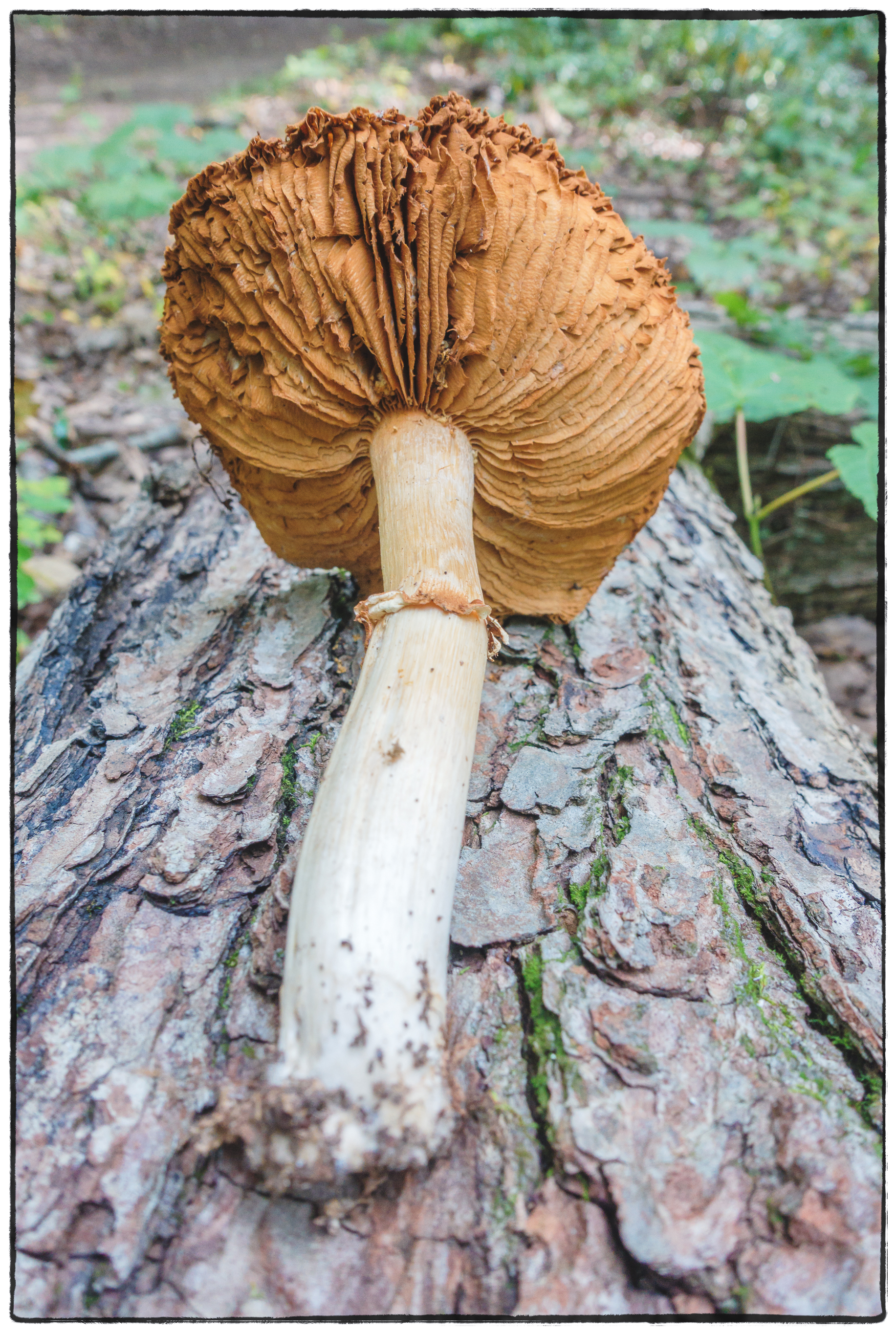
And I found these two brightly colored fungi.

I loved the deep reds of the first one.

I found the second one on top of a hollowed out log. It doesn’t seem likely that it got there in the natural course of things and imagine someone must have placed it there (possibly to take a picture as I was doing). I wasn’t the one to put it there, but I was happy to take advantage of its placement.

Taken with a Sony RX-100 M3.

Schneider-Kreuznach Retina Xenon 50mm f1.9

I love the Schneider Xenon lens on my Retina IIc so when I came across this article My Favorite Lenses – Schneider-Kreuznach Xenon 50mm f1.9 DKL on the Lens Bubbles site it was something I started keep my eye open for. Eventually I found this one at a reasonable prize and picked up a DKL-Sony E mount adapter (so that I could use it on my Sony NEX 5n).

It’s a fairly low contrast lens, with the kind of color rendition I liked from my Retina IIc. It’s also a solid, well built and rather heavy piece of equipment and of course the adapter adds a fair bit to the size (in the picture the silver part is the lens, and the black part the adapter).

I must admit that I found it rather frustrating at first. I had some difficulty getting it to focus correctly. With these adapted vintage lenses I usually focus wide open and use focusing aids such as focus peaking and focus magnification. That didn’t seem to work with this one and I suspect that it’s because of its low contrast nature. Instead I had to stop the lens down, focus and then return to whatever aperture I needed.

It’s certainly a very sharp lens, even wide open.

One interesting feature is the red “ears”, which move as you change aperture to indicate depth of field.

Incipient blackberries.

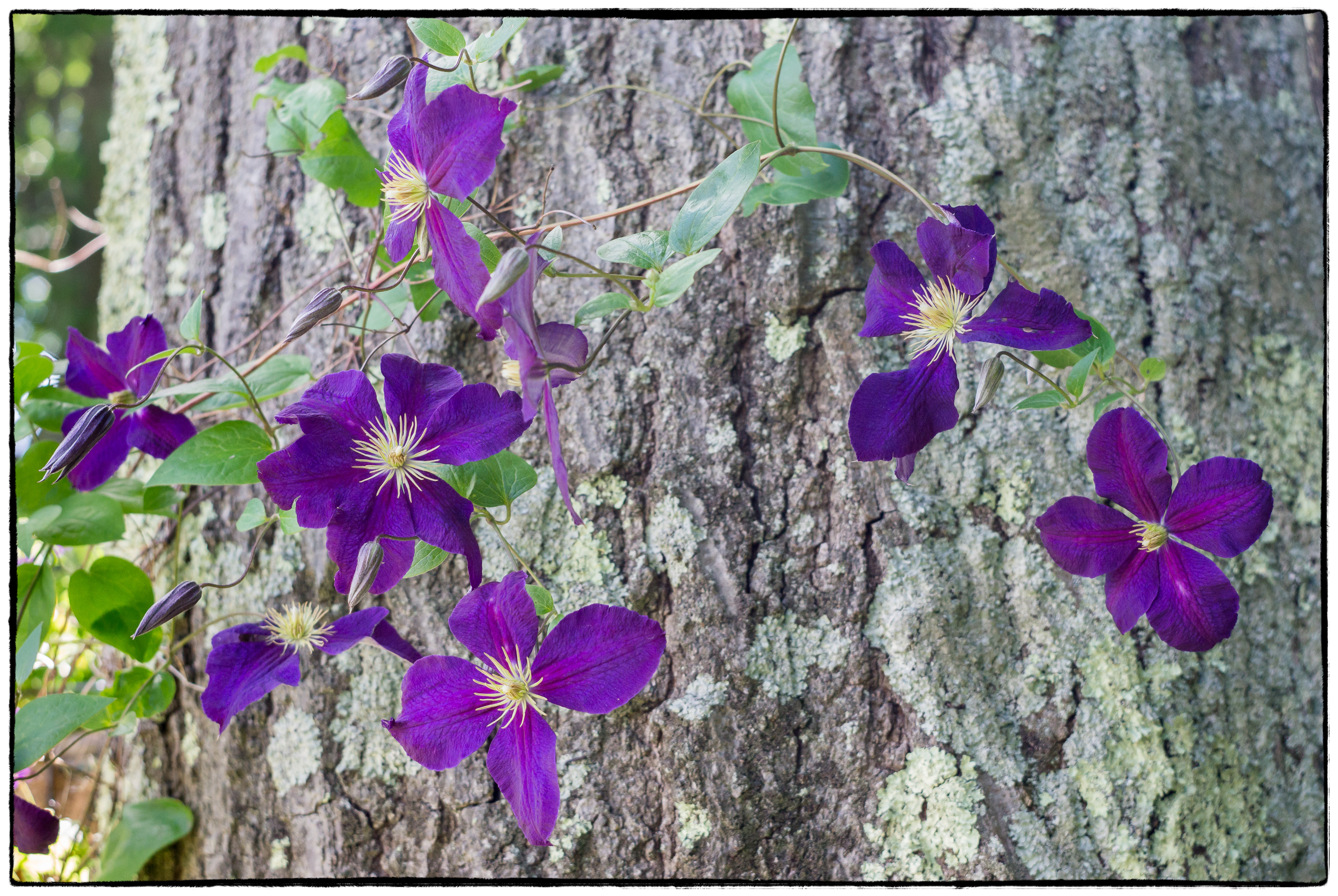
Clematis

Planters in our garden.

One other post also featured this lens: Chimney in the Woods.