In this video, Sebastian Siadecki introduces a new series on street photography photobooks, a genre with which he has extensive experience. He provides a general definition of street photography: work primarily about people in public spaces, with generally no interaction before the photos are taken.
He then then discusses two photobooks that, according to him, use repetition in interesting ways:
42nd and Vanderbilt by Peter Funch: This book features photos taken from the same vantage point: the corner of 42nd Street and Vanderbilt Avenue in Manhattan. The repetition of commuters in similar poses and expressions highlights their daily routines and habits. He explains that he initially dismissed the book because of its emphasis on the use of a long lens but later became “hypnotized” by the intimacy and focus on details. He notes how the book reveals not just repeated actions, but also consistent emotional states as part of the commute.
Twirl/Run by Jeff Mermelstein: This book is divided into two sections: women twirling their hair and men running in a hurry. The photos are displayed in a unique layout of three stacked images per page, emphasizing the collection over individual “bangers”. Siadecki discusses how Mermelstein’s long-standing practice of street photography led to the running series while the twirling series became a more conscious effort. He praises the book for reflecting the collective anxiety of New York City
I found myself wondering how the first one was created. Remember that Siadecki states that he almost dismissed it because of its use of a long lens (most street photographers use a normal or wide-angle lens). I worked in Manhattan for many years and know this area quite well. Its teaming with people and things happen very quickly. I don’t see how he could remember individuals passing by with possibly days between the chance encounters. The only way I can think that he did it was to take bursts of images and then later sort through them. So little technical skill may have been required. The images are not particularly pleasing aesthetically. So, I guess we’re in the realm of conceptual photography here: a genre that translates ideas or concepts into visual images, emphasizing the message over mere aesthetics and technique. It’s a genre that I’ve never fully understood, so I’d take what I’m saying, “with a grain of salt”. Maybe I just don’t get it.
As for the second one, if you watch the video, you’ll discover that there are 120 images of women twirling their hair, and 120 images of men running. Too many for me I’m afraid. I don’t have that kind of attention span.
So, I suspect I would find both books rather boring – if I were to buy them that is (which I probably won’t, although if I came across one in a bookstore, I’d probably spend a bit of time browsing through it). I think I’ll stick with the likes of Garry Winogrand, Joel Meyerowitz, Henri Cartier-Bresson etc.
Note that this is not a comment on Mr. Siadecki’s channel, which I love. I collect photobooks and his channel has given me lots of pointers as to what my next purchase might be.
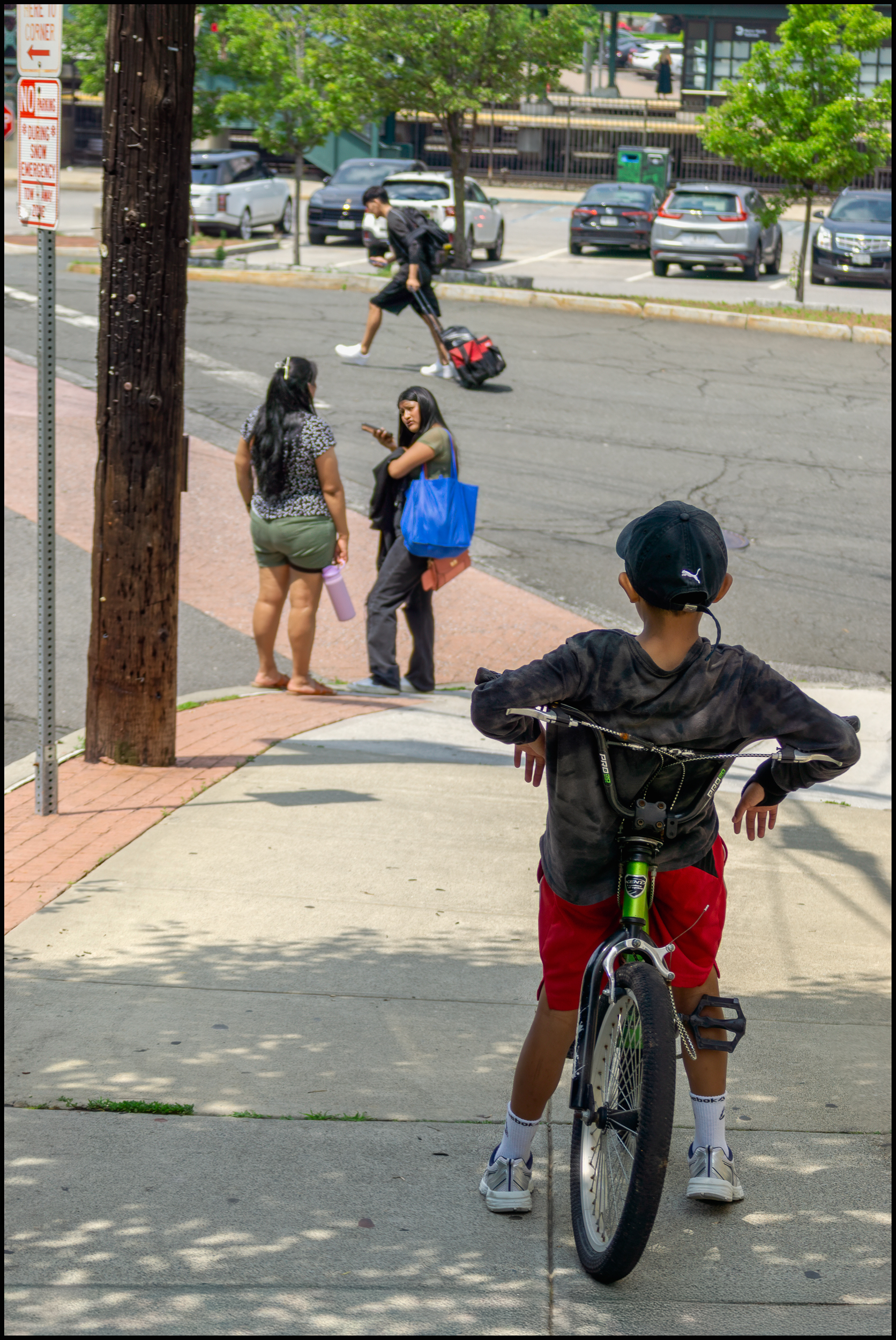
Taken by the Ossining Metro North Station. I really like this picture, probably because of the layers. Does it bother me that the man with the suitcase and the two women are blurred. Not in the least?
Taken with a Sony A6000 and Tamron 28-300mm f/4-7.1 Di III VC VXD lens.
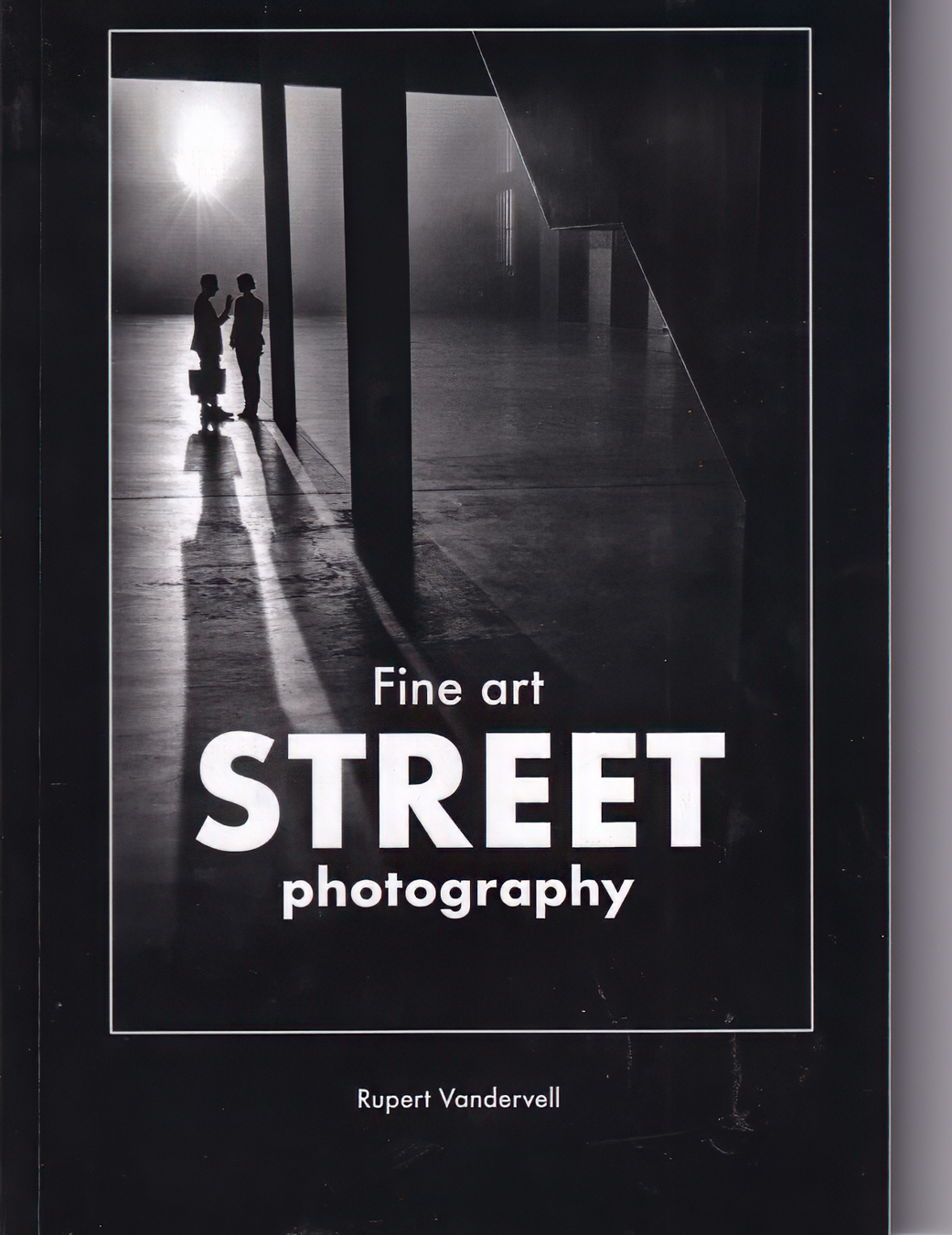
I’ve been a subscriber to Rupert Vandervell‘s channel: New Ways of Seeing for quite some time and have enjoyed it greatly. I like his delivery, and I like his videos, which are relatively short and not overproduced.
I’d like to start with a few small comments and one rather large criticism.
First the comments:
I don’t care for this use of the words “fine art” in the title. I’ve noted this before (See: Fine Art Photography) so I won’t go into it again here. If you’re interested, please read the post.
The title suggests that this type of high contrast image is the only type of street photography that deserves the name “Fine Art”. I doubt that Joel Meyrowitz, Stephen Shore, William Eggleston (to name but a few) would agree with this. In fact, the book is largely concerned with the type of street photography that Mr. Vandervell favors. In his introduction he is quite up front about this. Just don’t think that this is going to be a broad overview of the various types of fine art photography because it isn’t
A better title might be “Fine Art Street Photography – my way”. Seen that way it’s an interesting book sprinkled with useful insights and interesting anecdotes. Mr. Vandervell writes well and it’s an easy read.
If you’re looking for a “how to” book this is not it. But then Mr. Vandervell at no point claims that it is.
And now for the criticism:
As reviewers have pointed out the quality of reproduction of the images is truly terrible. If you watch any of his videos you will see that they are very contrasty with very dark blacks and very bright whites. In the book they’re all a very mushy grey. This is a pity because his images rely a lot on high contrast and in this book, you don’t get it. On top of this many of the photographs have faint lines (from scanning? from printing?) running through them. I’d suggest avoiding the book and instead taking a look at his YouTube channel. The photographs look much better, and it costs less. The images in this book simply do not do justice to Mr. Vandervell’s work.
As I mentioned earlier it was a very hot and humid day. As I left Ramenesque I noticed this group of people eating ice cream. A wonderful opportunity for a bit of street photography, I thought. Pity the guy on the far left was not a foot or two away from the rest. I could perhaps have waited to see if he would move, but I had to get to my train and I was a little concerned that they might notice me.