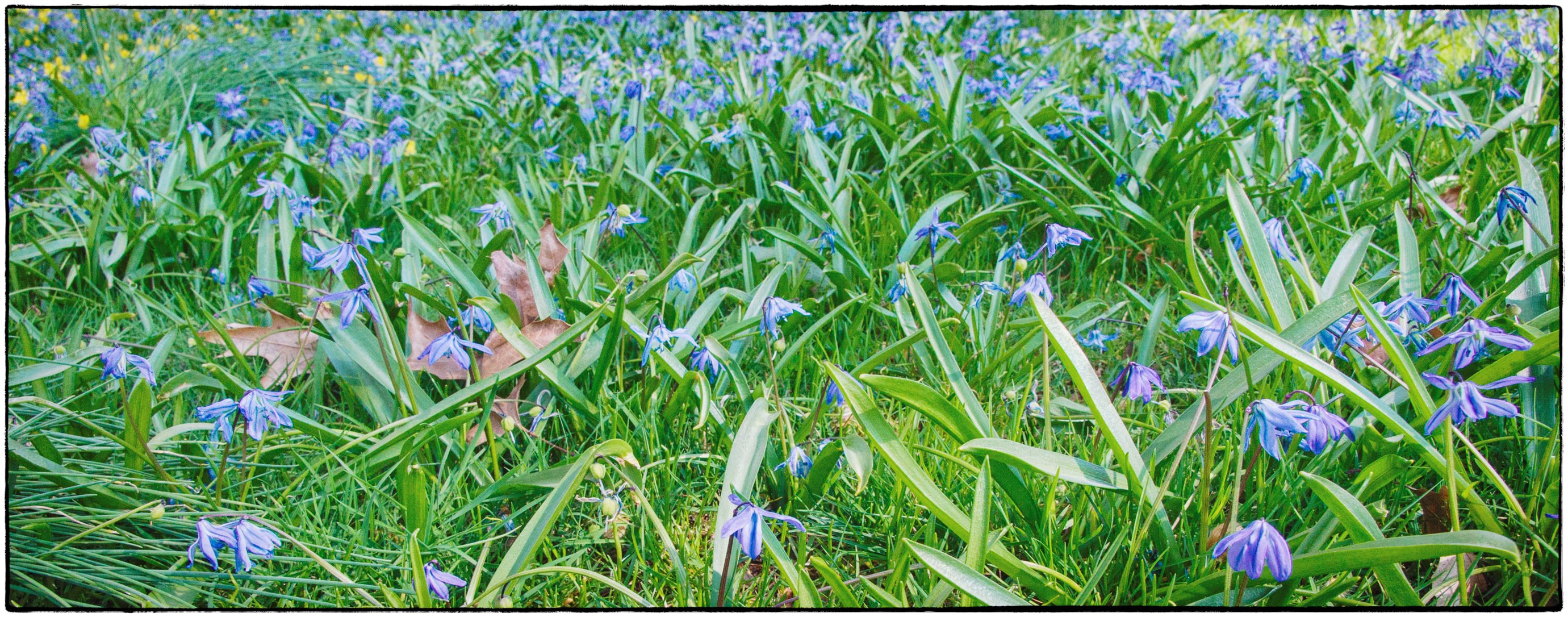
What’s wrong with this picture?

Although you wouldn’t think it from the number of flower pictures I’ve been posting of late I don’t really like flowers all that much. While I don’t mind looking at them I’m not a devoted gardener – that’s my wife. However, I’ve always loved bluebells. They grow wild in the woods where I grew up and I was always fascinated by the carpets of blue that you would see at certain times of the year. So when I bumped into this cluster of bluebells at the NY Botanical Gardens I had to take a picture.

When I looked at it later the first thing I saw was the brown leaves. Now I could say this this was deliberate. That the whole pictures is about transience and even though you see the flowers in their full spring glory now, autumn is just around the corner. But this would be a load of nonsense. The fact is that in my enthusiasm to take the picture I just didn’t see them – not at all! The eye (and the human brain) is an amazing instrument capable of shutting out things you don’t expect to see. This just underscores the need to look really hard when you take a picture so as to see any distracting elements.

You may think I’m crazy not seeing the leaves, but I’ll refer you to a fascinating book called “The Invisible Gorilla. How our intuitions deceive us“.

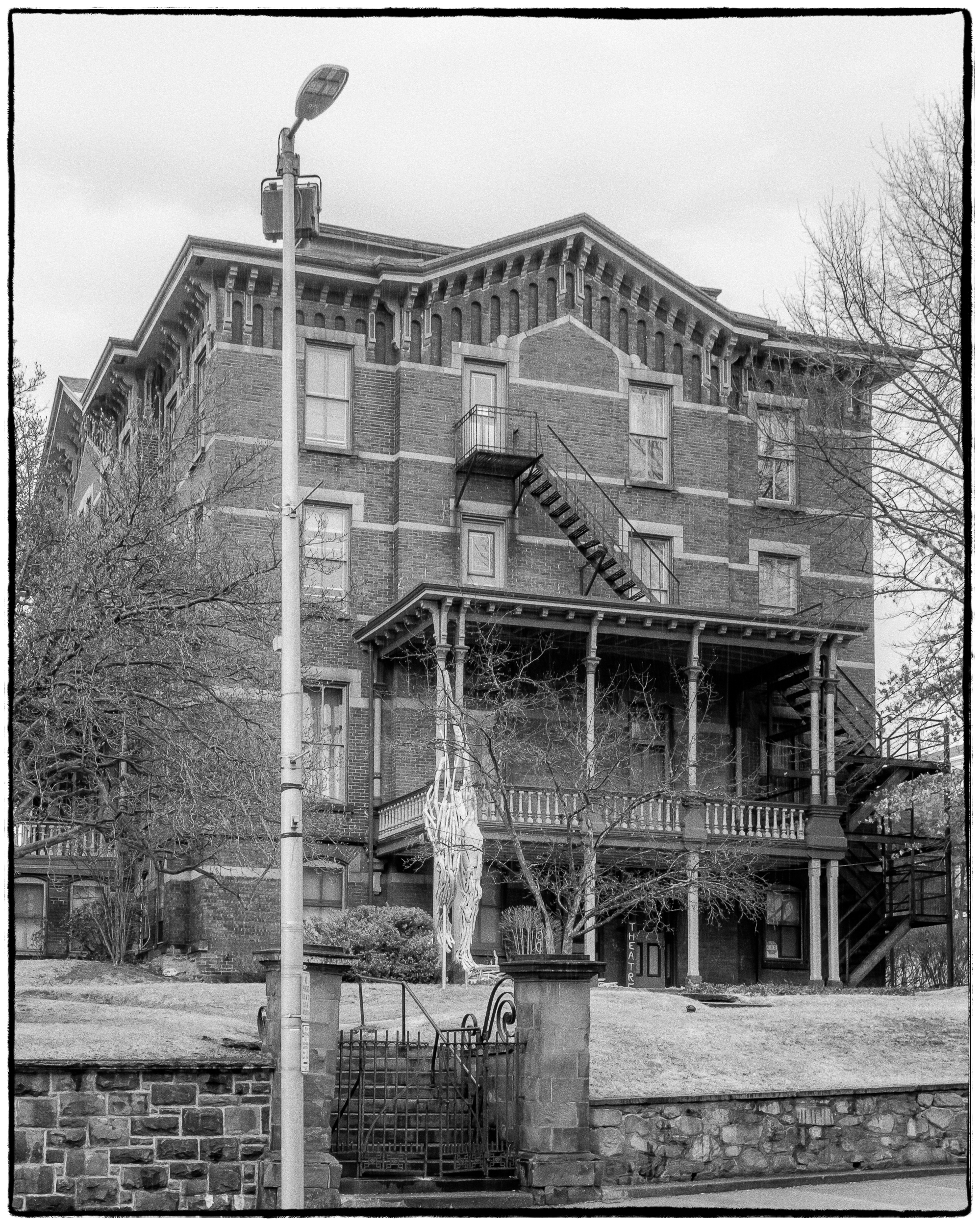
Matthew Vassar House

This house once belonged to Matthew Vassar (April 29, 1792 – June 23, 1868. Born in the UK, Vassar was a prominent businessman and Brewer. He was also known for his philanthropy. He was the founder of the renowned Vassar College (founded 1861).

A historic marker on the property reads: “Matthew Vassar. Founder of Vassar College lived house on this site for many years. Now site of Vassar Brothers Home for Aged Men“. The sign isn’t entirely correct. As Wikipedia explains:

The Home was built by Vassar’s nephews on the site of his old house, incorporating some of the original interior trim, such as the black marble mantels. It cost $45,000 ($1,103,000 in contemporary dollars) to build and was completed in 1880. The following year it was officially opened.

Designed for 50 men, it was initially home to six who met the criteria of being at least 65 years old, Protestant and residents of New York State. It continued to operate below capacity until 1903, when the death of Matthew Vassar’s widow made enough money available.

It remained a senior citizen’s home throughout much of the 20th century. In the 1970s, it became the property of the Cunneen-Hackett Arts Center, which has used the lower floor for galleries, public and private events, and rented out the upper floors as office space for other local non-profit organizations

So it seems that although Vassar lived on this site, he never actually lived in this building. And while the house was once the Vassar Brothers Home for Aged Men – it isn’t any more. Maybe they should think about changing sign.

Vassar also lived on a large estate in Poughkeepsie (Springside) in the latter part of his life. It seems it was never finished and much of what was finished has now disappeared. However, the gatehouse has been partially restored and the original pathways and trees remain. I believe it’s open to the public now. Perhaps I’ll go for a walk there one day.

I’m fond of co-incidences and in my research around this house I discovered a couple:

Vassar’s Springside estate was designed by Andrew Jackson Downing. Part of the reason why it was not completed was because Downing died at the early age of 36 on the Henry Clay Steamboat Disaster. In the past weeks I’ve been reading about Henry Clay in the context of the Mexican American War. The Henry Clay was built by Thomas Collyer, whose mausoleum I recently visited in Dale Cemetery, Ossining.

How’s that for a bunch of co-incidences! And this post, which started out as a simple snapshot taken in the rain in Poughkeepsie while waiting for my wife to finish what she was doing has now become longer than intended. An uninspired picture (I even considered not posting it) combined with an interesting (at least to me) story. It made me think about whether I’m more interested in the pictures or the stories. Or maybe both. In this case without the picture I would never have found out about the story. So I think they both go together.

Do we (I) take too many photographs?

Too many pictures?

Interesting article. Well worth reading. I tend to subscribe to the view expressed in a comment by Anthony Shaughnessy:

I’ve got 104 pictures in the galleries of my main site. That’s about 7.4 pictures per year I’ve been active.On the other hand, blogs are a great way to do something with the large numbers of pictures one takes. You can tell the story of the day’s shoot with a selection of a dozen-ish pictures from that day, even if they don’t all make the cut into your main portfolio. Reading down the months and years of your blog is then a story in itself with the photos making the story.

Source: The Online Photographer: What’s the Purpose of Taking More Photographs?

I tend to take as many pictures as I can, delete a lot of them and then spend time processing those that remain. I post some (few) to Facebook; some to Flickr; and most to this blog. The blog helps me keep a sort of illustrated diary of what I’m doing and helps me to keep up the discipline of taking pictures. Recently I’ve been feeling that I take too many pictures – but I don’t think that’s the problem. The problem is that I show them all on the blog. I think that what I need to do is to revise the blog so the diary aspect is downplayed and a set of portfolios (of pictures I really like) is more prominent.

I also liked this from Petapixel:

In closing, I want to take you to Switzerland where I also teach. Imagine a mountain before you. You see its peak and want to climb up to the top. It is your life’s goal. Start by standing back far enough to confirm it is really there, then head straight for it knowing it will disappear from sight for most of your life as you climb and meander the hidden forest trails that lift you ever higher even as many sections force you to drop down into the mountainside pockets of disappointment or even despair, but you will be climbing soon enough and always headed toward your goal.

There will be those special occasions — and may there be many of them — when the fruits of your labors are suddenly made visible, to be celebrated, when you will again see the peak, only closer now, giving you confidence to step forward ever more briskly and bravely.

At one point the tree line will thin out the way hair on the top of an old man begins to bald away, but the air will be clear and the path sure.

At the top you will delight in what you have accomplished. You look around you and see just how far you have come. But then your turn around and as you do you become aware of mountain peaks far higher than what you had ever dreamed of, peaks that from the distance when you first looked up were not even there, completely hidden from your view.

And now, there they are, huge peaks but your climbing days are done.

You have three choices: You can look up with raging jealousy and end your days in sadness and regret. Or you can look down at all the distance you climbed, become arrogant about every step you took and not have many friends with whom to share your closing days.

Or you can skim the horizon and take in the gorgeous sweep of the panorama before you. If you can do that you will know peace and rare humility.

We do not have to be number one in this world. We only have to be number one to ourselves. There is a special peace that comes with such humility. When you reach this peak in life, you’ve reached the highest mountain peak of them all.

The Helsinki Bus Station by Arno Rafael Minkkinen on Petapixel.

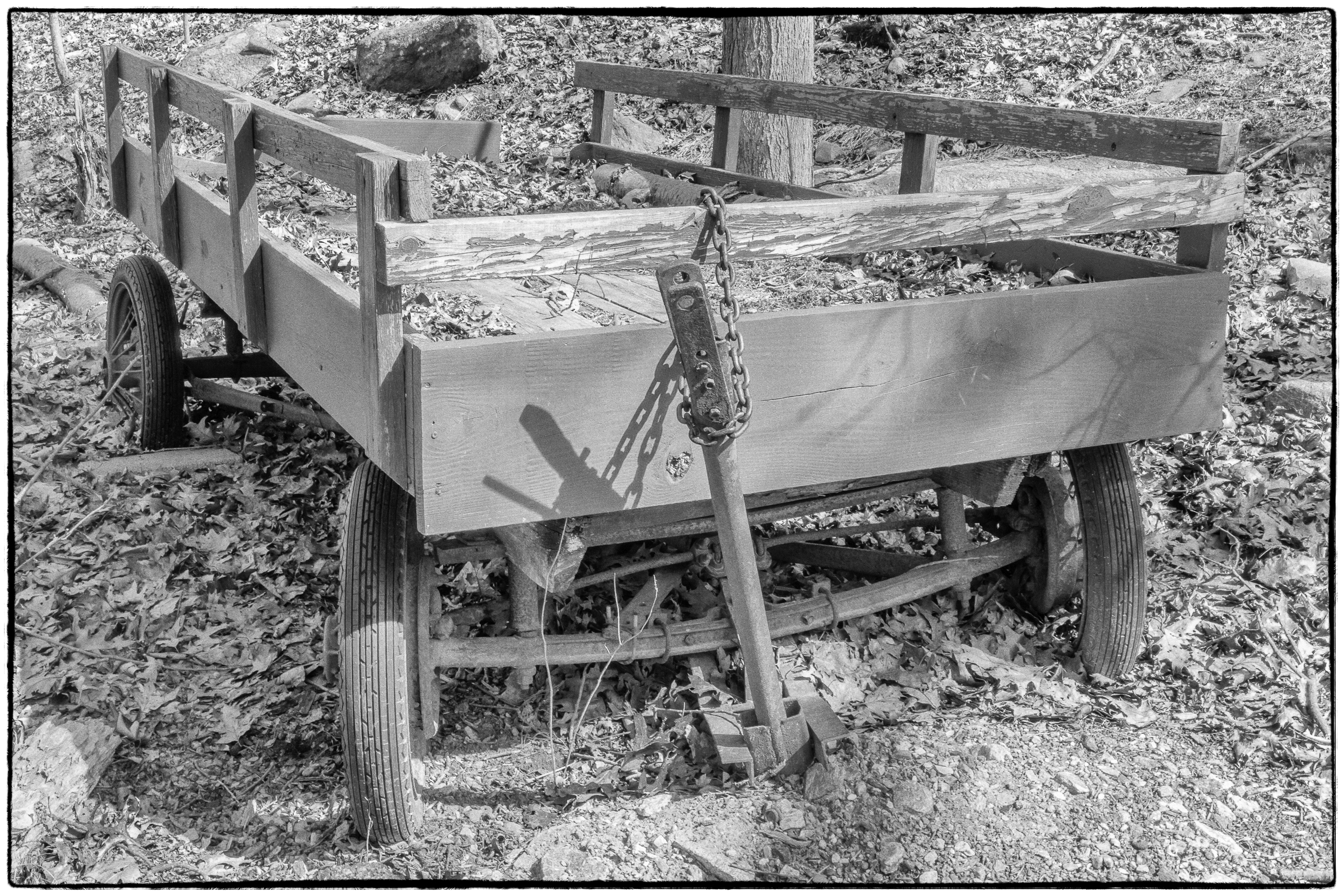
Old cart

Came across this during one of my walks. I love old pieces of equipment – actually old things in general. I post so many landscapes that you’t think I had a passion for landscape photography, but this isn’t actually the case. At one point, enamored of Ansel Adams I thought I might be, but I’ve since realized that I actually get more of a rush out of taking pictures of old things (buildings, farm equipment, military hardware, everyday objects etc.). I’m particularly happy if I can find an interesting piece of history associated with them. If it’s a bit quirky or humorous then so much the better.

So why so many landscapes. Simple – I spend quite a bit of time walking, both for the dog and for myself. I don’t particularly like walking the dog in urban areas and I live in the Hudson Valley so there are lots of places to walk in the woods, which is what I do. Every so often I come across a discarded piece of equipment, or a ruined building, but usually it’s just landscapes. Luckily the Hudson Valley has some very picturesque scenery.

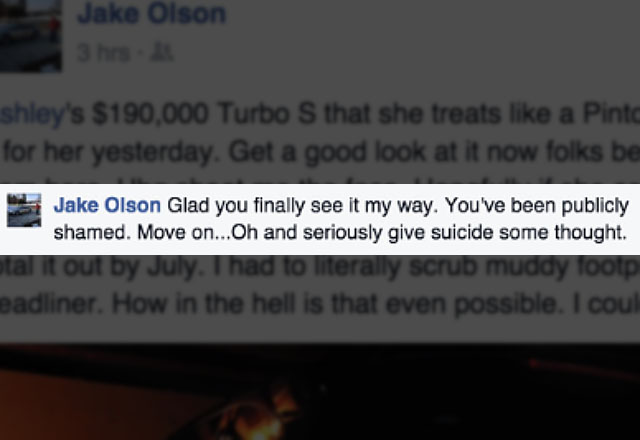
A sign of the times

There’s a good chance you’ve never heard of photographer Jake Olson before, but many people are learning of that name this week. He’s a self-proclaimed “famous” American photographer who’s now at the center of major controversy in the photography world.

Source: Petapixel (see above)

I hadn’t heard of Jake Olson before I read this post on Petapixel. So I took a look at his website and read some other comments on the internet. Is he a famous and/or successful photographer? I suppose he is to a certain extent – if one measures such things by visibility in social media and money (if indeed he really makes as much as he claims, a claim which I have no reason to dispute). However, it seems to me that there’s more to being ‘famous’ and ‘successful’ than these two areas. I’m fascinated by the history of photography and spend quite a bit of time studying famous photographers. He isn’t in their class. True his images are much better than mine (but then I don’t profess to be a ‘famous’ and ‘successful’ photographer – far from it: I know my pictures aren’t much good), but those of his I’ve seen are one dimensional, have pretty much the same look, are over-saturated. Moreover if, as I often read, photographs should say something then his don’t say much. His pictures don’t seem to sell for millions of dollars (which puts him in a different league to such luminaries as Cindy Sherman, Andreas Gursky and the like) and they don’t have the emotional impact of such old-time greats as Henri Cartier-Bresson, Ansel Adams, Edward Weston and others. Still he apparently makes a good living (much better than I do) doing what he does and I don’t begrudge him that. He’s found a niche (a bit like the late Thomas Kinkade) and is capitalizing on it – good for him.

I would wish him all success in his endeavours if it weren’t for his behaviour. His comments are, as far as I’m concerned, beyond the pale. Of course he might, as he suggests, be making these kind of comments largely to stir up more activity on his Facebook page. If so to me this doesn’t excuse what he’s saying. Unfortunately this type of speech is more and more common today, and more disturbingly more and more accepted. Donald Trump has legitimized this kind of behaviour. Having said this I have to say that I don’t much like many of the things said against him either. They’re almost as bad as anything he has said.

Whatever happened to class?