On the Trail to Raven Rock – A hint of the past glory

Most of the trails at the Rockefeller State Park Preserve are on former carriage trails from when the Rockefeller family still owned the property. The park is very popular, particularly at the moment as people deal with COVID and you usually see lots of people. Sometimes you see people riding horses, but you don’t often see carriages. So this was an unexpected, and pleasant surprise.

I had visions of the Rockefeller family out for a ride in their carriages – without the masks of course.

My dog, Harley doesn’t quite know what to make of horses. He doesn’t see them often enough to form an opinion. He does know what deer are though and he knows that they are something to bark at, and if possible chase. I think he sees horses as big deer, so I have to be careful to keep him close and socially distanced from the horses lest he spook them.

Taken with a Panasonic Lumix GF-1 and Lumix G Vario 45-150mm f4-5.6

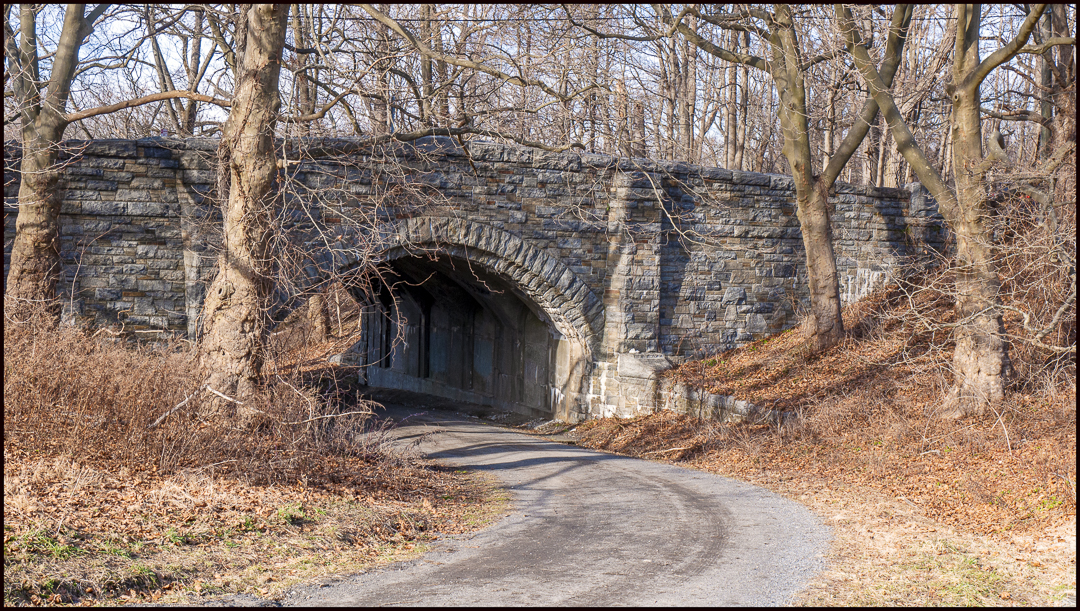
On the Trail to Raven Rock – Stone Bridge

I’ve explored a lot of the Rockefeller State Park Preserve, but have not walked much in the far eastern part. This was about to change. I’d heard about Raven Rock (or Raven’s Rock as it is sometimes called) and decided to take a look for myself.

Raven Rock is mentioned in Washington Irving’s “Legend of Sleepy Hollow”. Ichabod Crane goes to dinner at his love interest’s (Katerina Van Tassel) home and the village elders tell Ichabod local ghost stories, including the story of Raven Rock:

“Some mention was made also of the woman in white, that haunted the dark glen at Raven Rock, and was often heard to shriek on winter nights before a storm, having perished there in the snow”.

Lucas Buresch at the now no longer updated Archive Sleuth has this to say about Raven Rock:

So I stopped by the Warner Library in Tarrytown to do a little research. In The Place Names of Historic Sleepy Hollow & Tarrytown by Sleepy Hollow’s official Village Historian, Henry Steiner, I found this entry for Raven Rock:

“A ghostly woman in white is said to haunt a large rock in Pocantico Hills. The rock is in a dark and foreboding glen on the east side of Buttermilk Hill, southeast of Ferguson Lake”.

A second volume, Jeff Canning and Wally Buxton’s History of the Tarrytowns, gives an expanded description:

“Raven Rock is part of Buttermilk Hill in the northern reaches of the Rockefeller estate near the old Hawthorne Traffic Circle. Legend tells us that three ghosts, not just Irving’s lady in white, roam the area.

The lady in white was a girl who got lost in a snowstorm and sought shelter from the fierce wind in a ravine by the rock. The snow drifted in and she perished during the night. It is believed that the spirit of the lady meets the wanderer with cries that resemble the howling of the wind, and gestures that remind one of drifting snow, warning all to stay away from the fatal spot.

A more ancient legend tells of an Indian maiden who was driven to her death at Raven Rock by a jealous lover. Her spirit is believed to roam the area, lamenting her fate.

The third spirit is that of a colonial girl who fled from the attentions of an amorous Tory raider during the Revolution and leaped from the rock to her death“.

I started my walk on Bedford Road, not far from the entrance to the Stone Barns Center. One of the first things I encountered was one of the lovely stone bridges, which are dotted around the preserve.

Taken with a Panasonic Lumix GF-1 and Lumix G Vario 45-150mm f4-5.6

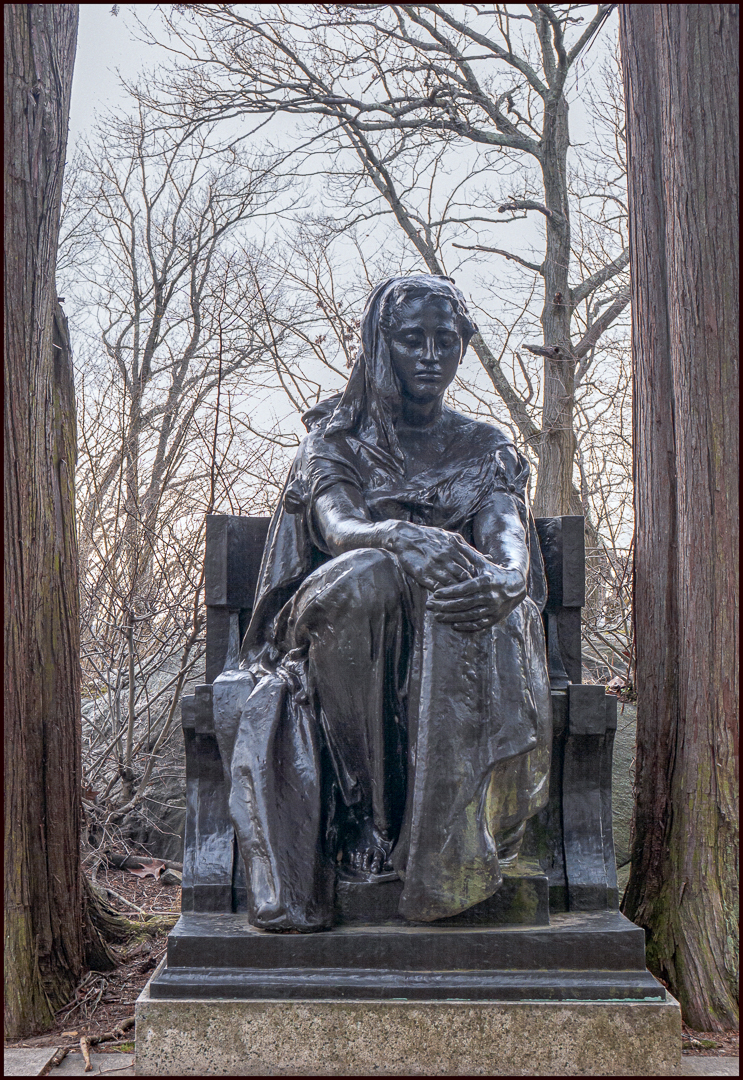
The Bronze Lady of Sleepy Hollow Cemetery

Many travelers come to Sleepy Hollow in search of its best-known spirit—the Headless Horseman, made famous by Washington Irving’s “The Legend of Sleepy Hollow.” However, these ghost seekers may not be aware of a second local legend, which has haunted the Sleepy Hollow Cemetery for over 100 years: the Bronze Lady.

Larger than life and cast in bronze, the towering figure watches over the mausoleum of Civil War General Samuel Thomas. Though her rather sleepy visage appears more sad than threatening, legend says that at night she comes to life and wanders the cemetery grounds, terrifying anyone who may have entered on a dare.

According to lore, as you get closer to the Bronze Lady, you’ll hear her weeping. If you knock on the door to the general’s mausoleum (once, or three times, depending on whose instructions you follow), you’ll have bad dreams that night.

Finally, if you dare to approach and sit in the Bronze Lady’s lap, she’ll allegedly cry tears of blood. If you further insult the statue—say, by hitting it in the face—you’ll be cursed for life. Thrill-seeking visitors have been known to run screaming from the cemetery after a supposed encounter with the Bronze Lady.

The statue was commissioned by General Thomas’ widow upon his death in 1903. According to The New York Times, the statue’s name is actually “Recuillment, or Grief.” A prominent sculptor of the time, Andrew O’Connor, Jr., created the Lady. Jesse Phoebe Brown, O’Connor’s muse and mistress, modeled for the statue. You can see her likeness in a number of other sculptures by O’Connor, including this one.
Though the Bronze Lady is one of the more popular monuments in Sleepy Hollow’s Cemetery, the widow who commissioned it was not so happy with the finished product. She told O’Connor she had hoped for something more “gay”—a rather odd request for a statue meant for a mausoleum. So, O’Connor cast another, happier head. But as soon as Mrs. Thomas told him she liked it, he smashed it on the floor, telling her: “I just made this to show you that I could do it. I should never let such a monstrosity out of my studio.’’ (The Lineup).

Taken with a Panasonic Lumix GF-1 and Lumix G Vario 45-150mm f4-5.6