A walk around Ossining – Finally signs of Spring – Bright yellow flowers

After a particularly cool and persistent start to Spring it was great to see the blossoms and flowers finally coming out. On the way to the Ossining waterfront we passed a large mass of these bright yellow flowers. I’m by no means an expert, but a little research on the internet leads me to think that they are Lesser Celandines (Ficaria verna), described by Wikipedia as follows:

Ficaria verna, (formerly Ranunculus ficaria L.) commonly known as lesser celandine or pilewort, is a low-growing, hairless perennial flowering plant in the buttercup family Ranunculaceae native to Europe and west Asia. It has fleshy dark green, heart-shaped leaves and distinctive flowers with bright yellow, glossy petals. It is now introduced in North America, where it is known by the common name fig buttercup and considered an invasive species. The plant is poisonous if ingested raw and potentially fatal to grazing animals and livestock such as horses, cattle, and sheep.For these reasons, several US states have banned the plant or listed it as a noxious weed. It prefers bare, damp ground and is considered by horticulturalists in the United Kingdom as a persistent garden weed. Emerging in late winter with flowers appearing March through May in the UK, its appearance across the landscape is regarded by many as a harbinger of spring.

I was at first shocked to read that it’s considered to be an invasive species in the US, but having reading about its toxic nature I’m no longer surprised.

Taken with a Sony RS-100 M3.
A walk around Ossining – Overview

I hadn’t been for a walk around Ossining in five or six years, but a couple of weeks ago the weather was lovely and my wife had gone out shopping. She had the car so I decided to take the dog for a walk down to the Ossining waterfront.

During our walk the signs of Spring were everywhere – trees and flowers were blooming. When we first moved to this area about twenty years ago I recall thinking of Ossining as a fairly typical old Hudson River town: a bit seedy, not terribly interesting and economically a bit depressed.

A lot has changed since then. An earlier post (See: Ossining Boat and Canoe Club) described the effects of urban renewal in the 1970s:

We went to see presentation on “Historic Downtown Ossining” given by the Ossining Town Historian. Very interesting if a little long – at least it seemed that way but that might be because we were very hungry. The presentation showed how a large part of downtown Ossining was lost to urban renewal and in 1970s. One entire side of main street disappeared and wasn’t really replaced with much. Very Sad. A lot of old photographs were shown, many in the form of before/after shots. It’s startling how much was lost.

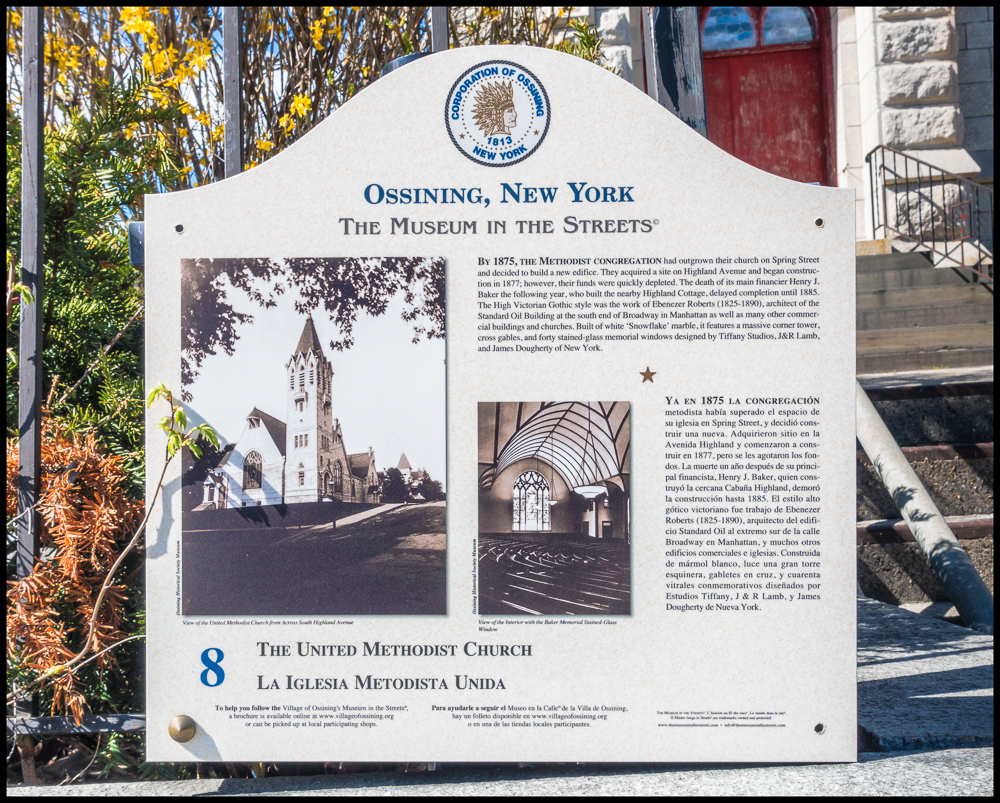
Many of the historical buildings in Ossining have now been incorporated into a scenic tour, each one described by a historical marker such as the one above. A number of new restaurants have opened up, including “3 Westerly“, which has a particularly scenic location right on the renovated waterfront. A new park has opened along Ossining Kill featuring the interesting double arched viaduct.

Taken with a Sony RX-100 M3.

An Excursion to the Dutchess County Fair – Pig Racing

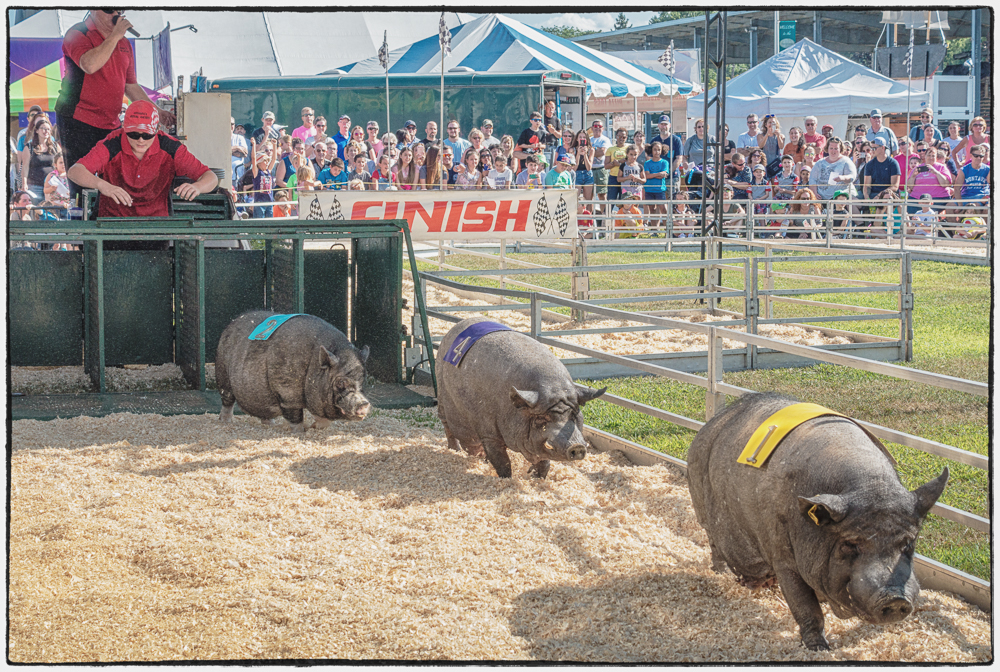
This was our final stop at the fair. Our friend had been talking about the pig racing all day and I must admit that I wasn’t really that interested. It turned out to be quite amusing, however.

We got there just in time to catch the last two races, which was probably just about enough (I’m not sure how much pig racing I can take).

The first race (see above) involved really small pigs. Not only were they small, they were also extremely fast and the race was over almost before you realized.

The second race (see below) involved really really big pigs. These were quite slow and ponderous, but added an element of suspense as they would from time to time stop for no apparent reason (could food have been placed around the track specifically to create this effect?). The race seemed to go on forever, the winner being a rank outsider who came from the rear of the pack.

Taken with a Sony RX-100 M3.

An Excursion to the Dutchess County Fair – Antique Farm Machinery

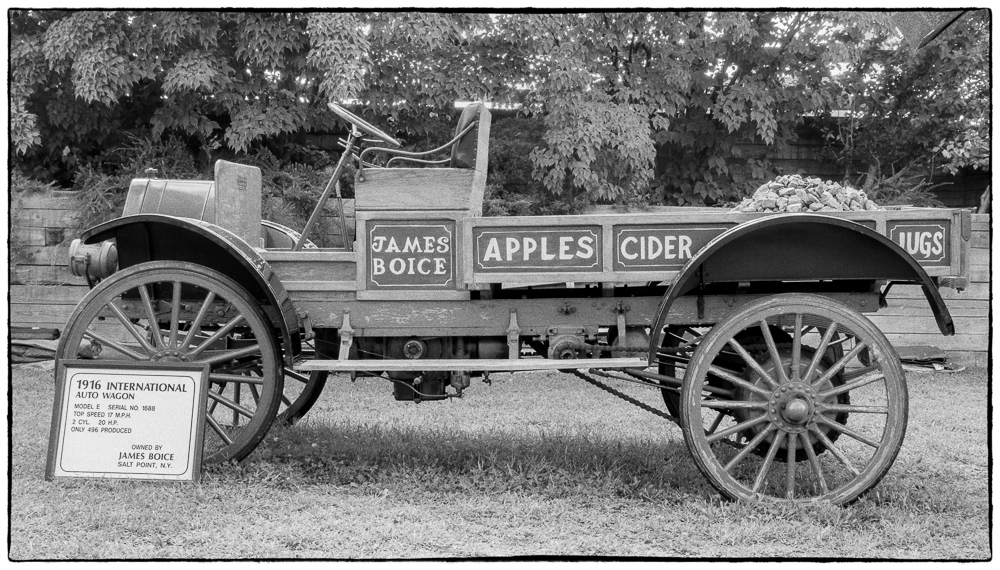
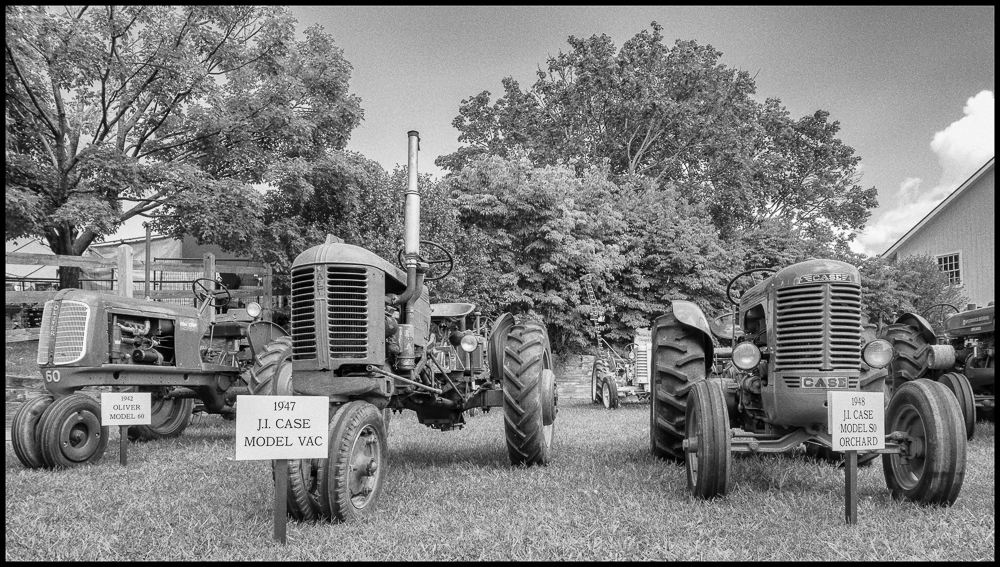
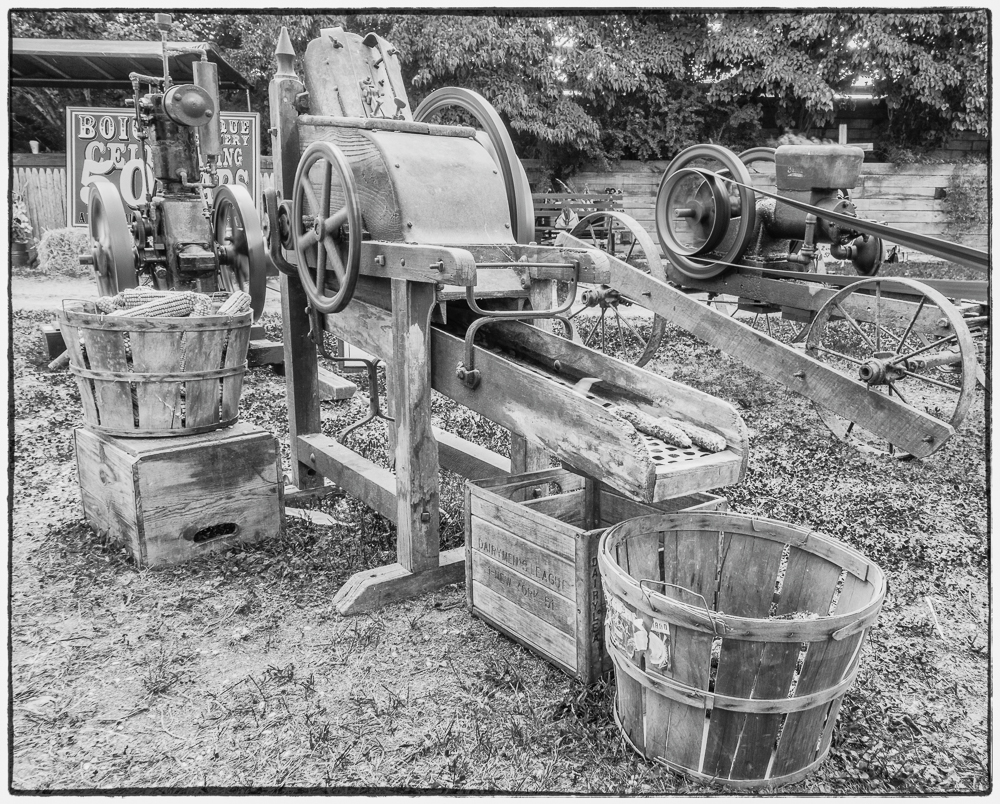
I love old machinery and the Dutchess County Fair had quite a lot, most I believe courtesy of Boice Antique Machines, featured in an article in the Daily Freeman News – At Dutchess County Fair, a new look at old machines:

There’s a symphony of combustion engines in the Antique Engine and Machinery Show at the Dutchess County Fair.

Among the sputtering, clanking and banging is the sound of steam-powered saw being operated by Jonathan Boice, who says the 1907 International Harvester machine was a turning point for farmers, allowing them to cut wood easily.

“What you would be doing is cutting fire wood the length of your stove or fire place,” Boice said.

“This is when someone went from doing it by hand to doing it with a power saw,” he said. “This was really the first power saw. I don’t know of an earlier machine than this for cutting wood.”

The 6-horsepower machine’s engine turns at 335 revolutions per minute.

“Attached is a box that looks like a tower and the water runs over trays that cools and evaporates,” Boice expalined. “As it evaporates, you have to add more. It carries about 15 gallons and has some leaks due to its age, so during the day, we may add water once or twice.”

Boice said the saw is largely in the same condition as when it was found several years ago, with ownership traced to a farm in Millerton.

“Mechanically, there were broken parts on it,” he said. “We didn’t want to paint it or anything like that. These machines are only original once.”

There are about 20 pieces of equipment on display in the Antique Engine and Machinery Show, including a rock-crushing machine that demonstrates the power of America’s industrial revolution and oat-processing equipment that turns a harvest into food.

Boice family members have been collecting the equipment over several decades and take several weeks to prepare for the fair.

“We work on this about three weekends before the fair — loading it up, bringing it over and making sure everything is ready to run,” he said.

“I wouldn’t quite call it a business,” Boice said. “It’s a family hobby. My nephew is in charge, and his father started it. … I’m one of the original ones in it, along with my brother’s wife, and there are some of our other family members that are involved, and we couldn’t do this without them.”

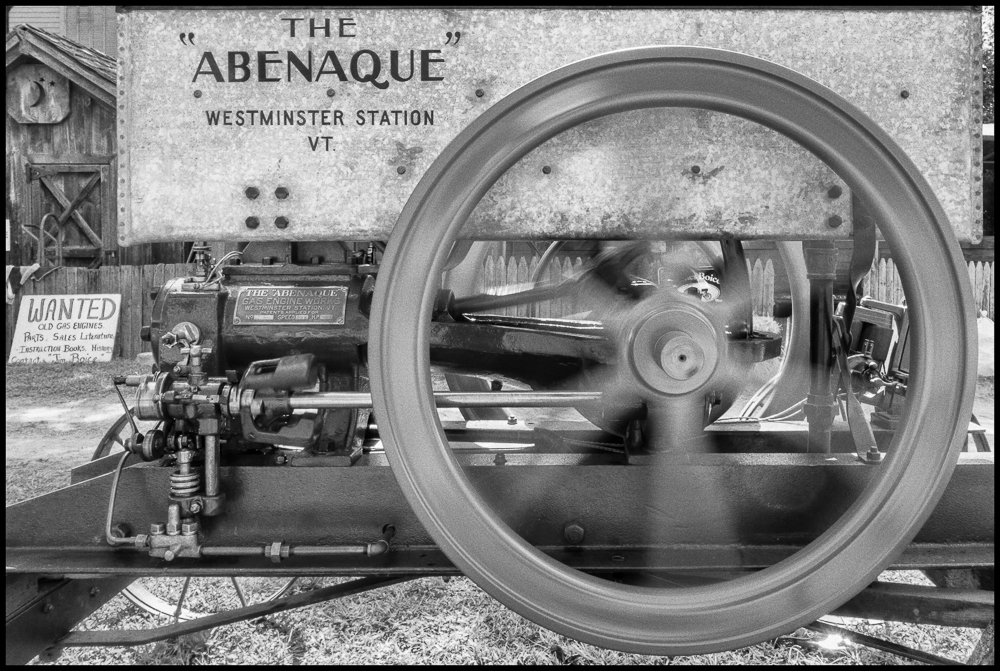
Below “The Abenaque”, which has its own interesting story described in an article in Farm Collector entitled The Short, Odd Story of the Abenaque Tractor.

Taken with a Sony RX-100 M3.