June Film Camera – Olympus Infinity Stylus

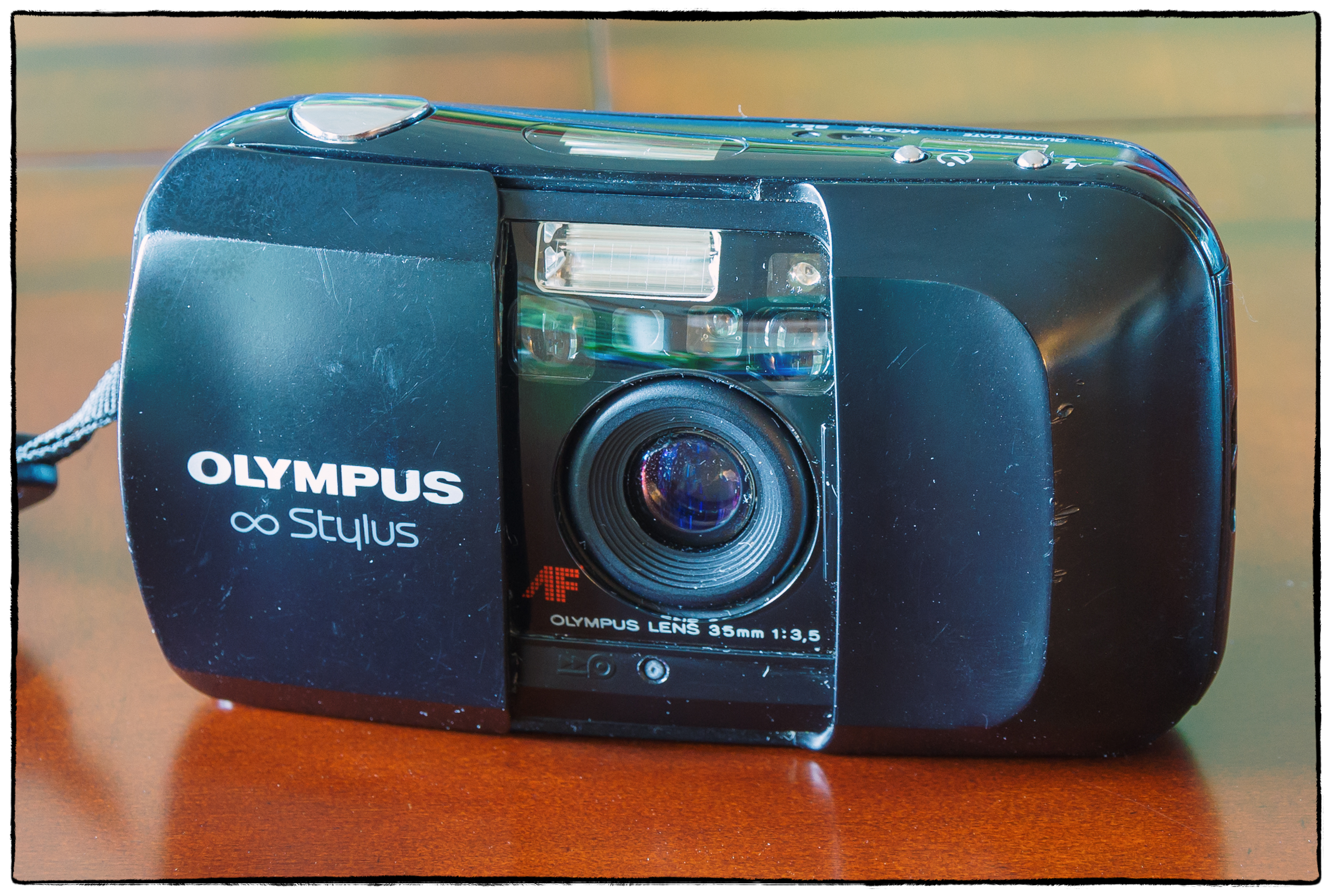
This is the original Olympus Infinity Stylus (known outside the US as ‘Mju’), not the rather more famous (and more expensive) Infinity Stylus Epic (see Back to film: Olympus Stylus Epic and Finally found something at the thrift store.  It’s known outside the US as ‘Mjuii’). I have two of them: one I bought myself (it was really inexpensive) and the other was given to me by a friend.

There’s not much to say about this camera (and in any case it’s all been said already in the many reviews on the Internet) so I’ll just provide a short summary of my impressions.

Visually it’s an attractive camera, all curves and shiny black bakelite. Yet it feels solid, like something that won’t break all that easily. It has the signature – also found on the Stylus Epic, the XA (see: Olympus XA) and many other compact Olympus cameras) Olympus sliding door. When opened it turns on the camera. The Infinity Stylus is quite small and fits easily into a trouser pocket. In terms of features it’s quite spartan having only three main buttons on the top plate: one to control the various flash options (I don’t like small on camera flash and so don’t use it), one to control the self timer, and the other the shutter button. Mine is the quartz date version so it also has a small window for you to see how the date options are configured and two really tiny (you have to set them with a pointed object such as a pen) buttons for changing and setting the date options. I don’t like date backs so the first thing I did was to turn this off. There’s also a small LCD on top which tells you the status of the battery; how the flash is set; and which frame you’re on. Film loading is easy: just slide the catch on the left side of the camera up to open the back; put the film cartridge on the left side; extend the leader to the appropriate point and close the back. There’s a fairly loud ‘whirring’ sound, which eventually stops and you see the number ‘1’ appear in the LCD. The ISO (ISO 50-3200) is set automatically using DX codes and there’s a small window in the back where you can see what film is in the camera.

The lens is a 35mm f3.5 and is reputed to be quite good. Reading around I’ve discovered that it focuses down to 1.1 feet. Focus and exposure are locked together with a single half press of the shutter. When the shutter button is fully pressed the picture is taken and the camera automatically advances to the next frame. Shutter speeds range from 1/15 to 1/500 of a second, but neither shutter speed nor aperture are displayed anywhere. All you get is a green light to show that focus has been locked and an orange light to indicate that a flash is required.

A few quibbles. As been said in all of the many reviews, the most annoying feature is that when you turn on the camera the flash is set to ‘automatic’. As mentioned above I don’t like on camera flash, so I have to remember to turn the flash off every time I turn on the camera on. It’s not hard to do – just two presses of a small button – but you have to remember to do it. I also found the viewfinder to be a bit ‘touchy’. If you don’t get your eye in just the right place it tends to black out (either partially or completely) and you have to move your eye around to see through it again. Another consequence of this is that I found it hard to see the two (green and orange) lights. I knew there was a green light when focus was acquired, but I just couldn’t see it until started to move my eye around to find it. I imagine that focus was locked even if I couldn’t see the light, but more worrisome was that since I’d turned the flash off the ‘need flash’ light never came on. I imagine it’s possible that I’ll end up with a blurry pictures because the camera selected a slow shutter speed.

Still, as the saying goes, the proof of the pudding is in the eating, and we’ll see more when I get the results back.

I have to apologize for the poor quality of the picture. I usually take more time – arranging the background, putting the camera on a tripod, focusing manually etc. However, I was in a bit of a rush and since I’d recently acquired a camera with better high ISO performance (more on that later) I thought I’d try just hand holding it. Well, while the camera’s performance is certainly better, mine isn’t. I still can’t hand hold slower shutter speeds and consequently the image is not as sharp as I would like it to be. Update: I redid the picture – this time with the camera on a tripod.

Grand Central Terminal

I wanted to capture some of the “hustle and bustle” of Grand Central Terminal and so used a slow shutter speed (1 second) to blur some of the motion. To stabilize the camera I rested it on one of the stone parapets near where the Apple Store is now located and used the self timer to trigger the shutter.

Taken with a Panasonic Lumix LX3 in September, 2010

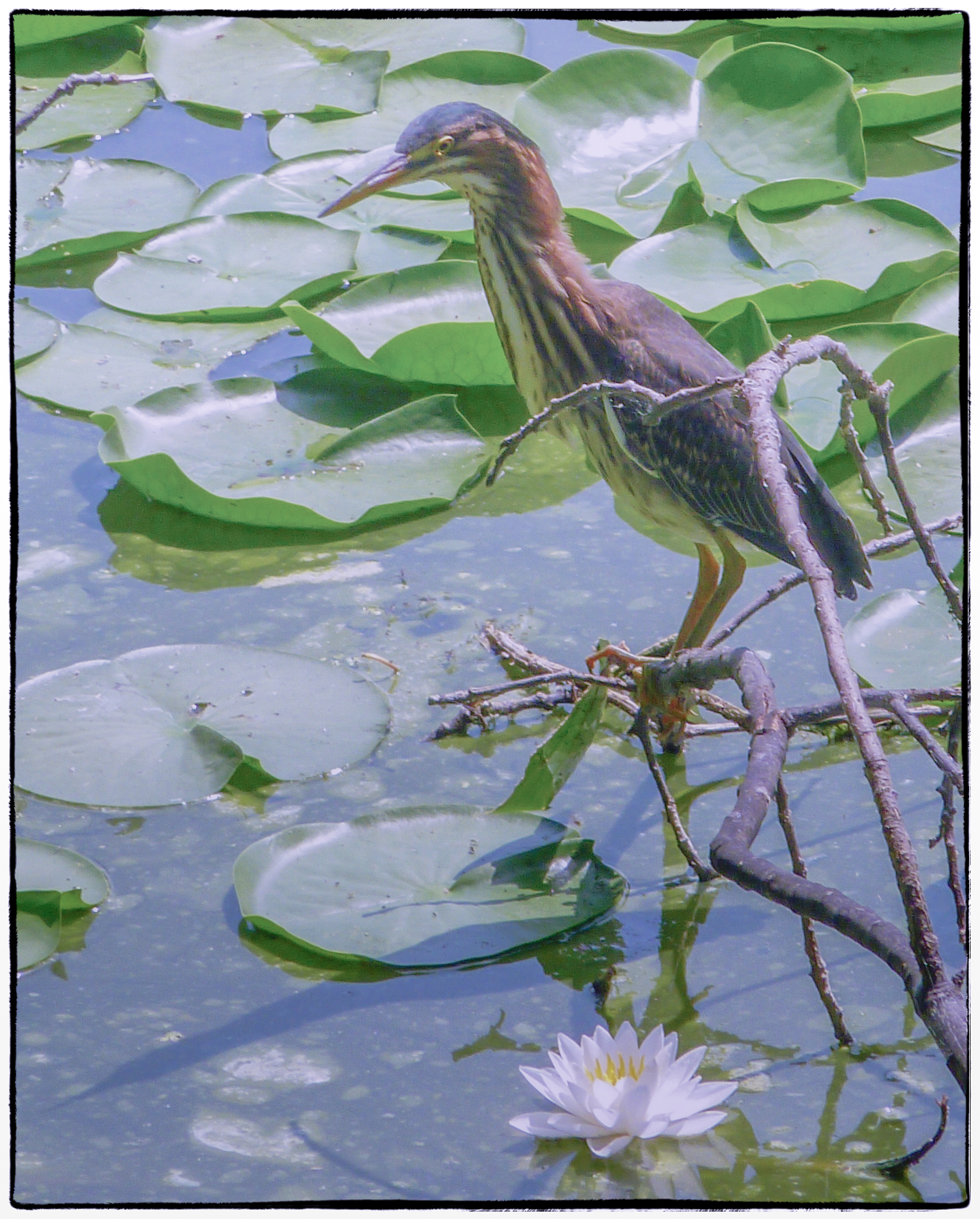
Green Heron

We have some frogs at our house in Briarcliff Manor. Our friends are staying there at present and have (or at least one of them has) developed a strange attraction to them. Yesterday he sent me a message with an attached picture saying that a “large” bird had turned up and that the frogs had disappeared. He suspected that it had been eating them. It didn’t want to leave, but did eventually after he threw stones at it.

The picture was a bit blurred and the bird was somewhat distant and consequently small in the frame. However, it looked to me as if it was a Green Heron. I’d taken a picture (see above) of this bird at Teatown Preservation so I sent it to him and he confirmed that it was the bird in question.

I don’t know about it being “large” though. Green Heron’s are only about 17 inches tall. Bigger than, for example, a sparrow I suppose, but much much smaller than the Great Grey Heron’s we have at the lake (but which I unfortunately have been unable to get a picture of so far). They’re magnificent birds, over three feet tall. I once saw one chase off a number of much smaller Egrets from its piece of the lake.

Oh, and yes Green Herons do eat frogs!

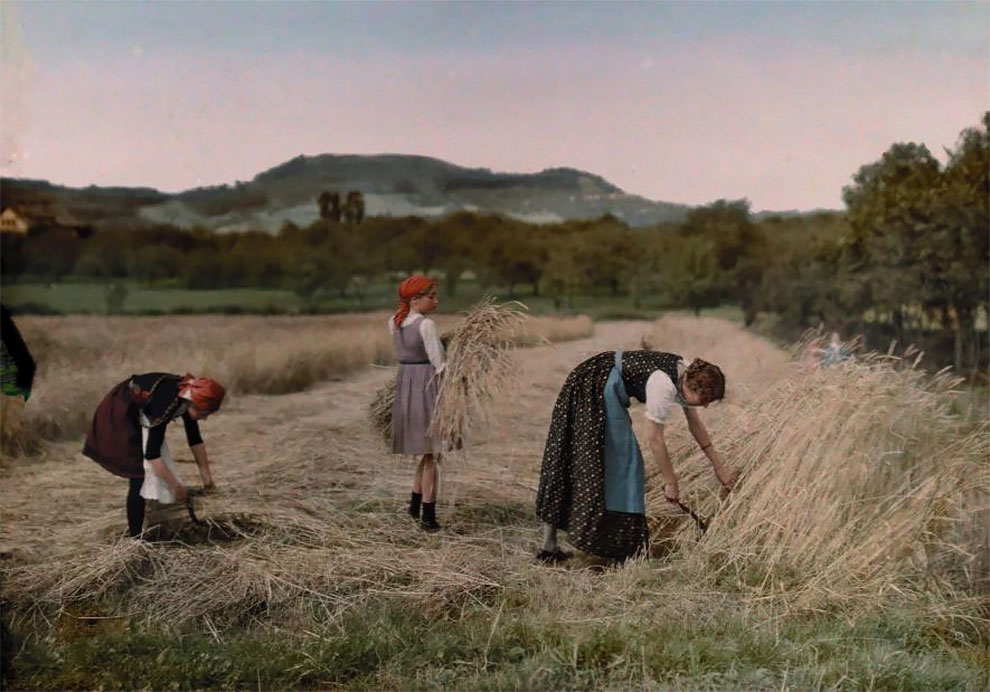
Autochromes

Source: DYT. These Autochrome Photos From The 1920s And ’30s Resulted An A Painting-Like Quality That Not Even Today’s Best Instagram Filters Can Replicate

Source: DYT. These Autochrome Photos From The 1920s And ’30s Resulted An A Painting-Like Quality That Not Even Today’s Best Instagram Filters Can Replicate

A number of years ago I went with a friend to see an exhibition of works by Alfred Stieglitz, Edward Steichen and Paul Strand at the NY Metropolitan Museum. While there I noticed some small photographs with vibrant colors and almost a glow to them. At that moment I fell in love with autochromes.

According to Wikipedia:

The Autochrome Lumière is an early color photography process. Patented in 1903 by the Lumière brothers in France and first marketed in 1907, it was the principal color photography process in use before the advent of subtractive color film in the mid-1930s.

Autochrome is an additive color “mosaic screen plate” process. The medium consists of a glass plate coated on one side with a random mosaic of microscopic grains of potato starch dyed red-orange, green, and blue-violet (an unusual but functional variant of the standard red, green, and blue additive colors) which act as color filters. Lampblack fills the spaces between grains, and a black-and-white panchromatic silver halide emulsion is coated on top of the filter layer.

Unlike ordinary black-and-white plates, the Autochrome was loaded into the camera with the bare glass side facing the lens, so that the light passed through the mosaic filter layer before reaching the emulsion. The use of an additional special orange-yellow filter in the camera was required to block ultraviolet light and restrain the effects of violet and blue light, parts of the spectrum to which the emulsion was overly sensitive. Because of the light loss due to all the filtering, Autochrome plates required much longer exposures than black-and-white plates and films, which meant that a tripod or other stand had to be used and that it was not practical to photograph moving subjects. The plate was reversal-processed into a positive transparency — that is, the plate was first developed into a negative image but not “fixed”, then the silver forming the negative image was chemically removed, then the remaining silver halide was exposed to light and developed, producing a positive image.

The luminance filter (silver halide layer) and the mosaic chrominance filter (the colored potato starch grain layer) remained precisely aligned and were distributed together, so that light was filtered in situ. Each starch grain remained in alignment with the corresponding microscopic area of silver halide emulsion coated over it. When the finished image was viewed by transmitted light, each bit of the silver image acted as a micro-filter, allowing more or less light to pass through the corresponding colored starch grain, recreating the original proportions of the three colors. At normal viewing distances, the light coming through the individual grains blended together in the eye, reconstructing the color of the light photographed through the filter grains.

I’ve tried to re-create the look digitally myself with no success. I’ve acquired filters that professed to produce this look – but they didn’t. I’m forced to conclude that, as the article suggests, you just can’t produce a digital equivalent. And I’m not inclined, nor am I skilled enough, to try the original process myself, so I’ll just have to admire them from afar.

Of the pictures shown in the article my favorites are the one above, and that of the soldiers (I thought at first Austrian because of the double headed eagle flag, but they could also be Russian or one of the other countries that uses such an eagle on its flag).