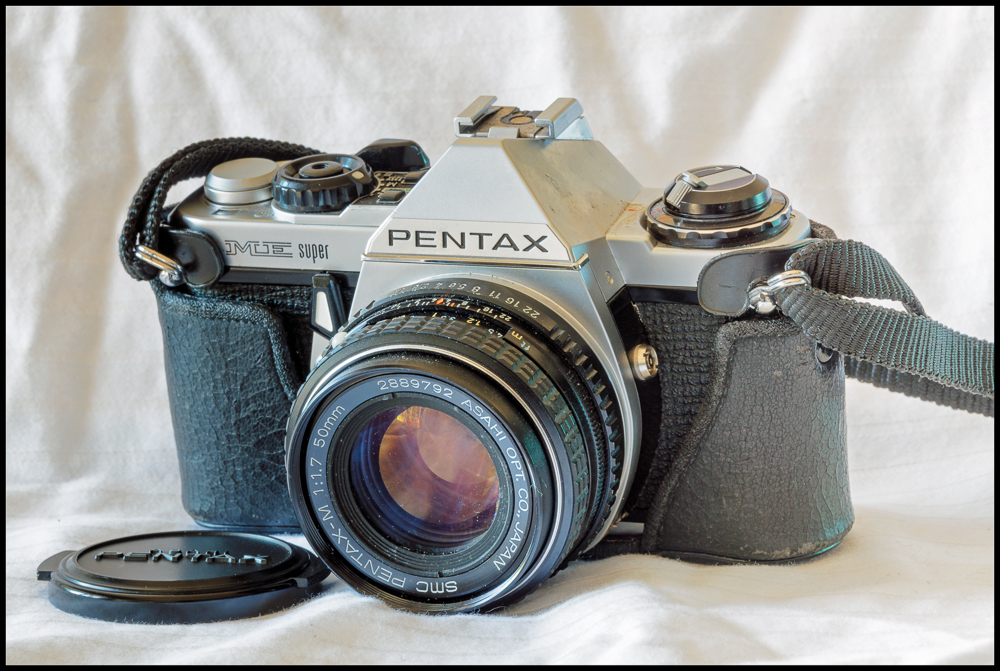
Film Camera 2018/1 – Pentax ME Super

I made a New Year’s Resolution in 2016 to use a different film camera every month. I did pretty well in 2017, using 10 cameras rather than the anticipated 12. Towards the end of 2017 going into 2018 I somehow “lost the thread” and haven’t used a single film camera since last October.

So I’ve decided to start again and try harder. I still hope to use 12 cameras during 2018, but clearly my former way of naming them (e.g. January Film Camera; February Film Camera etc.) isn’t going to work. Instead I’m going to use a numbering scheme. This is the first: Film Camera 2018/1 and it’s a Pentax ME Super.

It’s the first Pentax camera I’ve acquired. Some old friends from the UK were visiting and we were browsing around in the antique/bric-a-brac stores in Cold Spring, NY. I’d found a couple of cameras, but nothing that really interested me. I was about to leave when my friend came over and, knowing my interest in old cameras, brought me over to a cabinet I’d missed. In it was this Pentax ME Super and SMC Pentax-M 50mm f1.7. Everything seemed to be working and the price was absurdly low.

A Quirky Guy With a Camera has a good review (ME Superb! The Pentax ME Super) of it so I’ll try not to duplicate and focus more on my own impressions.

I liked this camera a lot. It’s small, light and consequently easy to carry around. It offers my preferred aperture priority exposure. There is also a manual exposure option, but I found the need to use two small buttons on the top plate rather “fiddly” and I didn’t try to use it. The viewfinder is large and bright and the combination of micoprism and split image rangefinder in the center made it very easy to focus. A series of shutter speeds appears along the left side of the viewfinder along with a green LED indicating which one has been selected. When the chosen shutter speed is too low the LED turns yellow.

I couple of things I didn’t like: 1) No depth of field preview; 2) I found it difficult to move the control dial from ‘auto’ to ‘lock’. You have to press a small white button and then turn a dial and somehow I struggled to get it to move.

I don’t have much to say about the lens at this point. I’ve finished a roll and sent it off for processing. I’ll have more to say when I get back the results. I’ll also know better whether the camera is functioning as well as it seems to.

Taken with a Sony A77 II and Tamron A18 AF-18-250mm f3.5-6.3.
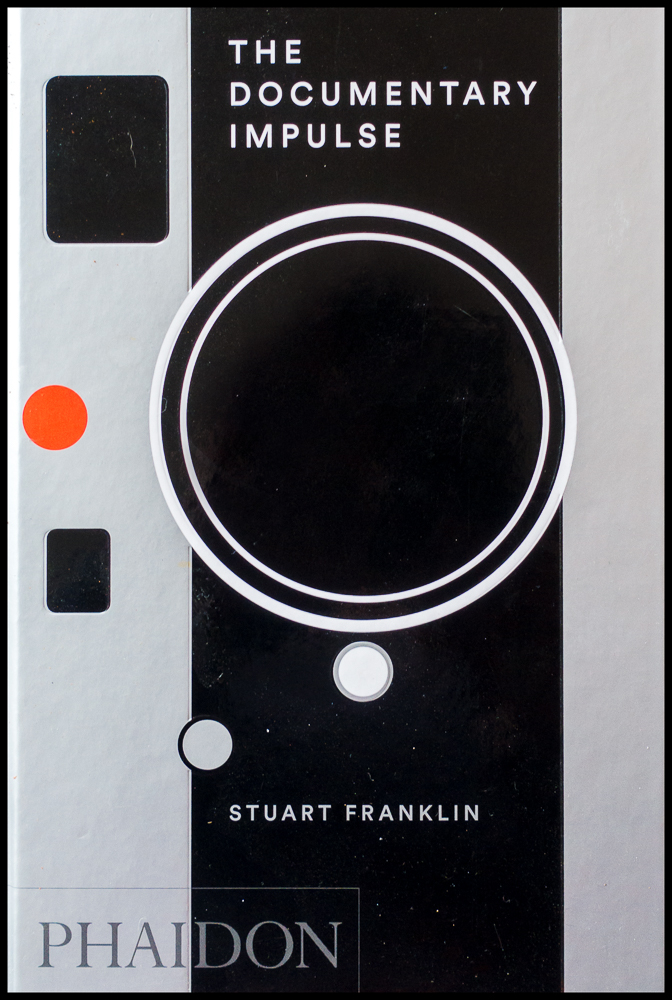
The Documentary Impulse

I consider myself a documentary photographer so when I saw this book it didn’t take me long to decide that I had to have a copy.

In a review entitled “The Documentary Impulse” in the New York Journal of Books, Richard Rivera notes:

Stuart Franklin’s The Documentary Impulse begins by questioning “What is documentary?” and draws distinctions between a “moral truth” and a “material truth,” and how at times a more powerful and visceral impact depends on intimacy rather than actuality. One example given is the staged walrus hunt in filmmaker Robert J. Flaherty’s Nanook of the North (1922), and how it leads us to draw conclusions as to what actually occurred.

The author also examines why photographers document the vestiges of vanishing cultures, as in the work of Edward S. Curtis with native Americans (from 1906 to 1930), and tackles how preconceived ideas of cultural mythos can cloud the process of objective documentation, the false premise of documenting cultures from an inherently racist point of view, and the challenges of documenting war and famine within the context of photojournalism.

Franklin adeptly explores the cumulative impact of staging and manipulative photography through references to Leni Riefenstahl’s film The Triumph of Will; Robert Capa’s Falling Soldier, 1936; Werner Herzog’s manifesto, “Minnesota Declaration: Truth and Fact in Documentary Cinema”; as well as TIME magazine’s founder, Henry Luce, and his philosophy of “fakery in allegiance to the truth.”

Stuart Franklin’s in-depth discourse on the role of photographers in society, and the needs that can only be addressed or spotlighted through photography, can be summed up in Lewis Hine’s life mission, “I wanted to show the things that had to be corrected. I wanted to show the things that had to be appreciated.”

The Documentary Impulse is a wide-ranging passionate exploration that covers many periods of photography and delves into the why and how we are driven to document the world around us.

The images are printed on high quality medium-weight matte paper, in color or black and white as originally intended.

Stuart Franklin is a photojournalist with an outstanding body of work, and his opening statement, “Photography (and journalism) practiced respectfully has the power to educate us all towards the greater understanding of, and empathy with, others,” is fully borne out by the book.

The Documentary Impulse is a remarkably insightful book—a wonderful, small format gem bursting with illuminating concepts and images.

So across this broad spectrum of types of documentary photography where do I see myself fitting. I certainly don’t document colonialism; nor am I a war photographer. I’m not trying to change the world. I could perhaps fit into the “(Re)interpreting everyday life”. I feel some affinity with Martin Parr and Lee Friedlander who both feature in this chapter. Perhaps the best fit is with what Franklin refers to as “On Visual Poetry and ambiguity”. This chapter features Eugène Atget, Henri Cartier-Bresson, Garry Winogrand and other photographers I’m not too familiar with: Helen Levitt, Sergio Larrain, Guy Tillim
.
I could quibble about the way that some of the photographers have been categorized. Why, for example is Josef Sudek (one of my favorite photographers) included under “Photography’s bid for a better world”? I was also surprised to find that even though Walker Evans is mentioned a number of times in the text, none of his photographs are presented. Of course these comments reflect my own, subjective views.

I differ from almost all (perhaps with the exception of Atget) of the above photographers in that my photographs rarely show people. And, of course, they are all so much more accomplished than I. Their work is what I aspire to, but will probably never come close to. It does, however, give me something to aim for.

I very much enjoyed this book.

Taken with a Sony RX-100 M3.

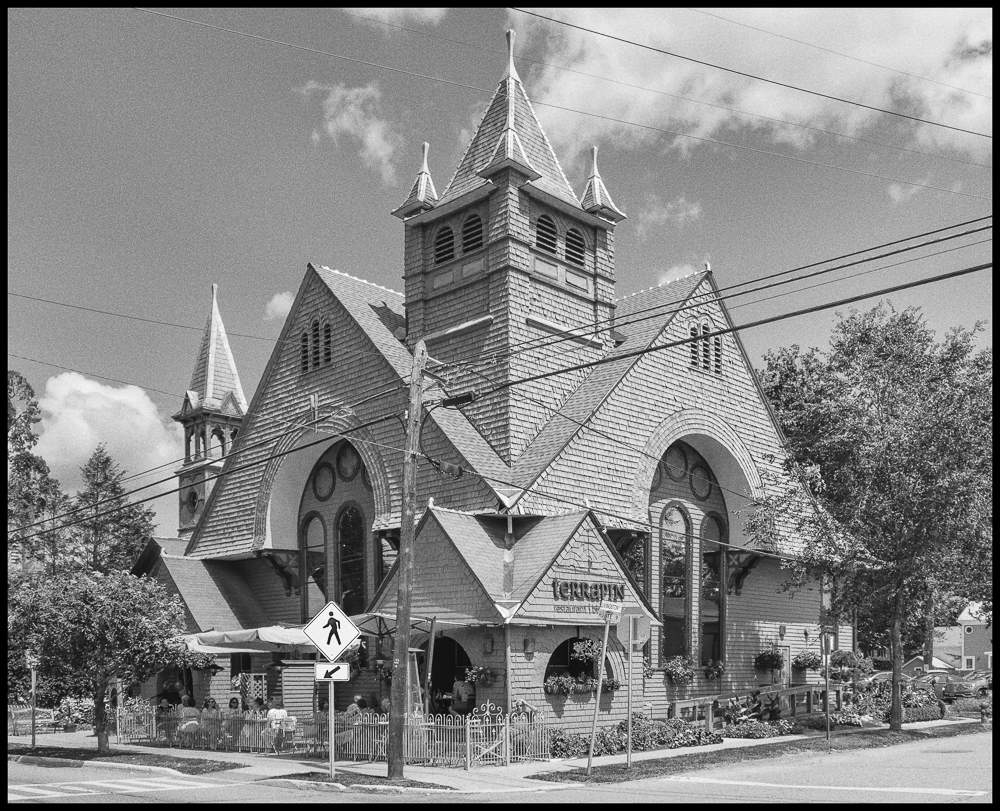
Terrapin Restaurant, Rhinebeck, NY

This restaurant in located right in the center of Rhinebeck, NY. It’s looks like a church, because once upon a time that’s what it was. According to the restaurant’s website:

Our restaurant is housed in a historic, renovated church building, formerly the First Baptist church of Rhinebeck, constructed circa 1825. The building’s soaring cathedral ceilings and windows offer a unique place for gathering in Rhinebeck.

In 1794, a man named Robert Scott, a cabinet maker and English Wesleyan, sailed to New York City from England. In 1795, persuaded by Margaret Beekman, he and his wife moved to Rhinebeck to open a school. He soon became a Baptist and worship was held in various houses in Rhinebeck Flats, as it was then called.

In 1824, land was donated by Mrs. Janet Montgomery, widow of General Montgomery, to build the first Baptist Church of Rhinebeck. The original church was finished in 1825, and now houses our formal dining room. The two doors which lead into the kitchen were the original entrances, one for women and the other for men. The Pulpit was where the large wooden arches still stand. An addition was added on in 1905, from money donated by Senator William Kelly, which now houses our bistro.

Two restaurants occupied the building prior to Chef Kroner purchasing it in 2003, when he completely renovated the space and moved Terrapin from its original location in West Hurley, NY.

This picture presented a bit of a dilemma. A lot of wires criss cross the frame. I find them distracting, but despite my best efforts I was unable to find an angle which didn’t show them. I could get a lot closer, but then I would be focusing on details and wouldn’t be able to get the view I wanted. Or I could try to remove them in post processing. I don’t usually mind removing a small distracting element, but this seemed a bit much. What if at some point in the future someone came across this image and thought that at the time it was taken there were no wires along Route 9 in Rhinebeck? In the end I decided to leave them in – probably because I’m lazy and it would be just too much trouble to try to take them all out.

Taken with a Sony RX-100 M3.

Return of the Red Baron

Model Fokker Dr.I Triplane (Dreidecker) seen in a neighbor’s house.

According to Acepilots.com:

While it remains the most famous airplane of World War One, only 320 of the Fokker Dr.1 Triplane were built (compared to thousands of Spads, Nieuports, Albatroses, and Sopwith Camels). Inspired by the devastating performance of the Sopwith Triplane, Anthony Fokker designed and built the Dr.I Dreidecker, and delivered the first triplanes to Manfred von Richthofen‘s Jagdgeschwader I in late August 1917. After a brief familiarization flight, the “Red Baron” took aircraft number 102/17 up on September 1, and promptly shot down a British R.E.8 of No. 6 Sqn, whose crew probably thought the three-winged craft was a friendly Sopwith.

Taken with a Sony RX-100 M3.