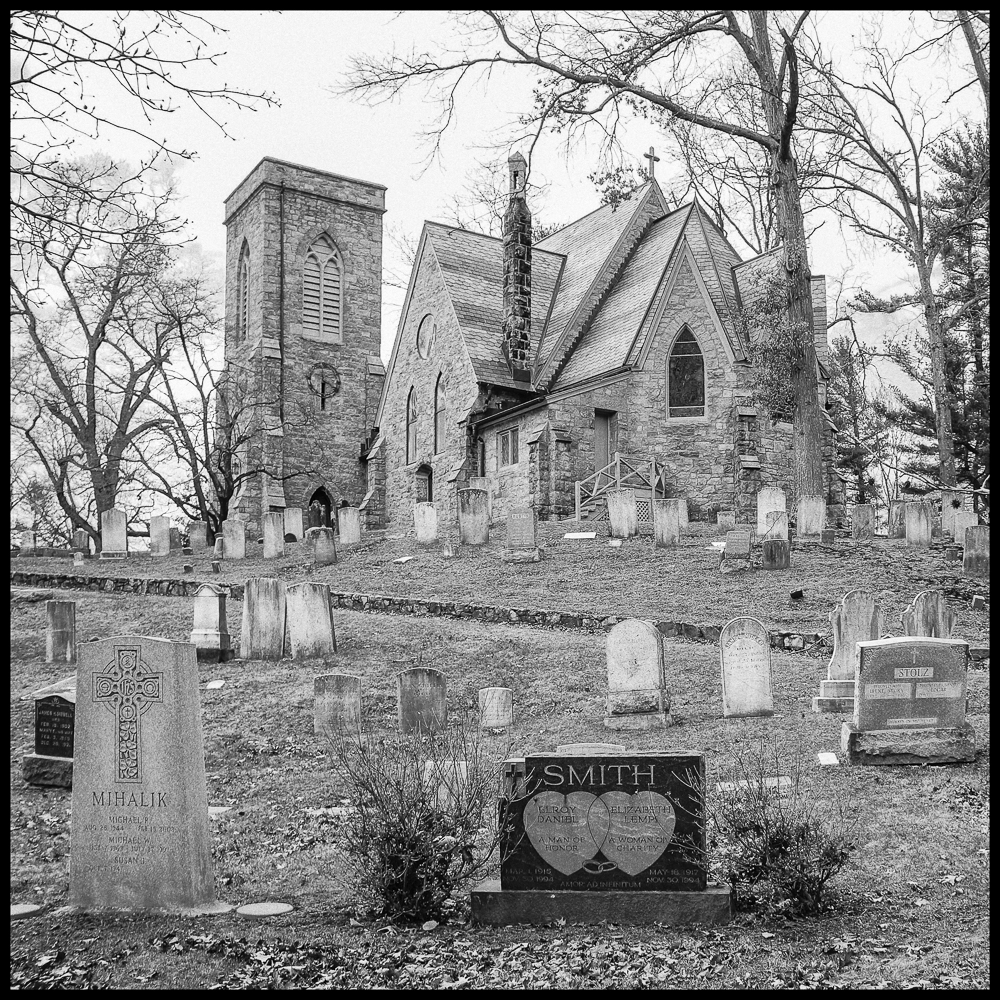
Of all the churches in our area I think this one is my favorite, possibly because it reminds me of St. Mary’s Church in Sandbach, Cheshire, UK where I grew up.
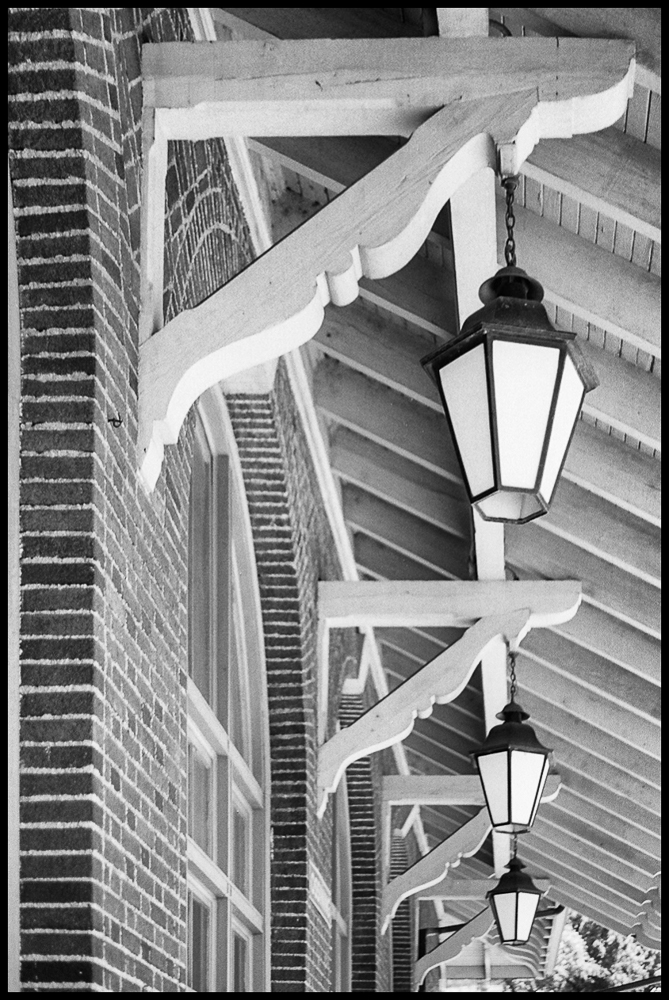
It’s located in Garrison, NY and I’ve posted about it before (see: St. Philip’s Church in the Highlands, Garrison). However, this is a different view and this one is in black and white where the other one was in color.
It has a rich history documented in some detail (accompanied by illustrations) in the history section of the church’s website.
I’ve always been fascinated by Benedict Arnold and so was interested to discover that there is a plaque inside the church which reads:
In memory of Colonel Beverley Robinson
Churchwarden 1770-1777
Who under God was
The founder of this Parish.
Born at Middlesex in Virginia 1722
Died at Bath in England 1792.
I already knew that Arnold was staying at the Beverley House when he fled, but the church’s website provides additional information:
At the outbreak of the Revolutionary War, Beverly Robinson, by then one of the wealthiest and most influential men in North America, was asked by his friend, John Jay, to sign an oath of allegiance to the newly created United States of America. Robinson declined Jay’s invitation.
By all accounts a fine man, a good landlord and devout Christian, Robinson chose to remain loyal to his British heritage, and refused to become part of the rebellion. In May 1777, he raised the Loyal American Legion. He served during the war years as a Loyalist Colonel in British Intelligence, leading agents made up of local citizens that aided the British armed forces. He helped plan and fought in the successful British conquest of Forts Montgomery and Clinton in October 1777.
In 1778, his home in Garrison was taken for the use of the Continental army, and Benedict Arnold came to occupy it in the summer of 1780, when he took up his post as commandant of West Point. Robinson’s entire estates were confiscated in 1779 on the establishment of the State government in New York.
Robinson was part of the plot, conceived by Benedict Arnold and the British spy, Major John Andre, to deliver the fortifications at West Point to the British. Robinson was on board the British ship, HMS Vulture, which Andre left to go ashore near Stony Point to meet Arnold and obtain the plans on Thursday, September 21, 1780. However, American cannon fire drove the Vulture back down the Hudson and Andre was forced to find another way back to British lines.
Dressed in civilian clothes, Andre was captured on Saturday, September 23. On the morning of Monday, September 25, Arnold learned that the plot had been uncovered and rode fullspeed to the landing where his barge waited. He ordered his men to row him to the Vulture, where he told the waiting Beverly Robinson of the plot’s failure.
Robinson and his family left for England at the close of the Revolution. Robinson died there in 1792, never returning to the Hudson River Valley. Some of the most touching early records of our church include letters, written after the war by Beverly Robinson to his old friend, John Jay, pleading for the restitution of his fortune and property. Jay’s letters in response simply say, “I’m sorry. It’s not possible!”
I also discovered that he’s buried in Bath Abbey in the town of Bath, UK where, co-incidentally our eldest daughter studied.
Taken with a Sony NEX 5N and Sony E 18-55mm F3.5-5.6 OSS
.