Leaping Goat

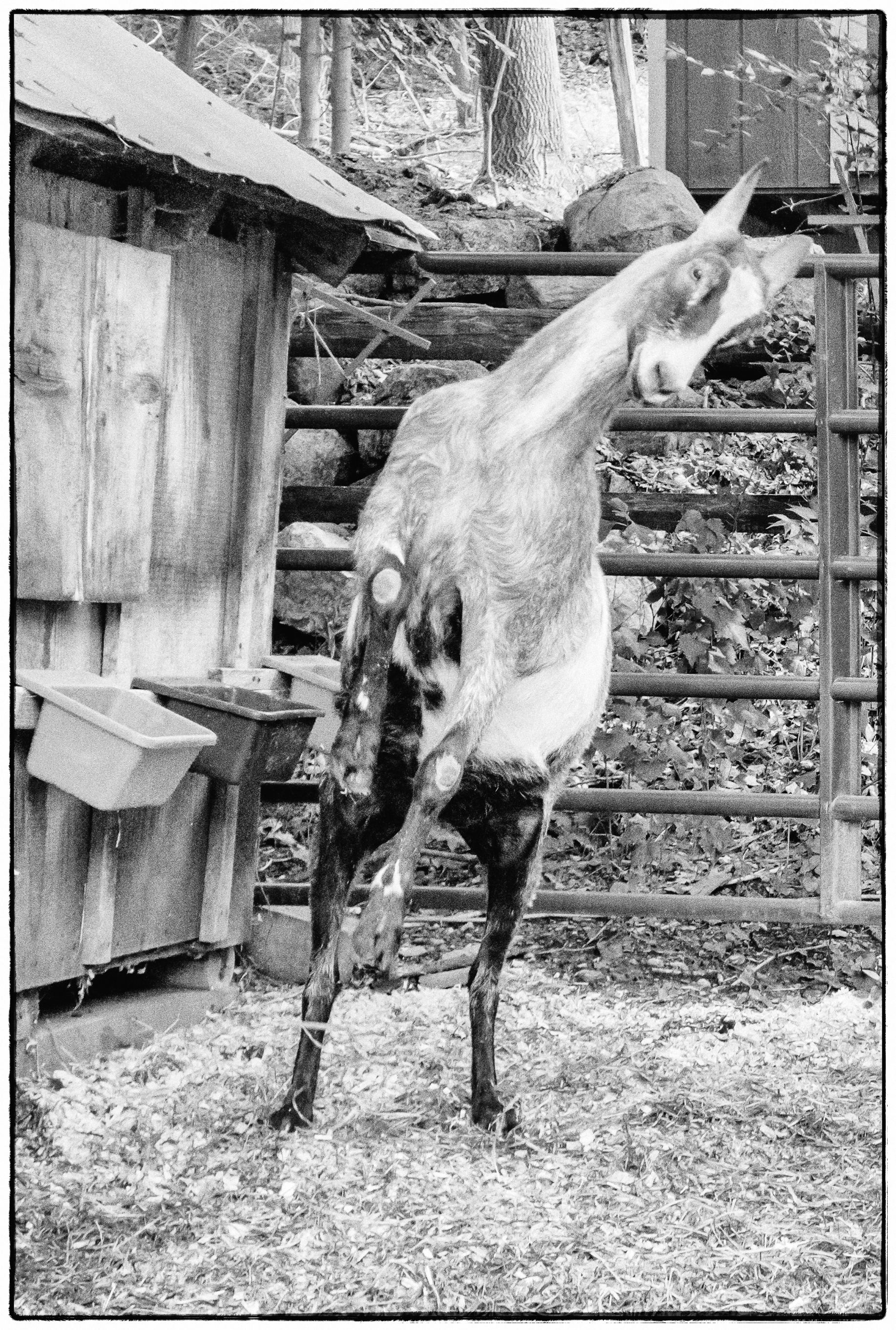
Taken at Niese’s Maple Farm in our town, Putnam Valley. A 2016 review on Yelp reads:

Niese’s Maple Farm is a gem in Putnam Valley. Making maple syrup from their tapped trees for generations, the Niece family is among the kindest and coolest people around. They have a huge respect for the environment – nature and animals. They make their own local products… from a large variety of maple syrups (plain, cinnamon stick, apple, blueberry and even hot), honey, and maple everything – maple coffee beans, maple breakfast sausage (from their own animals), maple granola, maple fudge and even sell eggs from their chickens, and oh – the baked goodies! Waffles, pies, cookies… And there are always new things to try!

You will be surprised, this cozy shoppe is packed with incredible things. Be sure to ask Mr. And Mrs. Niese about their mapling, local history, or what Mrs. Nurse is planning to bake next – truly delightful!

Great for local “foodie” product gifts, but be sure to buy 2 of everything… you’ll definitely want one for yourself!

Other reviews were not so charitable: “Rude and unfriendly, they don’t say hello when you walk in. The doughnuts are old and stale. They also would not allow me to refill my water bottle at the sink despite the fact that I made a purchase and they don’t sell bottled water! Skip this dump.” I must say that this latter comment is contrary to my own experience. I’ve always found the people there to be friendly and helpful.

There were two goats in the pen and they were playing/fighting. Whichever it was it involved a lot of leaping into the air and then coming down to butt heads.

Taken in June 2013 with a Sony NEX 5N and 18-55mm kit lens.

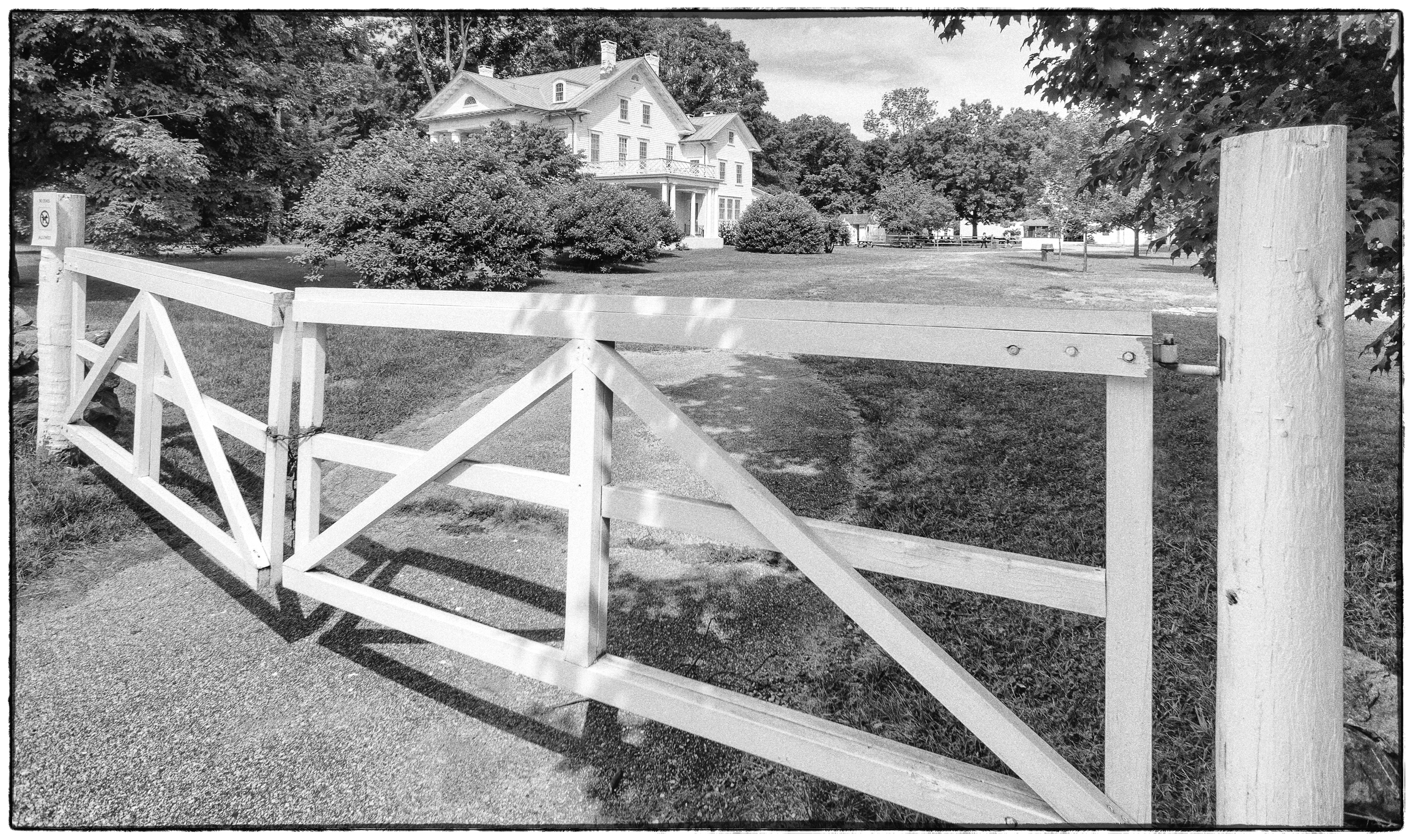
Muscoot Farm – Gate and Mansion

According to Wikipedia:

The land on which Muscoot Farm is situated was part of the 86,000 acres (350 km2) Van Cortlandt Manor chartered in 1697. After the death of Stephanus Van Cortlandt (Note: the first native born mayor of New York, or New Amsterdam as it was then known) in 1700 and his wife Gertrude in 1734, the manor was surveyed and divided into twenty large lots and twenty small lots. The Muscoot lands are located in “Great South Lot #6” which was inherited by Stephen Van Cortlandt. At that time, this region was very remote, inaccessible by roads, and probably uninhabited.

During the 1870s, at a time when farmland in Westchester was being sold off fairly cheaply, the three main farms (VanTassel, Carpenter and Vail) were purchased by Benjamin Brandeth (see also: Old Brandreth Pill Factory, Ossining NY and Old Brandreth Pill Factory Revisited), a pharmaceutical magnate from Ossining who had been dabbling in real estate ventures. During 1880’s this land was bought up by Ferdinand T. Hopkins another pharmaceutical executive from New York City.

Hopkins took these subsistence farms and developed them into a “Gentleman’s Farm”, a term applied to hobby farms owned by wealthy businessman who wished to maintain a connection with nature or with the farm life of their youth. Since profit was not the motive, Muscoot Farm, like most gentleman farms of that era, operated at a loss. It remained in the Hopkins family for almost 90 years and was finally sold to Westchester County in 1968.

Ferdinand Travis Hopkins was 46 years old when he decided to acquire a summer home in Westchester County. Born on his father’s farm in Lake Mahopac in 1834, he spent his first twenty years working alongside his father Nathanial Hopkins on the family farm. He then went to New York City where he made a considerable fortune both in real estate transactions and the pharmaceutical business. Through his second marriage to Martha Bishop Gourand he acquired a profitable business which produced a variety of medicated soaps, skin creams, and other cosmetic preparations.

In 1879, Martha gave birth to Ferdinand T. Hopkins Jr. Hopkins already had a son and daughter by his first wife, and a stepson, Claude L. Gourand, by his second. The appearance of a new baby may have played a significant role in Mr. Hopkins decision to purchase a summer home in Westchester County in 1880.

As purchased, the Ezra Van Tassel farm obviously was not an appropriate summer retreat for an important New York City businessman and his family. It was a working farm with few amenities. The Hopkins decided to build their new house on a knoll slightly north and east of the original farmhouse. They built a late Victorian clapboard farmhouse, with both Gothic Revival and Italianate features. The simple gable roof included a small cross-gable at the front. The house featured Venetian style shuttered windows on the second floor which were covered with brightly striped awnings. It was surrounded by porches and the porches were bedecked with hanging and potted plants, helping to merge the indoors with the outdoors. Painted with contrasting trim on windows, and doors, it was a striking example of the Victorian farmhouse as impressive country home.

Ferdinand Sr. died in 1920, leaving Muscoot to Ferdinand Jr. Ferdinand Jr. and his second wife, Myrtle Rose Kennedy, moved into the family home. With their two children, Jean born 1920 and Ferdinand III, born 1925, they spent their summers on the farm, even living in the house during the 1925 – 1927 remodeling when the main house was converted into a 20th-century Colonial Revival mansion. Myrtle’s parents William and Mary, moved into their former home across the road from the mansion. William Kennedy may have acted as farm superintendent for a short time during the mid-1920s.

In the late 1800s considerable land in Westchester County was taken to construct reservoirs to provide water for New York City. This had a profound effect on Muscoot. As described by Wikipedia:

On January 5, 1897 the city of New York notified Ferdinand T. Hopkins that it was taking 160 acres (0.65 km2) of land on Muscoot farm. This included land actually flooded once the Cornell Dam (New Croton Dam) was completed in 1906, plus adjacent acreage needed to protect the watershed of the reservoirs. This also included the parcels on which the house and all the farm buildings were located. Like most of the Westchester farmers he immediately set out to lease back the lands and buildings. Once he had regained the use of his summer home, he could concentrate on planning his next move.

New York City did not want to pay demolition expenses before its lands were flooded and preferred to offer the buildings to the public with the proviso that the buyer remove them at his own expense. In April 1899, the city put the buildings up for public action. Hopkins made an offer to the Aqueduct Commission which the city accepted.

The buildings acquired at auction had to be moved from the city property. Moving the various buildings required patience and ingenuity in an era when horses provided the motive power. Each building was moved without being dismantled. It would be gently moved off it foundation onto a bed of logs which served as rollers. A team of horses worked a large windlass which was set up in front of the building in the direction it was to be moved. Ropes from the building were attached to the windlass and as the horses turned it, the building was pulled forward off its foundation and across the log rollers. Once the edge of the bed of logs was reached, the logs from behind the house were moved to the front, the windlass advanced further.

There were many large buildings on the Hopkins property that had to be moved, plus a plethora of smaller structures. The main house, carriage house, carriage barns, and the horse barn at the southern end of the dairy barn each required weeks of preparatory work. Each building had to be carefully examined and reinforced to withstand the move. New foundations had to be prepared at the new site. The path between the old and new sites had to be leveled and smoothed, to make the move as easy as possible. In addition to these large buildings, the hen house, ice house, outhouse, old milk house, and corn crib made the journey northward toward the large dairy barn.

Taken with a Sony Nex 5N and 16mm f2.8 possibly with the wide angle adapter (I don’t remember and the metadata doesn’t report the focal length with the adapter).

Olympus OM2-n MD – Results

It took me a while to get around to using my August film camera. I had a bunch of old, color film that I wanted to use up so when trying out new/old cameras I’ve tended to use this first, and then convert the scanned images to black and white. I’ve now used up most of this old stock, so in this case I used true black and white film, specifically Kodak TX 100.

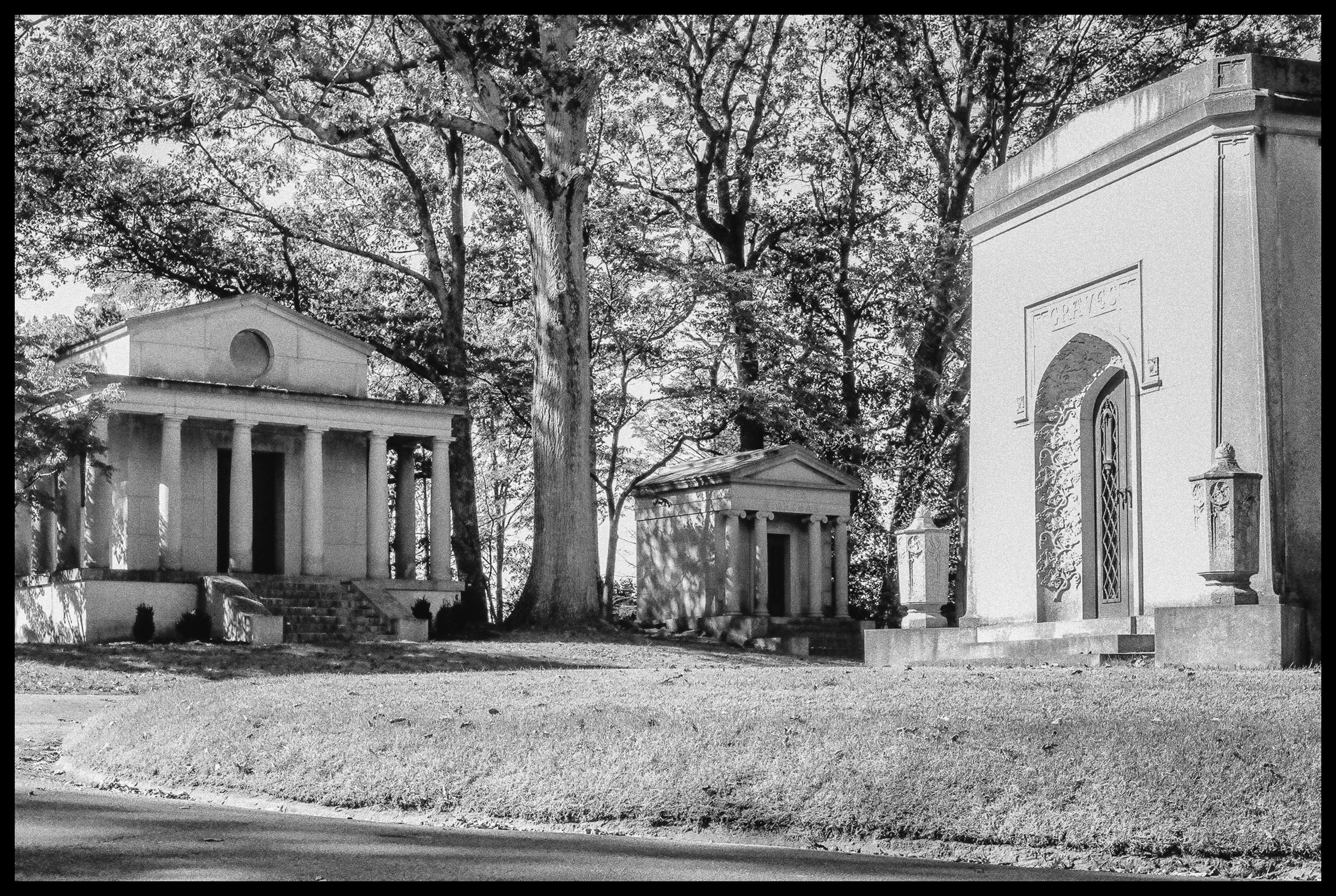
Suddenly I found I was very busy and had trouble thinking of a venue to try out the camera. I kept taking the camera with me, but time went by and I was getting more and more frustrated at not using it. Eventually I decided that I’d return to nearby Sleepy Hollow Cemetery, where I can usually find something worth photographing.

I have my film processed at The Darkroom and co-incidentally the resulting scans were made available to me on Hallowe’en. I say ‘co-incidentally’ because, in case you don’t already know, Sleepy Hollow Cemetery is pretty much “Ground Zero” for Hallowe’en in the US. The stomping grounds of the headless horseman, it’s also the final resting place of Washington Irving, the author of “The Legend of Sleepy Hollow“.

I must say that I loved using this camera. It’s small and fairly light for an SLR from that period and everything just felt right. One of the problems with only using a camera once is that you don’t really become familiar with it. This is particularly true with the OM2-n because of the unique arrangement of the controls i.e. they’re all on the lens, including the depth of field preview button. At first I was was groping around a bit to find the appropriate dial/button, but as I got used to it I began to appreciate how useful it is to have all of these controls (i.e. aperture, shutter, focus, depth of field) all in one location. I appreciated the large, bright finder typical of most film SLRs and which you no longer find on current DSLRs. The innovative (for the time) metering worked pretty well even if in a couple of cases (in particularly contrasty conditions) it did tend to overexpose highlights (this is probably a result of my lack of experience in using the camera rather than a problem with the camera itself). The 50mm f1.8 F-Zuiko auto-s that I was using focused smoothly and produced sharp results.

I like to shoot in aperture priority so this was perfect for me. Select the appropriate aperture and the display in the viewfinder shows you what shutter speed will be chosen.

The design of the camera reflects a belief in simplicity: just what you need – no more, no less. It was refreshing to use a camera that just gets out of the way and lets you focus on what you need to do while still providing you with the required feedback. This has been my problem with the compact point and shoot cameras I’ve been using of late. Although they get out of the way and let you focus on composition, they just don’t provide the information you need to be confident that you are getting the photograph that you want. On the other end of the scale are recent generation DSLRs. I just bought a Sony A77II and I must say that I find the complex functionality a bit bewildering. The OM2-n seems to just about get it all right.

A review of the OM2 on Casual Photophile comments:

All told, the OM-2 is a camera with which I’ve fallen in love. It’s tiny, inconspicuous, quiet, capable, and proud. It’s modern enough to use standard batteries, yet vintage enough to offer analog charms. The OM-2 can do anything we ask of it without breaking our backs or the bank. It just might be a perfect 35mm film camera. Staring at the OM-2 with the most critical eye leads one to stare without result. There’s nothing substantive about which to complain.

I’d very much agree.

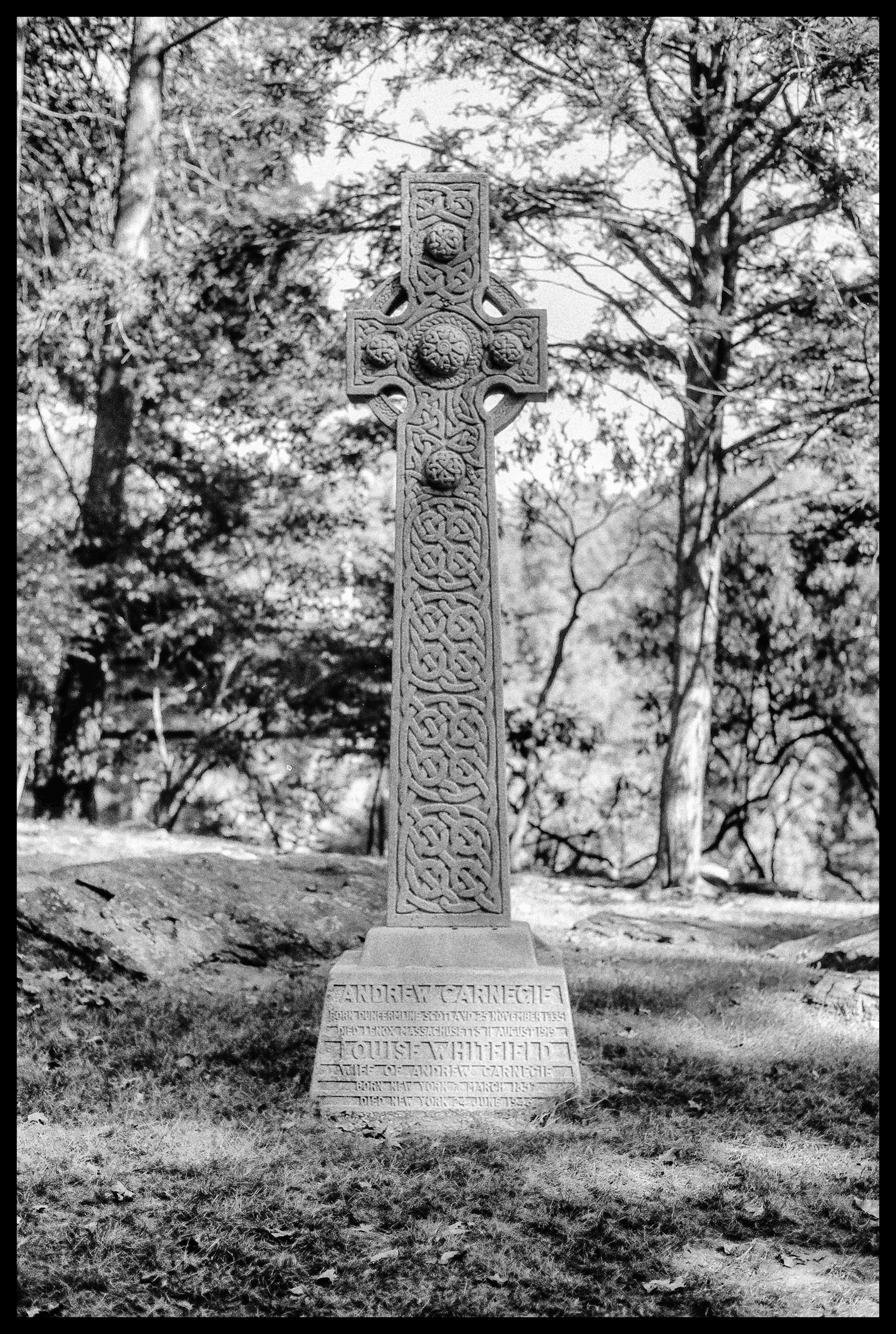
This simple celtic cross marks the final resting place of one of the richest people the earth has ever known: Andrew Carnegie.

Tombstones.

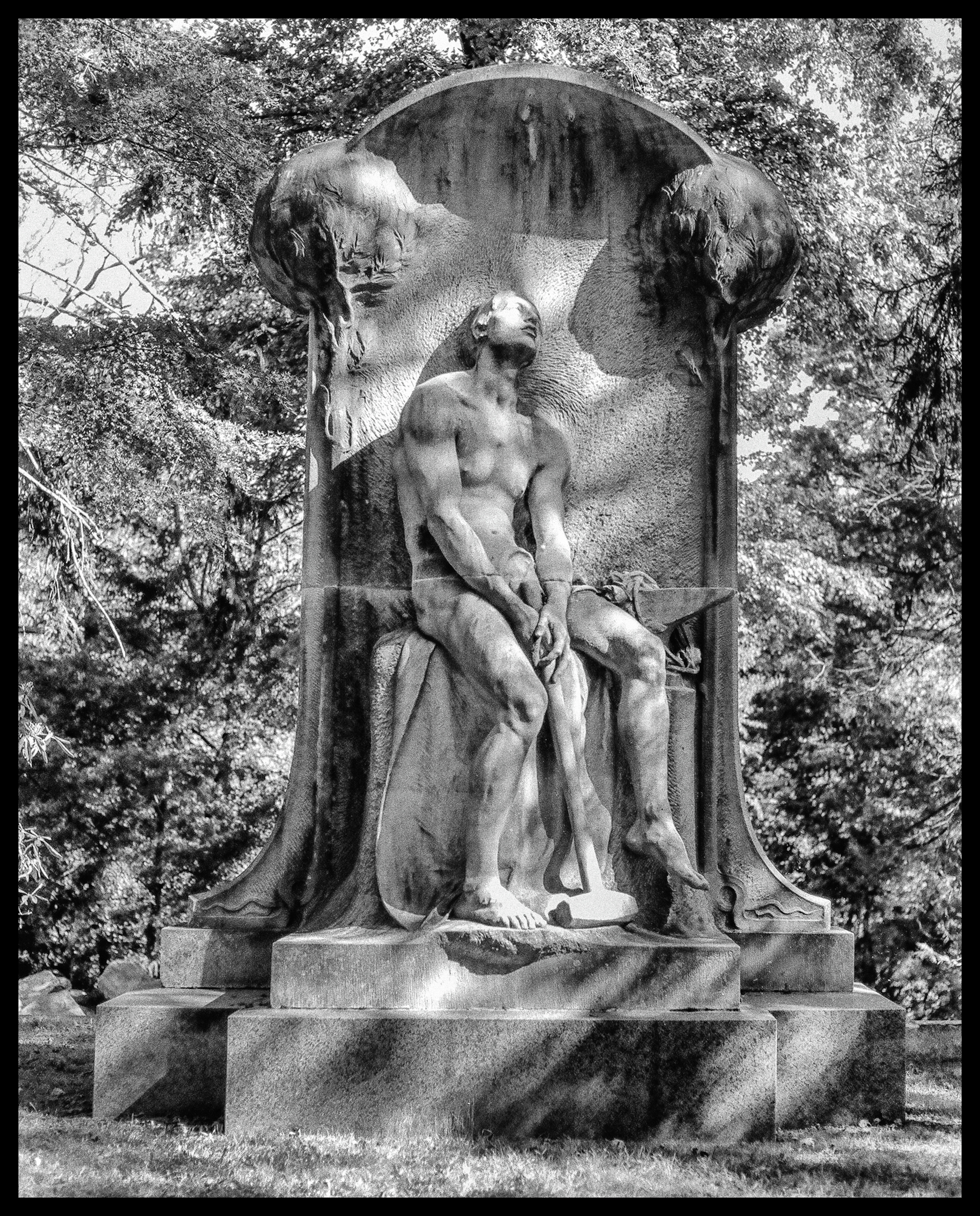
Henry Villard Memorial by Karl Bitter.

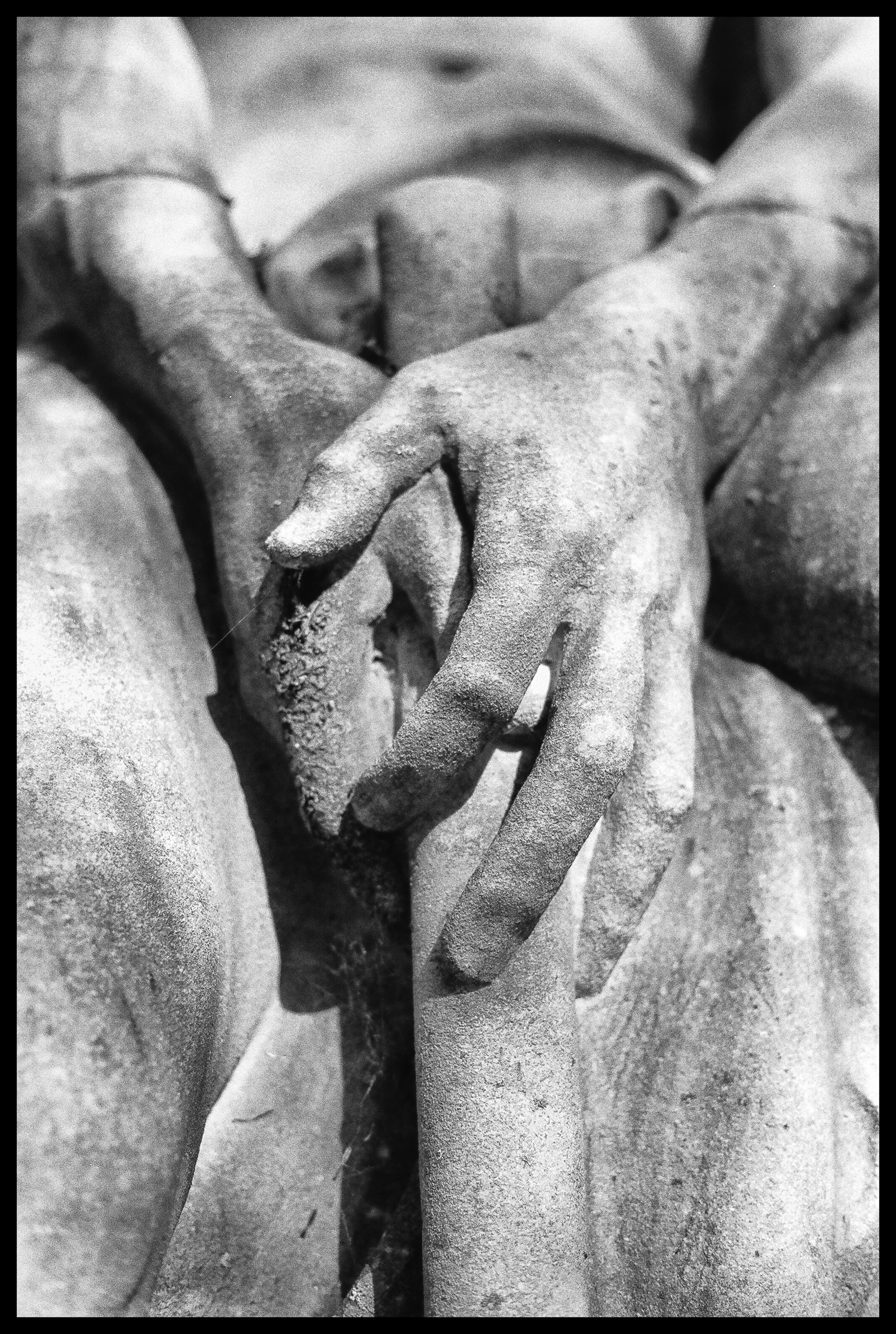
Detail of the Villard memorial.

William Evarts Benjamin (1859-1940) memorial. A prominent publisher and collector in Boston, Massachusetts.

Lyman Tiffany Dyer memorial. Trooper Squadron A 1896 – 1905. Member of Troop A ( Squadron A ), Volunteer Cavalry, Spanish American War. Participated in the Puerto Rico Campaign. Grandson of George Jones co-founder of the New York Times