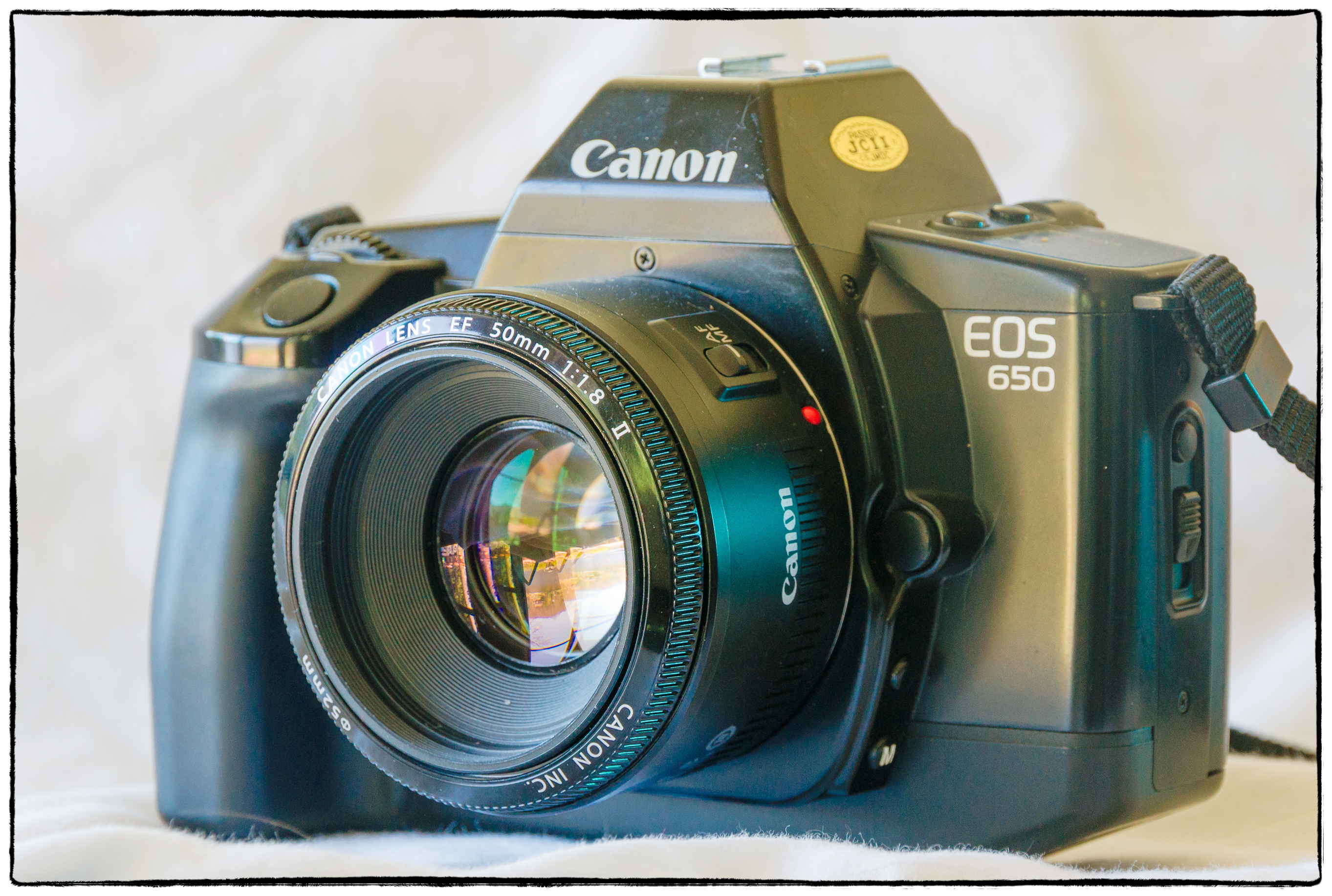
Some time ago an old friend gave me a Canon EOS Elan IIE (also known as the EOS 50E and EOS 55 in other markets) with 28-80mm Zoom Lens. I took a few pictures with and liked the feel and operation of it. I felt the urge to try it with a faster prime lens. Then I came across this Canon EF 50mm f1.8 with a Canon EOS 650 body attached to it for a very reasonable cost (it seems that they almost give away these older autofocus film cameras nowadays) and decided to go for it.
At first I wasn’t particularly interested in the body, but then as I read up on it I discovered that there was something a bit special about it. In 1987 Canon introduced a new lens mount (EF Mount) on it’s new line of Electro-Optical System (EOS) cameras. I remember feeling annoyed about this because at the time I had a Canon AE-1 and a few lenses. I understand that the new mount enabled Canon to “get a jump” on Nikon in the area of Autofocus Lenses. However, this move had one major downside: The old lenses would no longer work on the new cameras. So if I wanted to upgrade to a new body, I had to buy new lenses too. I decided not to upgrade and this is probably the reason why I completely missed autofocus film SLRs. I stuck with my older body and lenses until the digital era arrived, when, after a few digital compacts I finally upgraded to Minolta and subsequently Sony DSLRs.
What was so special about the EOS 650? You’d think that the first camera in Canon’s EOS line would be the EOS-1. But you’d be wrong. That camera was not introduced until 1989. For some reason the weird naming schemes that seem to afflict camera manufacturers dictated that the first EOS camera be called the EOS 650. So this camera introduced a mount that survives to this day. Modern canon DSLR’s have the same mount. Hence, the EOS 650 has some historical significance as the first of the line.
I liked the camera a lot. It feels solid to me and doesn’t overwhelm me with buttons and menu items. It has a mode button, an exposure compensation button, and an on/off dial (which also allows you to turn beeps on/off and to select full auto operation). A small button to the top right allows you to activate ‘partial metering’, which seems to be a 6.5% spot combined with auto-exposure lock (the normal metering is 6-segment evaluative (Matrix)). A fold down panel on the rear exposes buttons for manual film rewind, AF mode selection, drive mode and self-timer, and battery check. Manually setting ISO requires you to push two of the buttons simultaneously and then turn the dial on top. It’s rather cumbersome, but I guess you probably wouldn’t need to use it that much. Two buttons near the lens barrel are used for depth of field preview and manual aperture setting (the procedure for this seemed somewhat convoluted so I didn’t try it). A small LCD panel to the top right shows exposure information, current autofocus mode and exposure modes, a frame counter and battery check indicator. Changing exposure mode is easy. Just hold down the mode button on the left and turn the dial on the right. Options include Manual (M), Programme (P), Shutter Priority (TV), Aperture Priority (AV) and a rather unusual DEPTH mode where you select two focus points and the camera selects an aperture to give optimal depth of field. There are also indicators to show that the film has been wound correctly and whether the film wind mode is single or continuous. It’s a pity that to toggle between ‘one shot’ and ‘servo’ (i.e. continuous) you have to flip down the panel to the lower rear, hold the small button and turn the dial on top). It’s cumbersome if you change autofocus modes a lot. Luckily I don’t, almost always using ‘one shot’. The rear has a small window to show what film is in the camera. It’s all pretty minimal, and I like it.
The viewfinder is huge compared to digital SLRs. I compared it to my Minolta Alpha 500 (I don’t know how typical this is though) and it’s much larger and brighter. I’ve read that some consider the autofocus to be slow. Possibly it is compared to modern DSLRs (and even later generation film cameras), but it was fine for me. I’m not into action (sports, wildlife, small kids running around etc.) and so don’t need lightning fast autofocus. Shutter speeds go from 30 seconds to to 1/2000.
All things considered a very likable camera – and what a change from the last film camera I tried:
a fully automatic point and shoot Minolta 70W Riva Zoom (see February film camera – Minolta 70W Riva Zoom and Minolta 70W Riva Zoom – Results. In it’s day it was considered to be an enthusiast camera, but since it was the first EOS camera it was top of the line (until the slightly later EOS 620 came out). In 1987 it cost (with EF 35-70mm f3.5-4.5 lens)
the equivalent of about $1,250 in today’s dollars adjusted for inflation). Now we’ll see what kind of results it produces.